Alexander Kotov
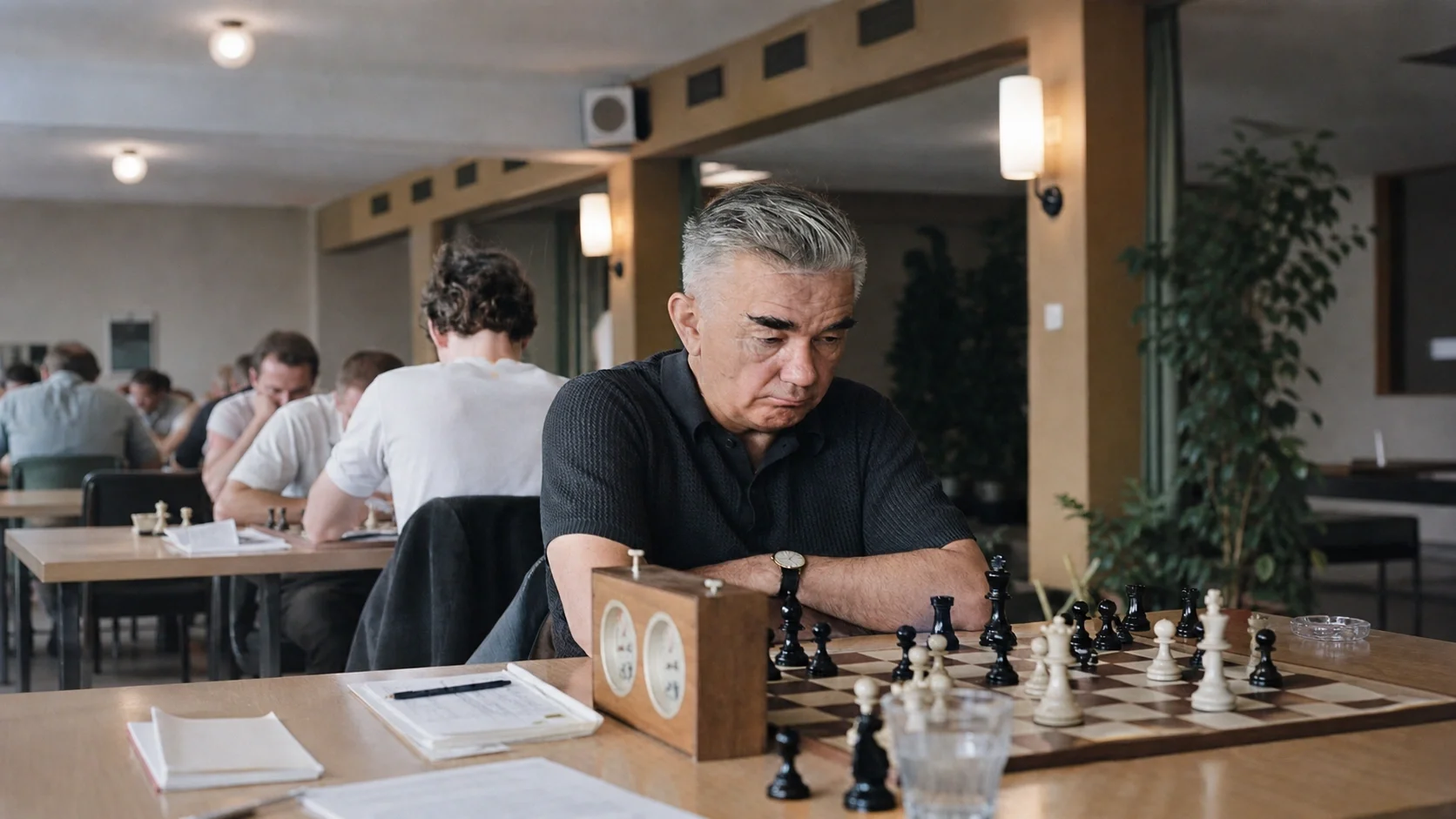
Ben Merk / Anefo, CC0, via Wikimedia Commons
Alexander Kotov was one of the most characteristic multi-role figures produced by Soviet chess: a strong attacking grandmaster at world-candidate level, a trained mechanical engineer who worked in wartime armaments design, a prolific author whose books shaped chess pedagogy for generations, and a public functionary who helped institutionalize chess in the USSR through federation work, arbitration, broadcasting, and mass instruction. His competitive peak came in the late 1940s and early 1950s, above all with second place in the 1939 Soviet Championship, a shared Soviet title in 1948, victory at Venice in 1950, and his crushing win at the 1952 Saltsjöbaden Interzonal with 16.5/20. FIDE awarded him the inaugural International Grandmaster title in 1950. Official published Elo lists I could verify show him on 2510 in January and July 1971; any earlier “peak” before 1971 belongs to retrospective systems, not official FIDE Elo.
Kotov’s historical influence today rests even more on his writing than on his over-the-board record. His best-known pedagogical contribution is the method set out in Think Like a Grandmaster, especially the ideas of candidate moves, the tree of analysis, disciplined calculation, and the dangers of time-trouble collapse, later nicknamed “Kotov syndrome.” Those ideas entered mainstream chess instruction and remained central enough to be discussed by later trainers and by cognitive scientists studying expert search in chess. At the same time, that same body of literature has also been criticized on two fronts: first, for its ideological function inside Soviet cultural politics; second, because empirical studies of actual expert search behavior show that strong players often revise and revisit lines more fluidly than Kotov’s most rigid formulations suggest.
Biographically, the secure public record is strong on his birthplace, education, engineering career, chess offices, writings, and death, but weaker on a fully documented family register. Russian local and institutional sources agree that he was born on August 12, 1913, in Tula, studied at the Tula Mechanical Institute, moved to Moscow as an engineer, and died there in January 1981. Russian institutional sources give January 7, 1981; several English chess databases give January 8, 1981, so that date should be treated as disputed in secondary literature. Publicly accessible institutional sources identify his widow as Elena Maksovna Kotova, but I did not locate a comparably strong open source for a full, verified account of children or broader household details, so those details are left unspecified here.
Kotov was born on August 12, 1913, old style July 30, in Tula, then part of the Russian Empire. Russian local biographical sources describe him as a member of a hereditary gunsmith family. His father, Alexandrovich Egorovich Kotov, is described as a master gunsmith, carpenter, locksmith, and mechanic. Those same sources record that Kotov first became interested in draughts through his father and turned seriously to chess only after finishing the seventh grade. By age sixteen, he had already finished school early, become the strongest school player, and, soon after, champion of Tula.
His formal education was technical rather than literary or purely sporting. In 1930, he entered the Tula Mechanical Institute, graduated in 1935, and was sent to Moscow as an engineer, initially to a parachute-design bureau. This engineering formation remained central to how contemporaries and later institutions remembered him. Russian Chess Federation and Tula biographical sources alike emphasize the union, in his public image, of engineer, chess master, and writer.
During the German-Soviet War, he worked in the defense industry. Russian sources state that he served as chief engineer or worked in a design bureau on direct military production, especially on a new mortar design, and that he received the Order of Lenin in early 1944 for this work. The Russian Chess Federation’s memorial entry also frames this wartime engineering service as a major part of his identity, not merely a biographical aside.
On family, the open record is notably thinner than the public record for his career. The strongest institutional evidence I found names Elena Maksovna Kotova as his widow in a memorial note from the Russian chess library sphere. I did not find a comparably strong open institutional source that securely lists children and other close relatives, and that absence is worth stating plainly because later internet references are inconsistent and often unscholarly. For an academically cautious profile, the verified family record in open sources supports his origin in a hereditary artisan family and his marriage to Elena Maksovna Kotova; further family particulars remain unspecified here.
His death date requires one small historiographical caution. Russian institutional sources give January 7, 1981, as the date in Moscow. Several English-language chess databases and summaries give January 8, 1981. The safest formulation is that he died in Moscow in early January 1981, with January 7 prevailing in Russian institutional memory and January 8 appearing in some English databases.
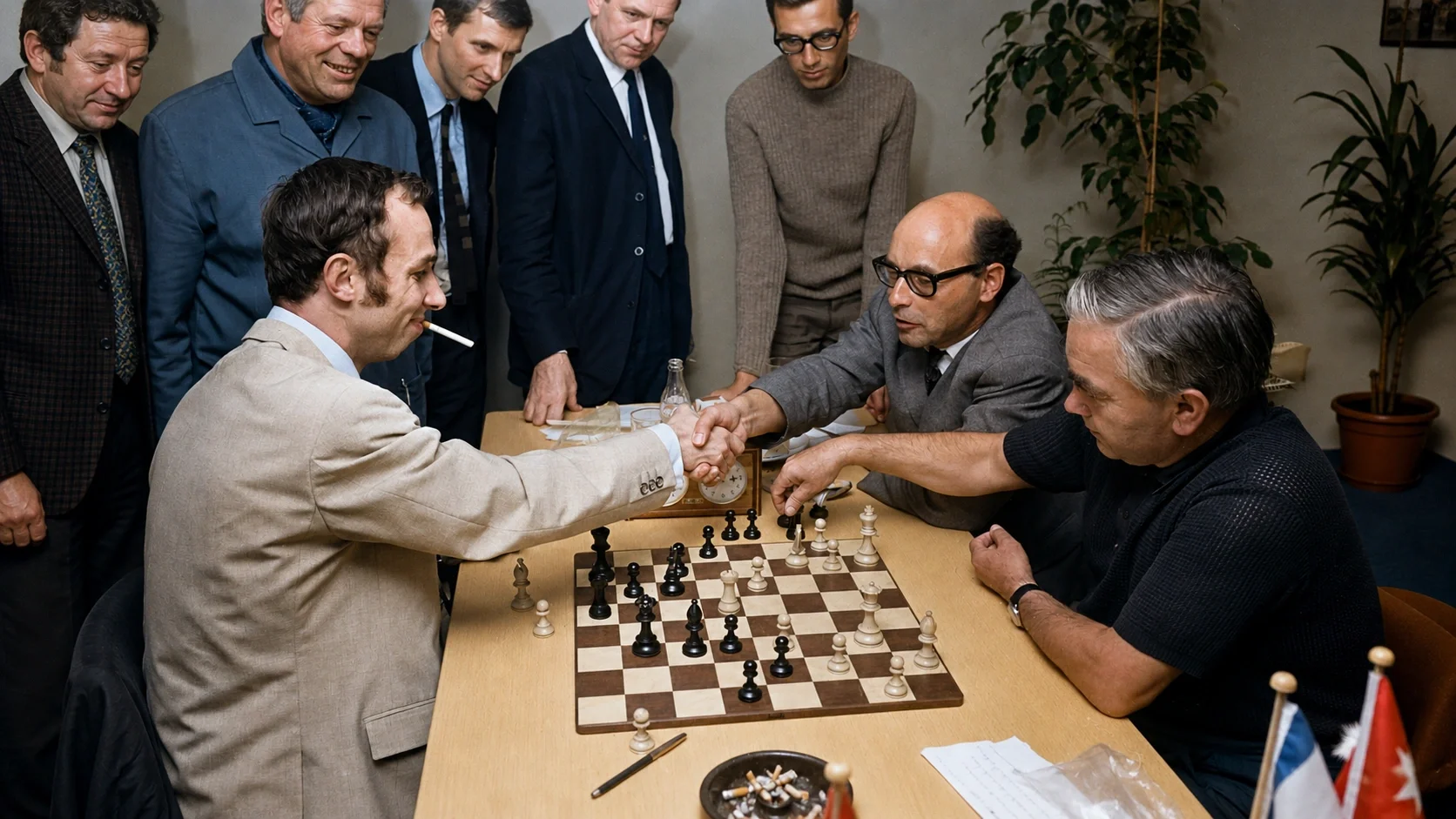
Anefo, CC0, via Wikimedia Commons
Kotov’s rise in chess was comparatively late by elite Soviet standards, which makes his breakthrough all the more striking. Russian biographical sources note that he became a first-category player in the mid-1930s, made master level in 1938 after the Soviet Championship semifinal in Kyiv, and then exploded into prominence by taking second in the 1939 Soviet Championship behind Mikhail Botvinnik. That result was strong enough to make him the third Soviet grandmaster after Botvinnik and Grigory Levenfish in the domestic Soviet sense, before FIDE’s international title system existed. He then won the Moscow Championship in 1941.
His real world-class peak came after the war. At Groningen 1946, he beat both Botvinnik and Max Euwe, a feat the Russian Chess Federation still highlights in memorial summaries. In 1948, he finished fourth at the first Interzonal in Saltsjöbaden with 11.5/19, which qualified him for the first Candidates Tournament. In the same year, he shared first in the 16th Soviet Championship with David Bronstein on 12/18. He won Venice 1950 ahead of Vasily Smyslov, then played the inaugural Candidates in Budapest, scoring 8.5/18 and finishing sixth. His peak tournament result was the 1952 Saltsjöbaden Interzonal, where he scored 16.5/20, remained undefeated, and finished three full points ahead of the tie for second between Tigran Petrosian and Mark Taimanov. At Zürich 1953, he scored 14/28; not a contender’s score, but still in one of the strongest tournaments ever held.
He also contributed to Soviet team dominance. OlimpBase’s official statistical summaries show him as second reserve for the USSR team at the 1952 and 1954 Olympiads, scoring 2/3 at Helsinki and 4/6 at Amsterdam, both in gold-medal teams. His later career became sparser, but not negligible. Russian Federation materials still single out his victory at Hastings in 1963 as a notable late achievement.
Kotov’s official international title history is unusually clear. FIDE’s history pages show that he was among the 27 inaugural International Grandmasters in 1950. Russian institutional sources add that he later became an international arbiter and served as chief arbiter for major events, including men’s Olympiads in the 1970s. His official Elo can only be documented from the start of FIDE lists in 1971 onward. OlimpBase reproduces the first FIDE lists and shows Kotov on 2510 in January 1971 and again on 2510 in July 1971. That is the highest official published Elo I could verify. Pre-1971 “peak ratings” are therefore either unspecified or retroactive estimates rather than official FIDE numbers.
Kotov’s literary output was unusually broad. Russian bibliographical sources list tournament books, analytical manuals, memoirs, fiction, interviews, and newspaper pieces. He wrote not only formal chess instruction but also literary prose, most famously the Alekhine-centered novel White and Black, which later became the Soviet film White Snows of Russia. The Russian Chess Federation and the Russian State Public Scientific Technical Library both stress that he left behind a large literary corpus and belonged to the USSR Writers’ Union.
His most influential theoretical contribution is the training method codified in Think Like a Grandmaster. Public bibliographic and preview sources clearly show the book’s structure: analysis of variations, the tree of analysis, selection of candidate moves, positional judgment, planning, endings, and practical advice on time trouble and self-knowledge. San Francisco Public Library’s catalog summary, working from the standard English edition, accurately distills the core: candidate moves, the tree of analysis, and the factors of success.
The principal analytical ideas can be stated compactly. First, the player should identify candidate moves before making deep calculations. Second, calculation should proceed in an orderly tree, branch by branch, rather than in a confused back-and-forth scan. Third, planning requires verbal clarity: Kotov’s later strategic writing was repeatedly paraphrased by later trainers as insisting that one should be able to formulate a plan in words. Fourth, time management is itself a part of the thinking technique. These principles became staples of postwar chess instruction because they offered club players a method, not merely examples.
His co-authored The Soviet School of Chess had a different aim. It was historiographical and ideological as well as pedagogical, presenting Soviet chess supremacy as the product of socialist cultural development. That framing was so explicit that Dover’s English-language edition prefaced the work with a warning about propaganda and distortion. For historians, this book is still important, but it must be read both as chess history and as an artifact of Soviet cultural self-legitimation.
Kotov’s long project on Alexander Alekhine was equally important. Russian bibliographic materials show that he worked on Alekhine’s legacy from the late 1940s, publishing the major volumes in 1953 and 1958 and later abridged English-language and revised editions. Whatever one thinks of its ideological slant, this project helped restore Alekhine to usable Soviet memory after years of estrangement.
Soviet chess institutions, journalism, broadcasting, and coaching
Kotov’s place in Soviet chess culture cannot be reduced to game scores. Russian institutional materials repeatedly present him as a chess organizer and state-facing cultural worker. The Russian Chess Federation’s memorial page and other institutional summaries describe him as a longtime deputy chairman of the USSR Chess Federation and chairman of the board of the Central Chess Club of the USSR. They also note his work as an international arbiter and chief arbiter of major competitions, including the men’s Olympiads of 1972 and 1974.
His most durable coaching role was not as a private trainer to one future world champion, but as a mass educator. Soviet television’s Shakhmatnaya shkola, which ran from 1969 to 1988, was launched from Kotov’s idea of teaching chess on television. Public summaries of the program explain that it targeted different ability groups, assigned homework, and ultimately certified more than 50,000 viewers for chess categories. Kotov taught the more advanced “classed player” audience together with Yuri Averbakh and others. In this sense, his coaching legacy was civic and pedagogical, not merely elite and individual.
His journalistic and editorial roles deserve careful phrasing. I found strong public evidence for his activity as a chess journalist and literary collaborator, and for the high esteem in which contemporaries held his writing, but weaker open evidence for a single defining formal editorship. A Radio Svoboda reflection on Soviet sports writing later grouped Kotov with the most professional grandmaster-journalists in the Soviet press. A memorial evening report records editor-journalist Friedrich Malkin discussing his collaborative work with Kotov, and later memorial notes recall Kotov’s gratitude and literary connections. The safest analytical conclusion is that Kotov functioned as a journalist and public educator of high standing, even when exact editorial titles are not always readily recoverable from open web sources.
More broadly, Kotov’s work sat inside the Soviet attempt to make chess a prestige culture. Scholarly work on Soviet chess history describes chess as a propaganda device for advertising the superiority of Soviet culture, and research on the “Soviet school” shows how Soviet commentators tied national success to a supposedly distinct national method and style. Kotov was not just a beneficiary of this system. Through the Soviet School of Chess, federation work, and mass broadcasting, he was one of its articulate codifiers.
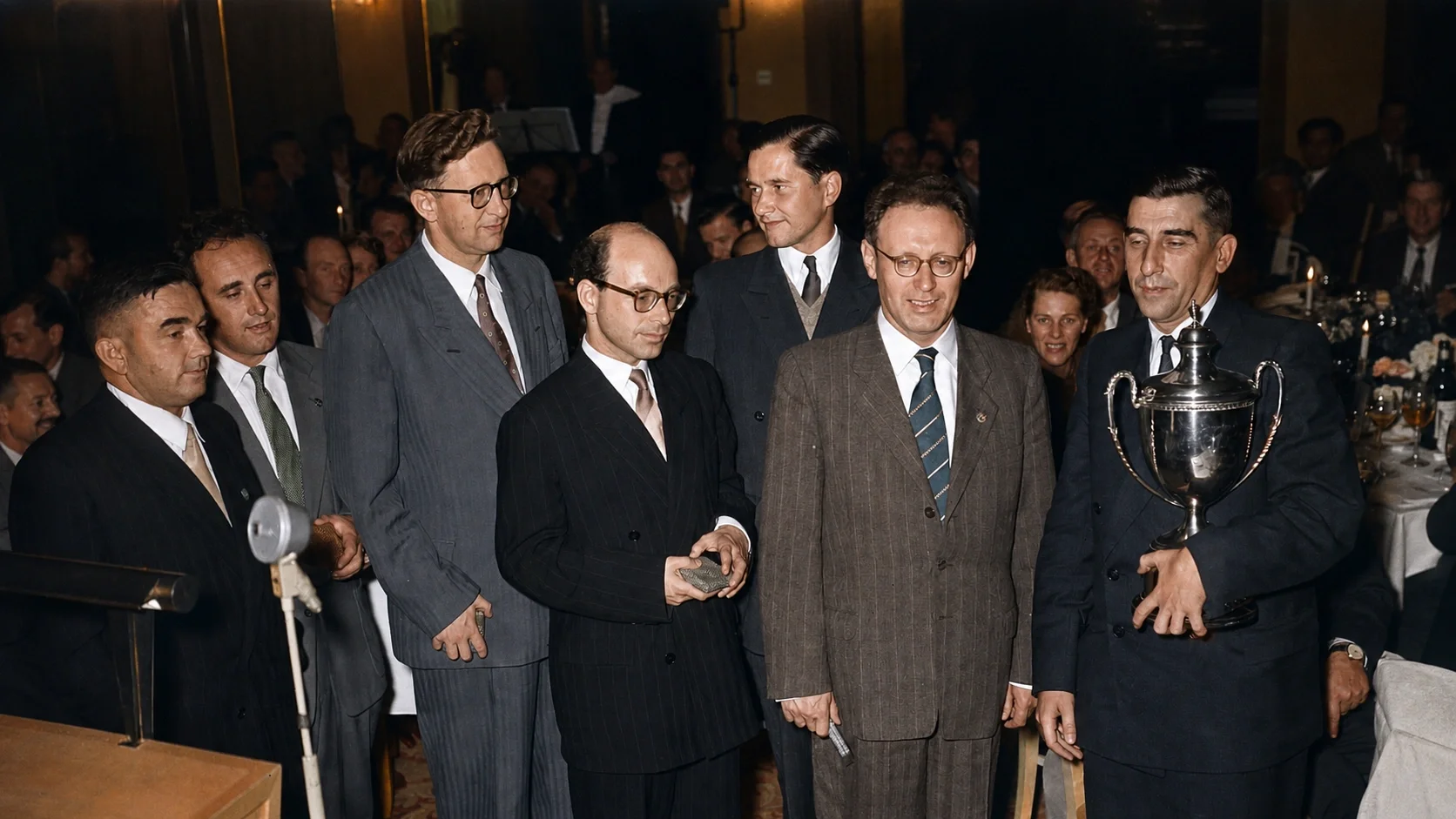
Joop van Bilsen for Anefo, CC0, via Wikimedia Commons
Kotov’s legacy has always had a double edge. On one side, he gave chess pedagogy a durable vocabulary and a disciplined framework that still shapes how instructors talk about analysis. On the other hand, later historians and psychologists have criticized parts of that framework. The empirical criticism is the cleanest. Campitelli and Gobet’s study of skilled chess search behavior found that strong players, including a grandmaster, often revise candidate sets and jump among variations, which sits awkwardly with the most rigid “each branch only once” version of Kotov’s prescription. Their evidence suggests that Kotov’s model works very well as an instructional ideal and a simplification, but less well as a literal, full description of how expert calculation always unfolds.
The historiographical criticism concerns ideology. Later readers, including critics cited in chess-historical discussions, have argued that Kotov’s work on Alekhine and on Soviet chess history often carries visible political framing and selective narration. Max Euwe was quoted as calling Kotov’s writings examples of distorted history, and the Dover edition of The Soviet School of Chess explicitly warned readers about Soviet propaganda techniques. These criticisms do not erase the value of Kotov’s archival labor or pedagogical clarity, but they do require careful source criticism when using him as a historian.
Mikhail Botvinnik vs Kotov, Groningen 1946
Opening: Nimzo-Indian, Sämisch. Why it is representative: This is one of the games that created Kotov’s postwar reputation, and Russian federation summaries continue to cite it alongside his win over Euwe as proof that he could beat the biggest names when tactics and energy were on his side. Critical phase: the tactical midgame where Black’s initiative turns into a direct attack. Brief modern-engine takeaway: once Black’s combination gets going, the position is decisively winning. Viewer link: Chessgames.
Kotov vs Tigran Petrosian, USSR Championship 1949
Opening: Queen’s Gambit Declined, Exchange structure, D36 family. Why it is representative: it shows Kotov’s tactical alertness in a short, brutal miniature against a future world champion. Critical phase: Petrosian fell into a sharp opening trap and resigned after only 13 moves. Brief modern-engine takeaway: Black’s position is already strategically and tactically broken by the time the miniature ends. Viewer link: Chessgames.
Kotov vs Paul Keres, Budapest Candidates 1950
Opening: Nimzo-Indian, Sämisch, E24. Why it is representative: this is one of Kotov’s signature Candidates wins and appears in later collections connected with his teaching legacy. Critical phase: White’s kingside operation converts dynamic pressure into a winning attack. Brief modern-engine takeaway: after White’s tactical coordination clicks, the attack is winning and Black’s king cannot stabilize. Viewer links: Chessgames, tournament page.
Kotov vs Vasily Smyslov, Budapest Candidates 1950
Opening: Sicilian Scheveningen structure, B85. Why it is representative: this is the famous game associated with what later became “Kotov syndrome.” Critical phase: after long thought, Kotov missed the immediate tactical refutation 42...Rf2+, which FIDE’s retrospective history still highlights as the winning move Smyslov found. Brief modern-engine takeaway: Black had a forced win at the critical moment; the game became famous less for the whole opening than for the psychology of time trouble and missed calculation. Viewer links: Chessgames, FIDE historical note.
Yuri Averbakh vs Kotov, Zürich Candidates 1953
Opening: Old Indian, A55. Why it is representative: this is the most famous Kotov game, the one most often cited when his name comes up as a player. Critical phase: the queen sacrifice, commonly identified around 24...Rxf4!! in later collections, after which Black’s attack on the exposed white king becomes overwhelming. Brief modern-engine takeaway: the sacrifice is sound, not romantic bluff; Black’s compensation is fully real and grows into a forced finish. Viewer links: Chessgames and related collections.
Kotov vs Samuel Reshevsky, Zürich Candidates 1953
Opening: Queen’s Indian, E14. Why it is representative: it shows that Kotov could also win long, serious games in a super-tournament, not only tactical miniatures. Critical phase: Reshevsky outplayed him for stretches, but time pressure and Kotov’s resistance turned the tables. Brief modern-engine takeaway: the game is a good reminder that practical chess and clock management were part of Kotov’s identity, not just abstract analysis trees. Viewer links: Chessgames.
In legacy terms, Kotov sits at the meeting point of three histories. First, he belongs to the generation that turned Soviet chess into the world’s dominant national chess culture. Second, he helped create the public language through which ambitious amateurs learned to think about candidate moves, calculation, planning, and time trouble. Third, he exemplifies the ambiguity of Soviet chess writing itself: technically rich, institutionally powerful, and often ideologically overdetermined. Later trainers such as Mark Dvoretsky and Artur Yusupov treated him as an originator of a general theory of chess analysis, even while later practical teachers and psychologists softened or corrected his more machine-like prescriptions. That long afterlife is why Kotov remains more than a Soviet champion and candidate. He remains a reference point in the history of how chess players are taught to think.
