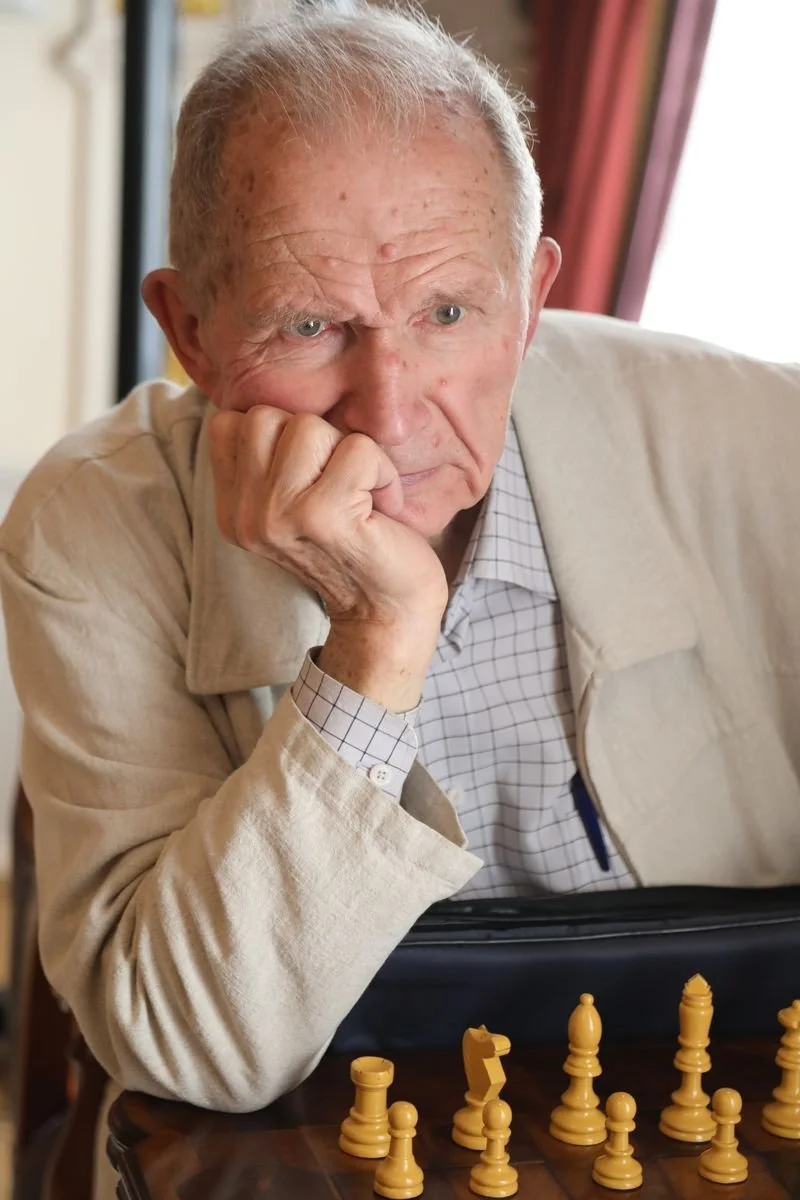
Alexander Nikitin: The Engineer of Champions
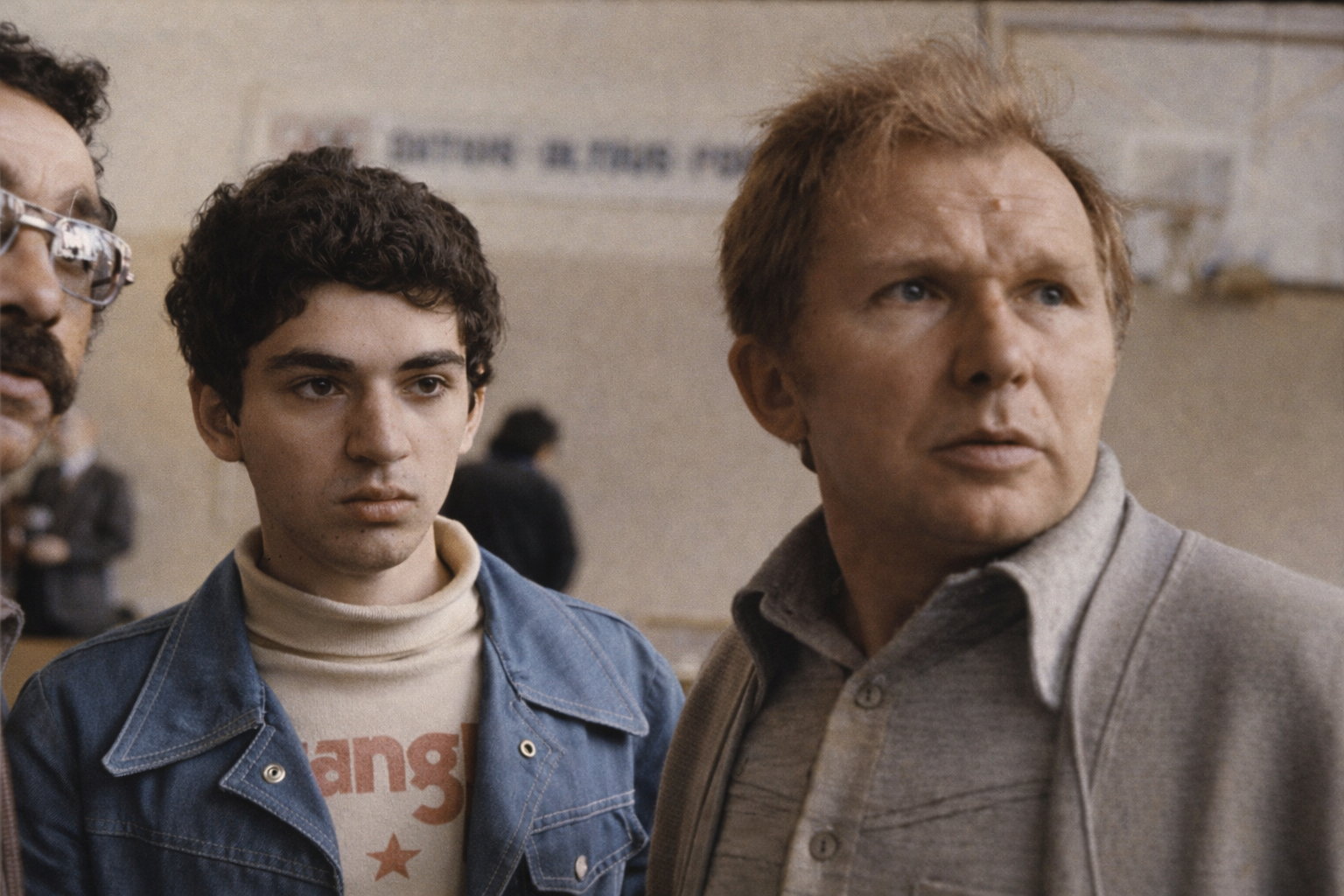
Garry Kasparov and Alexander Nikitin
Alexander Sergeyevich Nikitin, born on 27 January 1935, belongs to that rare class of chess figures whose fingerprints are everywhere even when their name is not on the marquee. Official obituaries remembered him as a strong International Master, a Merited Coach of the USSR, and a FIDE Senior Trainer. That is all true, but it is still too small. Nikitin was one of the great developmental minds of Soviet and post-Soviet chess: player, analyst, coach, second, institution-builder, historian, and opening theoretician. To call him merely “Kasparov’s coach” is accurate in the way calling a cathedral “a building” is accurate.
What made Nikitin historically important was not that he became a headline tournament star himself, but that he mastered the machinery by which stars were made. In him, several strands of twentieth-century chess converged: the Soviet youth-training system, the culture of serious opening preparation, the role of the second in world championship combat, and the later turn toward memoir and self-documentation. His life lets you watch chess move from club and school culture into something more like a scientific high-performance profession.
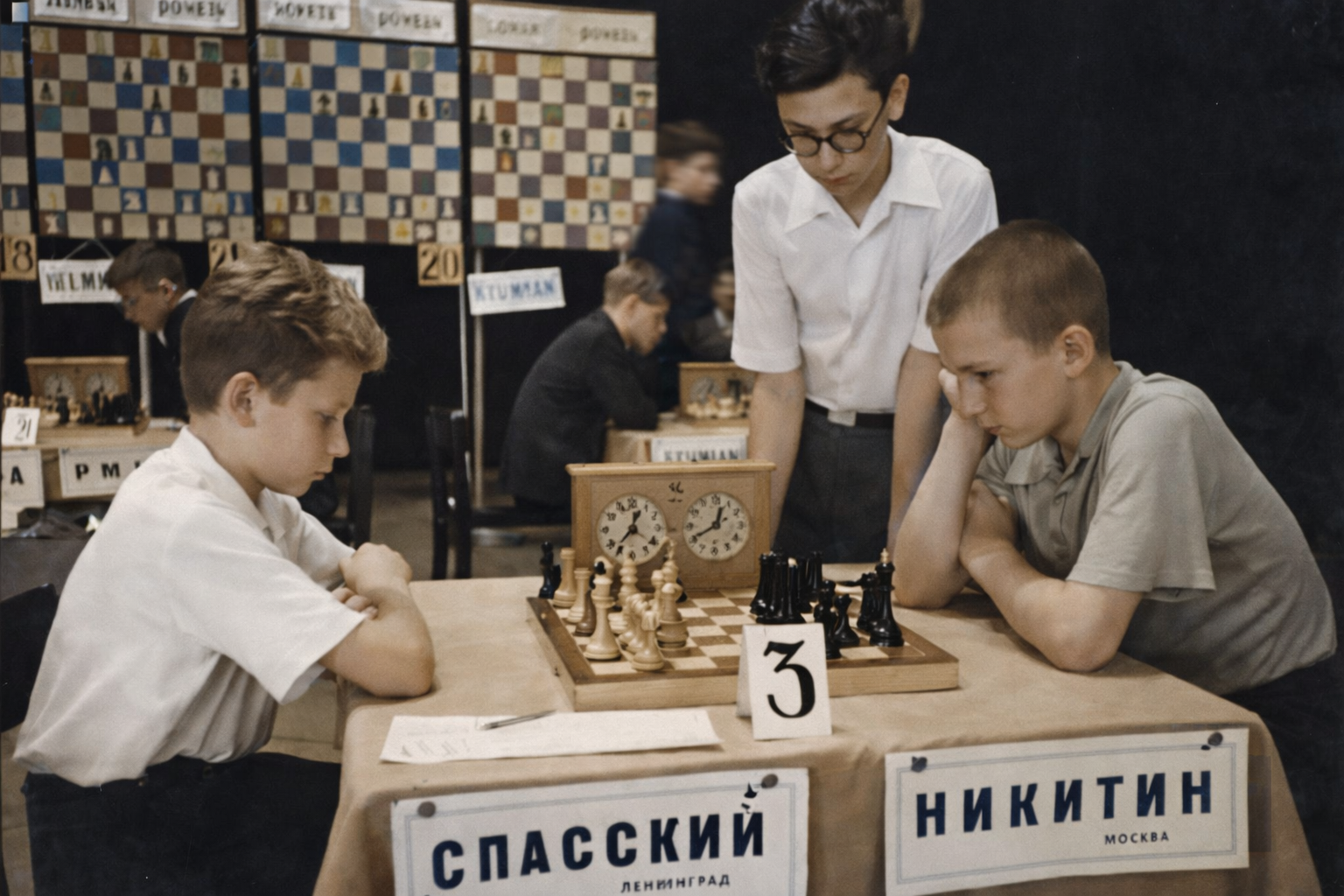
Boris Spassky and Alexander Nikitin
Nikitin’s formation began in a very Soviet, very literary way. As a boy of seven, he found Emanuel Lasker’s Manual of Chess in his uncle’s library, was captivated by its “incomprehensible diagrams,” studied it intensely, and then went to Moscow’s Pioneers’ Palace. There he came under the guidance of Andrey Yaroshevsky, Evgeny Penchko, and later the noted pedagogue Grigory Ravinsky. Russian Chess Federation profiles describe him as one of the USSR’s strongest juniors. At the same time, he was not a romantic dropout who abandoned ordinary education for the board. He graduated from school with a gold medal, entered a technical university, and then worked as a radio engineer for roughly fifteen years. That double identity, chess intellect plus engineering discipline, shaped everything that followed.
As a competitive player, Nikitin was serious, accomplished, and more than respectable. Publisher and federation biographies credit him with achieving master strength unusually early, while official and database sources show sustained high-level play over many years. He played in the 1959 USSR Championship, which was one of the strongest national events on earth, and his best Moscow result was sharing 2nd through 5th in 1954. For the Soviet student team he won World Student Team titles in 1955, 1957, and 1958; OlimpBase records six appearances across 1954-55 and 1957-60, with a formidable aggregate score of 35/45, or 77.8%. Long after his main playing years, his recorded FIDE rating still reached 2445 in 1994, a mark of genuine master-level durability.
Yet the essential turning point in his own playing life was negative, and that matters. In a late interview he recalled that the 1959 Soviet Championship coincided with his examinations; after finishing last, he concluded that he could not combine two equally serious vocations and chose study and engineering over a full-time playing career. This was not failure so much as self-diagnosis. Nikitin understood very early that chess greatness was not only a matter of talent but of structure, scheduling, and total commitment. Later, as a coach, he would build exactly those structures for others.
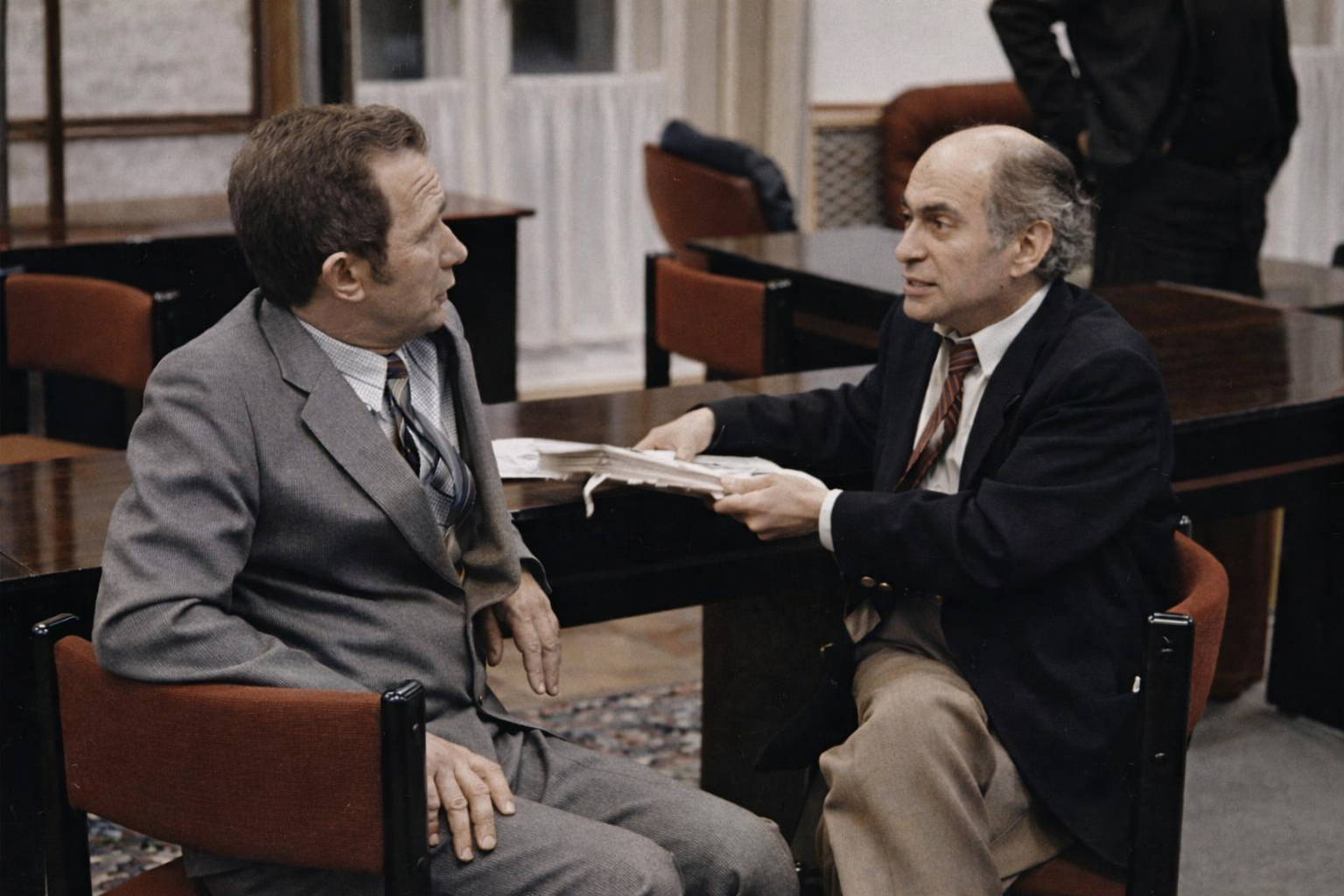
Alexander Nikitin and Mikhail Tal
His move from engineer to elite chess specialist is one of the most revealing episodes of his life. After graduation he worked at what he described as a “secret tech factory” for about fifteen years. Then a twist: Nikolai Baturinsky of the Soviet Sports Committee recruited him into the national chess apparatus. Nikitin later explained that his job was to gather chess information for leading grandmasters, with Anatoly Karpov foremost among them. This is an underappreciated piece of his legacy. Before he became famous as a personal trainer, Nikitin was already functioning as an information curator and analytical aide inside the Soviet high-command of chess. In modern language, he was doing database work before databases existed. By his own later account, relations with Karpov’s camp and the authorities eventually soured, and he left that role, but the experience refined his sense of preparation as organized intelligence rather than casual inspiration.
Then came the meeting that made him part of world chess history. The exact dating of the decisive first Nikitin-Kasparov encounter varies a little in the sources, which is worth noting in an academic profile. Russian Chess Federation material places it in Vilnius in 1973, FIDE’s obituary says 1974, and in a 2020 oral recollection Nikitin linked the Vilnius youth-games trip to a 1976 assignment. Kasparov himself, in that same interview, said they had known each other since 1973. The broad story, however, is stable: Nikitin saw a tiny ten-year-old Garry Weinstein, later Kasparov, on the Azerbaijan team, was astonished by his opening knowledge, memory, and calculation, and quickly grasped that this was not normal prodigy behavior but championship material.
Nikitin’s first assessment of the young Kasparov is almost famous in itself. He later said he was amazed by Garry’s opening erudition and phenomenal memory, and in the 2020 interview described the boy’s calculation as already “on par with grandmasters.” Kasparov, for his part, said that Nikitin’s recommendation led to his invitation to Botvinnik’s school, an event he described as life-changing. This is crucial. Nikitin did not merely “discover” talent in the vague mythic sense. He identified it, authenticated it for gatekeepers, and connected it to the institutional pipeline that could turn a prodigy into a contender. In Soviet chess, that was an act of enormous consequence.
What distinguishes Nikitin from many trainers is that he left unusually clear evidence of his developmental philosophy. In the foreword to his Kasparov memoir, reproduced in the English edition, he describes writing a serious, deadline-driven program in 1978 for Garry’s mother. The aim was not short-term applause but the cultivation of an “extra-class grandmaster,” with staged targets extending toward a future candidates cycle and, ultimately, the world title. Later in the same text he noted with understandable pride that the actual timetable of Kasparov’s growth came very close to the one he had projected. This is vintage Nikitin: less mystic guru than architect with blueprints.
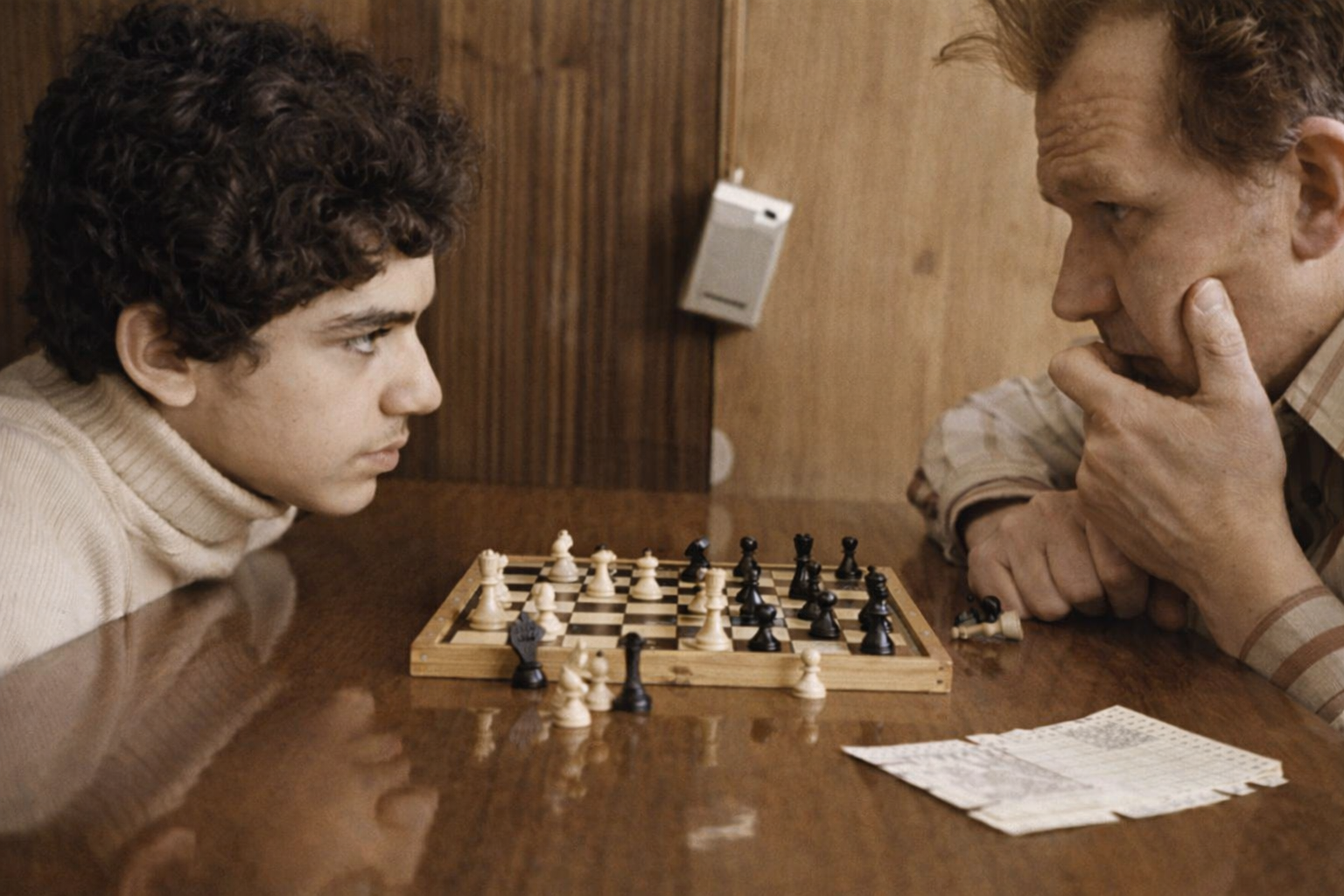
From there, Nikitin became central to one of the great ascents in sports history. Published biographical material says he coached Kasparov through 1990 and served as Kasparov’s chief second in the candidates and world championship matches from 1983 through 1987. FIDE’s obituary did not hedge: without Nikitin, it said, Kasparov might not have become “the great Kasparov.” Kasparov himself later remarked, “We have lived a whole chess life together,” and after Nikitin’s death, he publicly called him his first coach, the man who had his back through every step up the mountain. Those tributes were not sentimental excess. They were historically literate.
Nikitin’s coaching method was wider than opening preparation. He explicitly described himself as an “unusual psychological source of support” for Kasparov, someone who stayed calm under pressure and transmitted that calm to the player. He also understood that elite match play was bodily work. In the 2020 interview, he vividly recalled endurance sessions with Kasparov in training camps near the Caspian Sea, running along the shoreline and later on asphalt in the heat. Nikitin said Kasparov knew he needed stamina and that this preparation helped in the long matches against Karpov, where fatigue itself became a silent combatant. Here again, Nikitin looks strikingly modern: trainer as analyst, conditioning planner, and emotional stabilizer all at once.
That breadth of role explains why Nikitin matters beyond the Kasparov story. He was not merely a private tutor to one genius; he was also an institutional pedagogue. From 1977 to 1993, he worked at the Spartak youth school, later associated with Tigran Petrosian, and after Petrosian’s death in 1984, he ran it. Nikitin later emphasized that Petrosian had truly taught there, not merely lent his name, and that after 1984 he himself became head coach, organizing the entire work of the school. Federation and interview sources connect that milieu to the development of Boris Gelfand, Levon Aronian, Alexander Grischuk, Dmitry Yakovenko, Baadur Jobava, and many other grandmasters. The exact degree of one-to-one personal coaching varies from player to player, but the institutional reach is beyond doubt.
After the Kasparov partnership ended in the early 1990s, Nikitin did not turn into a museum piece. He assisted Boris Spassky during the 1992 Fischer rematch, later worked with Etienne Bacrot, coached Dmitry Yakovenko, and, for a period, also worked with Grischuk. FIDE’s obituary highlighted that Jakovenko, who worked with Nikitin from a very young age, eventually rose into the world top five. Russian Federation material on Bacrot notes that Nikitin was among the former Kasparov seconds who helped in the French prodigy’s training. There is an ethical continuity here too: just as Nikitin had once chosen serious education over a purely romantic chess life, he later insisted that Yakovenko obtain a higher education alongside chess. He taught ambition, but not at the cost of intellectual ballast.
As a writer and theoretician, Nikitin was substantial in his own right. Russian Chess Federation material credits him with a series of books that include Mikhail Chigorin (1972, with co-authors), while library records document his co-authorship with Garry Kasparov on major Sicilian works, including Sicilian--e6 and--d6 systems and The Sicilian Scheveningen. These were not decorative publications. The Scheveningen was one of the crucial battlegrounds of modern opening theory, and Nikitin was helping articulate theory around a system deeply bound up with elite practice. In the 2000s, he also assisted Kasparov with historical and autobiographical writing, including work connected to My Great Predecessors and Kasparov vs Karpov.
His most important books, though, are probably the memoirs about coaching Kasparov. The original Russian work appeared in 1998; later English editions divided it into Coaching Kasparov, Year by Year and Move by Move, Volume I: The Whizz-Kid (1973-1981) and Volume II: The Assassin (1982-1990). These books matter because Nikitin did not treat them as nostalgia albums. He explicitly said he wanted readers to see not only how Kasparov’s chess strength grew, but how his personality was formed. He also presented the material as practically useful for trainers and, implicitly, for parents managing exceptional young players. For historians of chess culture, that makes Nikitin more than a witness. He becomes a theorist of talent formation.
His later years show the same refusal to stop teaching. Federation sources say he participated in the “Chess Hopes of Russia” program in 2012 and 2013 and served on the Russian Chess Federation trainers’ committee. In interviews he described himself, with a flicker of humor, as a freelancer “who doesn’t hit anyone with my lances,” and said he kept writing because his head was full of useful thoughts he did not want to disappear. In 2020, an English edition of his book about his friend Evgeny Vasiukov was published. Even in old age, Nikitin remained what he had always been: a transmitter of chess memory and judgment.
So how should he be ranked, historically? Not among the very greatest tournament players, plainly. But among trainers, seconds, and chess intellectuals, he belongs in the front chamber. He stands at a hinge point between the Soviet chess machine and the era of personalized super-coaching. One foot remained in the world of Pioneers’ Palaces, sports committees, and pedagogical schools; the other stepped into a world of targeted opening files, physical conditioning, psychological management, and long-range career engineering. He is a reminder that genius on the board is often a collective construction, assembled in notebooks, training camps, arguments, and quiet acts of faith. FIDE’s formulation that Kasparov might not have become “the great Kasparov” without Nikitin is blunt, but it is not extravagant. It is probably the cleanest single sentence ever written about his legacy.