Alexander Tolush: Life, Chess, Style, and Influence
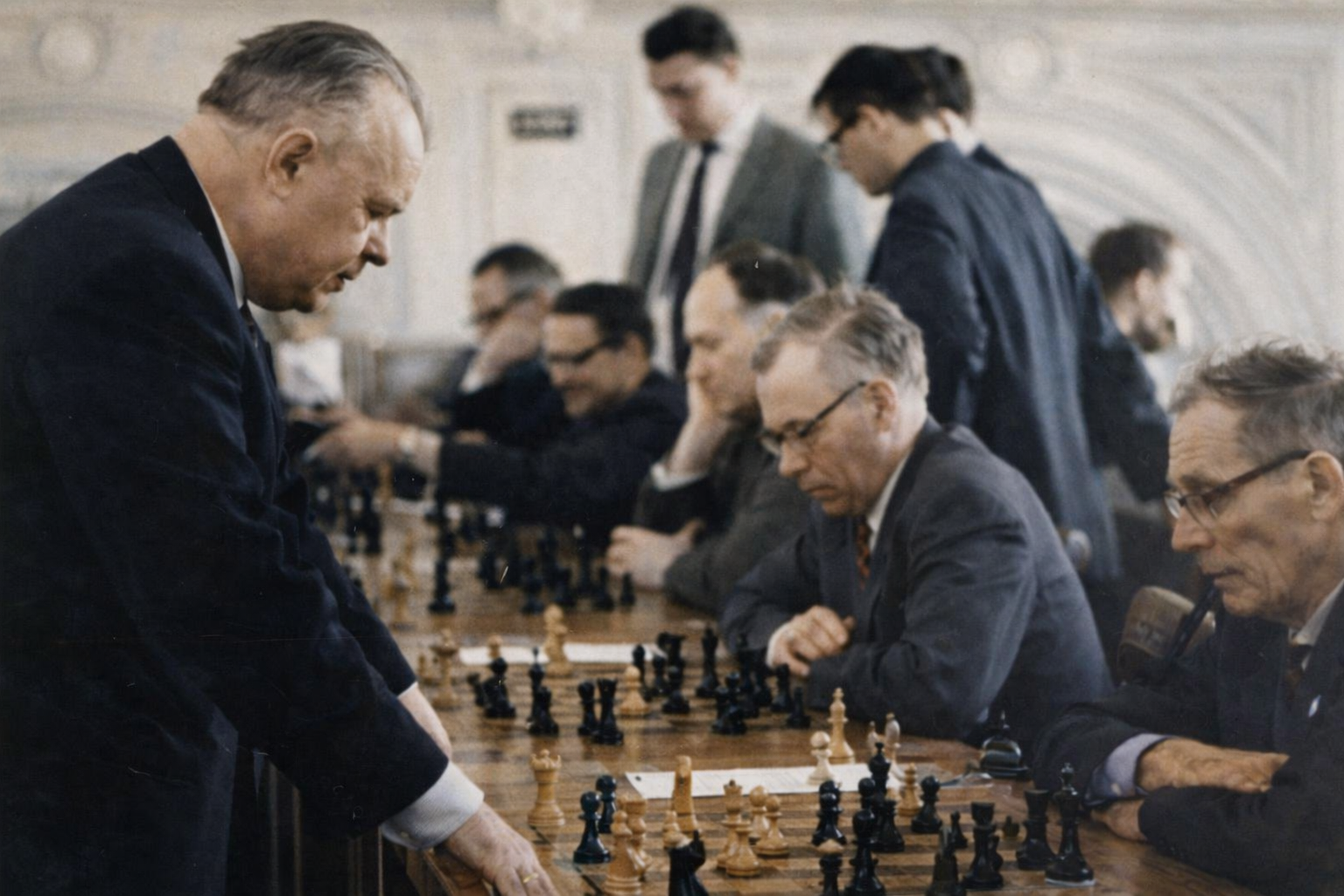
Alexander Tolush gives a simultaneous exhibition
Alexander Kazimirovich Tolush belongs to that class of chess figures who can look like footnotes only because the page around them is crowded with world champions. Born in St. Petersburg on 1 May 1910 and dead in Leningrad in early March 1969, he was not only a Soviet grandmaster but also a trainer, journalist, radio commentator, and later an International Master of Correspondence Chess. In Soviet chess memory he stands as a distinctly Leningrad figure: fiercely original, aggressively creative, and profoundly influential on younger players, most famously Boris Spassky.
A small historiographical note is worth making at the outset. The sources do not agree on every detail. Russian biographical records generally give Tolush’s death as 2 March 1969, while some later English retrospectives give 3 March; similarly, his tally of Leningrad city titles varies because shared first places are not always counted the same way. Those discrepancies are minor, but mentioning them is part of taking Tolush seriously as a historical subject rather than flattening him into a legend.
Life and formation
Biographical sources portray Tolush as largely self-made. He lost his father at fifteen, did not complete formal schooling, and continued by self-education. That matters because Tolush’s career does not read as the product of smooth institutional grooming. He emerged instead as an intensely local talent shaped by study, temperament, and the severe culture of competitive Leningrad chess. His life remained overwhelmingly tied to that city, where he first made his name, where he worked, and where he ultimately died and was buried.
He came forward in Leningrad tournaments in the early 1930s, and by 1935 he had already won the RSFSR championship and the semi-final of the Soviet trade-unions championship. The same year he defeated José Raúl Capablanca in a simultaneous exhibition in Leningrad, a small but vivid emblem of his temperament: Tolush was willing to attack greatness directly, without much ceremonial hesitation.
The war years interrupted but did not erase that trajectory. Russian biographical sources state that Tolush volunteered for the front, defended Leningrad during the blockade, and was recalled in 1943; ChessBase’s retrospective confirms his service as an officer in the Red Army. It is hard not to read his postwar chess through that experience. His games often feel like arguments against passivity: tense, combative, unwilling to let a position settle into safety.
Competitive career
As a tournament player, Tolush’s record is stronger than his modern name-recognition suggests. He played in ten USSR championships, achieved repeated success in Leningrad city competition, and established himself after the war as a dangerous presence in elite Soviet chess. ChessBase’s retrospective counts multiple city-title successes between the late 1930s and mid-1950s, while the Russian Chess Federation’s official profile remembers him as a four-time champion of Leningrad. What matters more than the exact accounting is that Tolush was not a provincial stylist who briefly flashed and disappeared. He was a sustained force in one of the hardest chess ecosystems on earth.
His postwar Soviet-championship performances show the scale of that strength. In 1944 he defeated Botvinnik and finished seventh. In 1947 and 1948 he placed fifth. In 1950 he scored 11/17 to share second through fourth, just half a point behind Paul Keres. In 1952 he scored 11½/19 to share fourth through fifth. These were not ornamental placings. In 1950 he finished level with Lipnitsky and Aronin; in 1952 he finished level with Boleslavsky. Tolush was living, round after round, in the deep water of Soviet elite competition.
The clearest summit of his over-the-board career was Bucharest 1953. There Tolush finished clear first with 14/19, scoring ten wins, eight draws, and only one loss, to Smyslov. Petrosian finished second on 13 points, Smyslov third on 12½, and the field also included Boleslavsky, Spassky, and Szabó. This victory brought Tolush the grandmaster title. It remains the decisive evidence that he was more than a brilliancy hunter. He could dominate a long, strong international tournament and do so by a full point.
His later career never turned into a world-title campaign, but it remained substantial and, at moments, dramatic. In the 1957 USSR championship he led or co-led deep into the event and still had a chance at first place until the very end; Tal’s win in their decisive last-round encounter pushed Tolush back to shared fourth-fifth on 13/21. Russian chess history still singles out that tournament as one of his most inspired performances. The same official retrospective also credits him with further international tournament victories in Leningrad and Bucharest in 1953 and in Warsaw in 1961.
On Soviet national teams, Tolush was used sparingly but effectively. At the 1957 European Team Championship he scored 4/5 on board 9 for the victorious USSR team, good for 80 percent. At the 1961 European Team Championship in Oberhausen he served as first reserve and scored 4½/6, or 75 percent, as the Soviet side again took gold. Those figures suggest exactly the kind of player he was: not always the federation’s headline act, but extremely valuable wherever decisive, fighting chess was wanted.
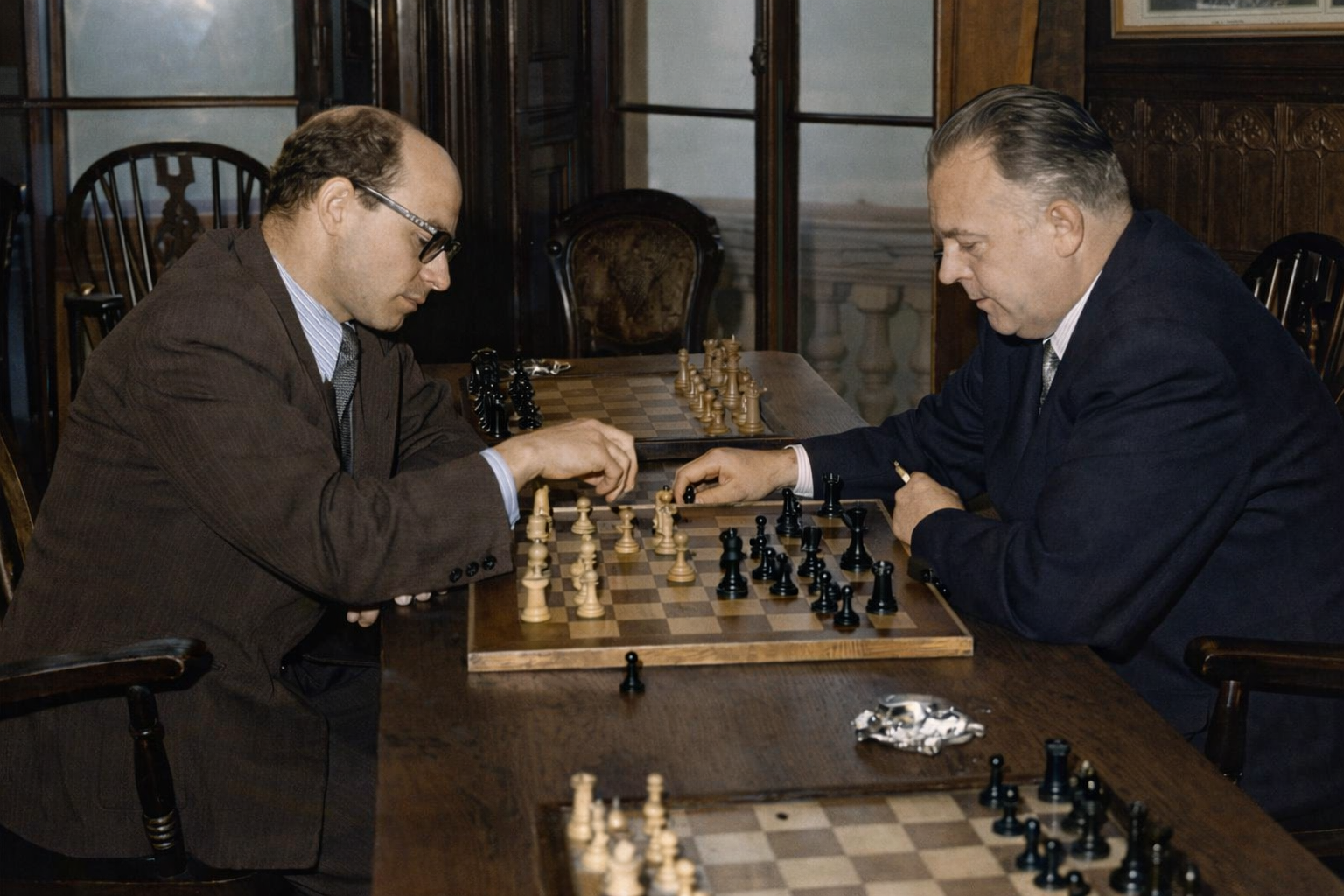
David Bronstein and Alexander Tolush
Style: attack, tension, and the art of unstable positions
Tolush is remembered above all for style. The Russian Chess Federation’s official profile describes him as one of the USSR’s most creative players and an adherent of ultra-attacking chess, forever pushing himself forward with the cry “Onwards, Kazimirovich!” Yet Russian biographical summaries add an illuminating complication: Tolush often preferred closed openings and can be described as actively positional. That combination is the key to him. He was not merely a tactician who loved sacrifices. He was a player who knew how to build pressure, preserve tension, and then make the position catch fire.
That paradox deserves emphasis. Tolush’s attacks were often grown rather than merely thrown. He liked positions with latent energy, incomplete development, unresolved pawn structures, and plenty of room for initiative to swell. In that sense, he belongs to a particularly rich line of attacking players: not the purely reckless kind, but those who understand that the most dangerous combinations are often the flowering of earlier positional pressure. Russian sources explicitly stress his mastery of seizing and maintaining the initiative and of keeping the struggle under strain.
Botvinnik’s assessment of Tolush, preserved in official and biographical sources, is unusually revealing. Botvinnik did not celebrate him as a technician. He emphasized Tolush’s independent style, his ability to create over-the-board commotion when every piece needed to play, and his gift for transforming that commotion into an artistic attack. This is close to the core truth about Tolush. He was dangerous precisely because he could make the board feel suddenly alive in all directions.
Mikhail Yudovich’s portrait complements that judgment. He remembered Tolush as the sort of player who changed the character of the struggle sharply, fought to the very end, and kept hidden traps available even in difficult positions. That description catches something essential: Tolush was not just an attacker, but a destabilizer. He altered the terms of the game. Stability was something his opponents wanted; instability was his native climate.
Tolush also left a mark on opening theory. The Tolush-Geller Gambit of the Slav Defense entered master practice through his games against Smyslov in the 1947 USSR championship and against Levenfish in the 1947 Leningrad championship. That detail is more important than it first appears. It means Tolush’s contribution was not just aesthetic or pedagogical. He physically expanded the repertory of serious chess by testing sharp, risky ideas at master level.
A few signature episodes help crystallize his chess personality. The 1935 simul win over Capablanca announced his nerve. His victory over Botvinnik in the 1944 USSR championship showed that his tactical imagination could pierce even the future world champion. And his famous 17-move miniature against Vladimir Alatortsev demonstrated how fast he could convert initiative into total collapse for the other side. These are not disconnected curiosities. Together they sketch a player who could strike like lightning but usually did so from a storm cloud he had been patiently building.
Trainer, journalist, and chess communicator
If Tolush had done nothing beyond his own tournament record, he would still be a historically interesting Soviet grandmaster. But his second life in chess history is as a trainer. He worked with Paul Keres from 1947 to 1955, with Ludmila Rudenko from 1949 to 1953, and with Boris Spassky from 1952 to 1960. That range alone is striking. Tolush’s expertise was sought not only by emerging talents but also by already established masters who valued what he could see and teach.
His role in Spassky’s development was especially consequential. The Russian Chess Federation’s official profile says he played a particularly significant role in the evolution of the young Spassky. Bucharest 1953 provides the clearest concrete scene: Tolush accompanied his pupil to Spassky’s first international tournament, won the event himself, and saw the teenage Spassky share fourth through sixth and receive the IM title. Botvinnik later observed that Spassky’s preferred way of playing resembled Tolush’s early influence.
Russian biographical sources say Tolush gave Spassky a taste for attack and for non-obvious sacrifices. That phrasing is important. Tolush seems to have taught more than calculation. He taught attitude: a readiness to value activity over material, to trust dynamic possibilities before they could be fully counted, and to meet complexity by leaning into it rather than shrinking away. That influence matters because Spassky later became world champion, and contemporaries continued to hear Tolush’s imprint in his early attacking voice.
There is also a faintly tragic chronology here. Tolush died in 1969, only months before Spassky won the world championship. He did not live to see the fullest public vindication of the most famous pedagogical bond of his career.
Tolush’s contribution extended beyond private coaching. He worked as a chess journalist, published reports in Vecherny Leningrad, and spoke on radio. That made him a public mediator of chess culture as well as a participant in it. In the Soviet setting, this is not a trivial addendum. It means Tolush helped shape how chess was explained, narrated, and socially understood, not only how it was played.
Official recognition followed. Russian biographical records list him as USSR Master of Sport from 1938, International Master from 1950, Grandmaster from 1953, and International Master of Correspondence Chess from 1965. They also note the Medal “For Labour Valour” in 1957 and the title of Merited Coach of the USSR in 1963. Those distinctions show that Tolush was valued institutionally not just as a brilliant player but as a contributor to Soviet sporting and pedagogical culture.
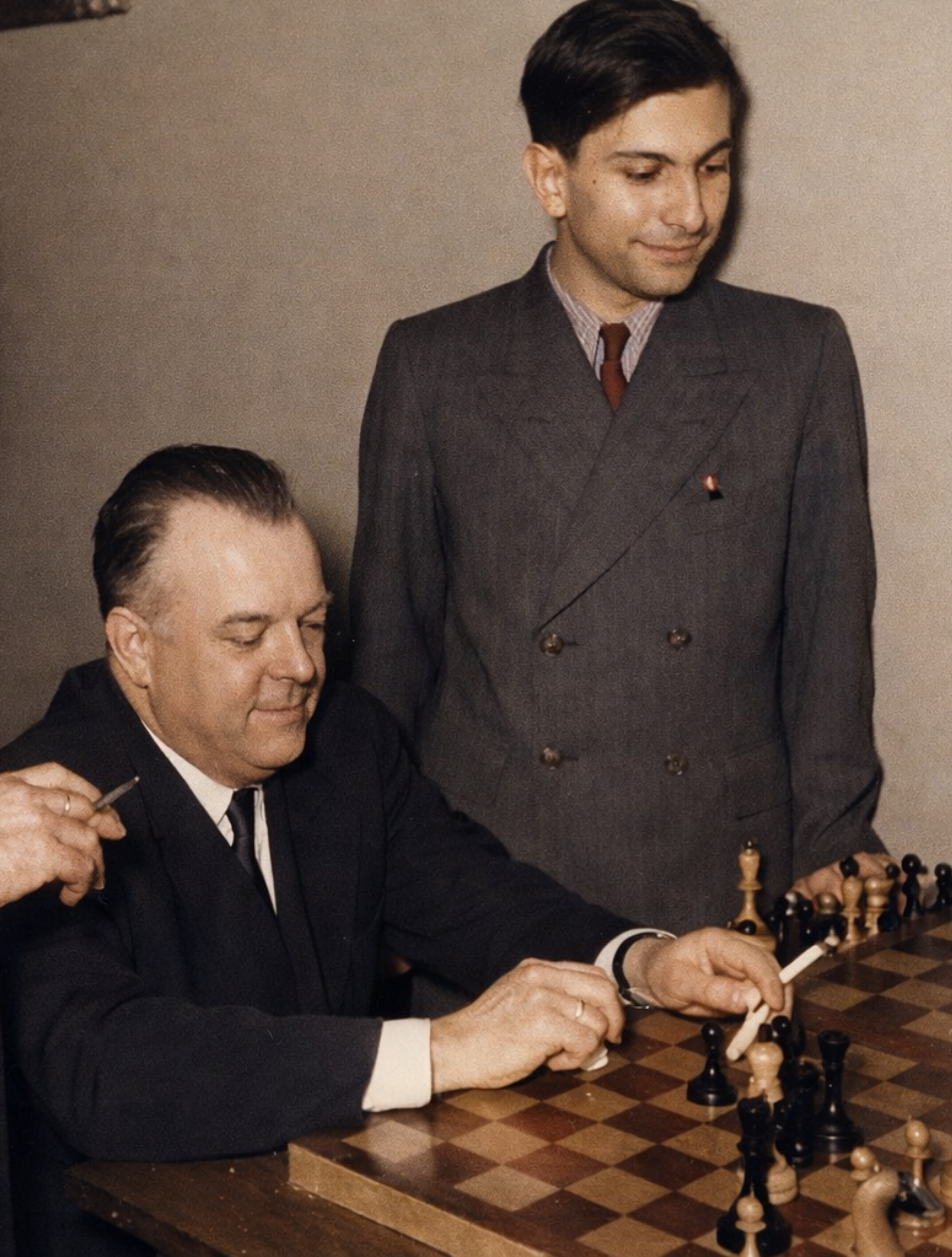
Alexander Tolush and Mikhail Tal
Correspondence chess and analytical depth
One of the most neglected parts of Tolush’s profile is his correspondence career. Russian records show that he won the semifinal of the 4th World Correspondence Championship with the extraordinary score of 9/9, then shared sixth-seventh in the final, and later scored 6½/10 on first board for Leningrad in the 1966-68 Soviet correspondence team championship. The ICCF roster confirms his correspondence IM title in 1965. This part of the record complicates any easy caricature of Tolush as merely an over-the-board swashbuckler. Success in correspondence chess at that level implies disciplined analysis, theoretical seriousness, and durable positional understanding.
Historical place and legacy
Why, then, does Tolush occupy a secondary place in many standard narratives of twentieth-century chess? Partly because his results were somewhat uneven, and partly because Soviet chess in his era was crowded with giants. ChessBase’s retrospective describes his tournament career as erratic, and that feels fair. But erratic is not the same as minor. Tolush could beat the best, win a major international event outright, help shape a future world champion, and remain important enough that the Russian Chess Federation still commemorates him as one of the Soviet Union’s most creative players.
A productive way to place him historically is as a bridge figure. He links prewar Leningrad chess culture to the postwar Soviet golden age, individual attacking flair to institutional coaching, and old-style brilliancy to modern dynamic chess. His games and teachings suggest that attack, in his hands, was not the opposite of positional play but its dangerous continuation by other means. That is why Tolush matters beyond crosstables. He represents a theory of chess life in which initiative is not ornament, but oxygen.
Posthumously, Tolush was curated rather than forgotten. He was buried at Bogoslovskoe Cemetery in St. Petersburg, and a 1983 book compiled by his wife Valentina gathered a biography of him together with 92 games and recollections by contemporaries. That kind of memorial volume is revealing. It suggests that Tolush endured in chess memory not only as a results sheet, but as a presence, a voice, and an aesthetic.
So the fullest profile of Alexander Tolush is not simply “strong Soviet grandmaster,” and not only “Spassky’s attacking mentor,” though both are true. He was a self-educated Leningrad chess figure of rare combustion: battle-tested, stylistically singular, competitively dangerous, pedagogically influential, active in journalism and radio, and serious enough analytically to excel in correspondence play as well. He never became world champion, but he helped shape what world-championship chess could look like when initiative, nerve, and imagination were allowed to run hot. In chess history, his importance lies as much in the sparks he set in other people’s games as in his own.
