Genrikh Kasparyan: Pioneer of Armenian Chess and Master of Endgame Studies
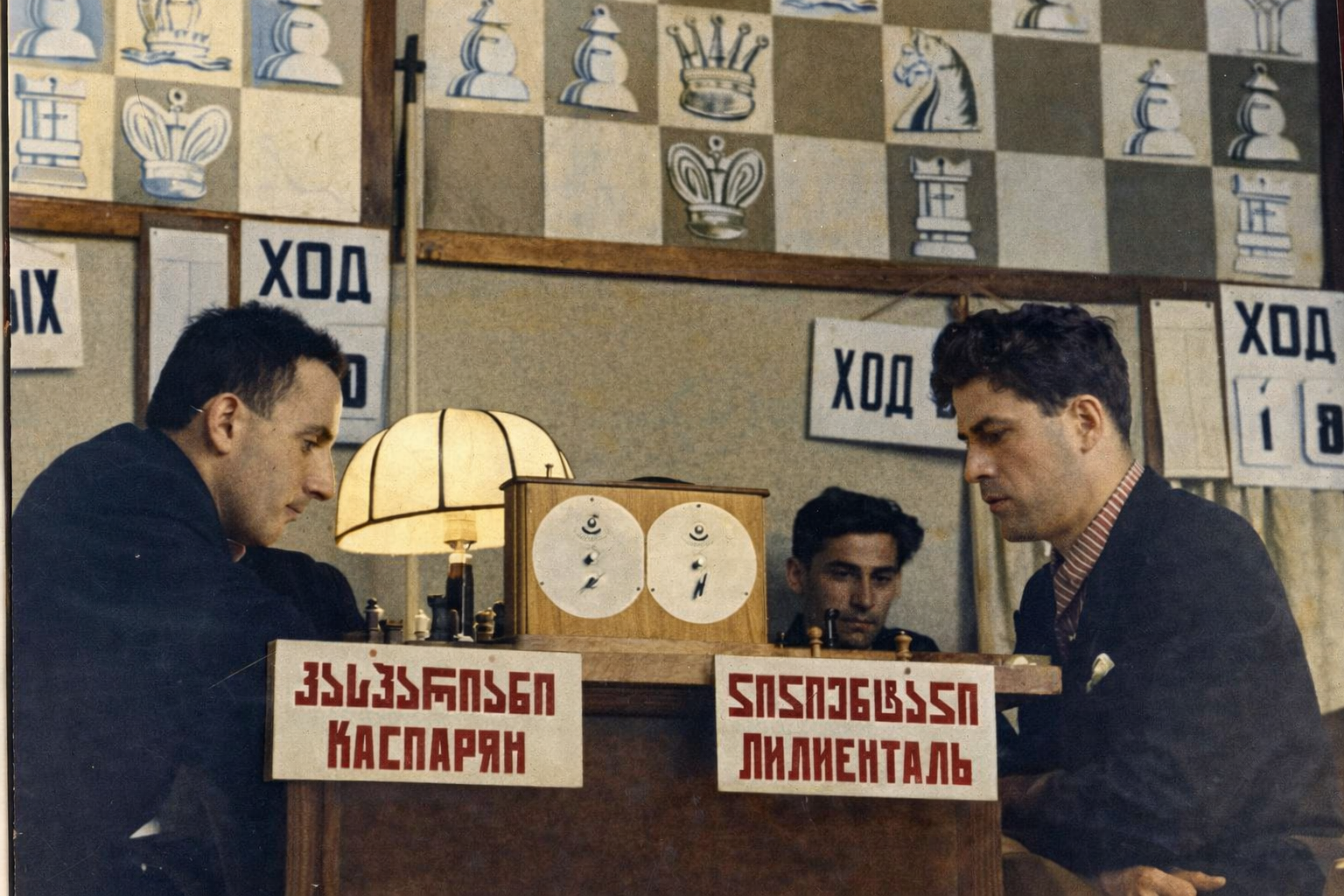
Genrikh Kasparyan - Andor Lilenthal - 10th USSR Chess Championship, Tbilisi, 1937.
Early Life and Introduction to Chess
Genrikh Moiseyevich Kasparyan (also spelled Henrik Gasparyan) was born on 27 February 1910 in Tiflis (modern Tbilisi), then part of the Russian Empire. His family had roots in Nagorno‑Karabakh/Artsakh: his parents Movses Kasparyan and Shushanik Ishakhanyan had moved from that mountainous region to Georgia earlier in the century. Kasparyan was the fourth of five children, and chess became part of his upbringing thanks to his elder brother Ruben, who taught him the rules. Another close relative – an uncle – later took the young Genrikh to a chess club, which helped nurture his fascination with the game.
In 1926, he enrolled at the Tiflis Polytechnic Institute. Despite having little time for competitive play during his studies, he made headlines when he won a mass amateur tournament with 600 participants that same year. By the late 1920s, he was already composing chess problems; his early collection of studies, covering 1927–1930, received praise from the eminent Soviet champion Mikhail Botvinnik, who noted that Kasparyan translated the experience of a tournament fighter into beautifully analysed studies. Around this time, Kasparyan corresponded with renowned composers Leonid and Arvid Kubbel and befriended another endgame pioneer, Alexey Troitsky, both of whom influenced his approach to composition.
Rising through Soviet chess
Kasparyan’s practical results soon matched his reputation as a composer. In 1931 he won the Tbilisi city championship and then took first place in the semi-final group of the 7th USSR Championship, finishing ahead of future world champion Mikhail Botvinnik. Although he struggled in the final itself, the performance established him on the all-Union stage.
After graduating, he spent time working on railway construction along the Black Sea coast but continued to compete. In 1933, he placed second in the Transcaucasian republics championship and, after being sent to Alaverdi in north-eastern Armenia, he entered the first Armenian championship held in Yerevan in 1934, winning it with a commanding score. The following year, he claimed the Transcaucasian title, confirming his status as one of the strongest players in the region. By moving permanently to Yerevan in 1936, he cemented his role in Armenian chess. That same year, he faced Vitaly Chekhover in a 16-game match for the title of Soviet Master of Sport; after winning the play-off, he became the first Soviet Master from Armenia. Kasparyan later recalled that Chekhover praised his courage in attack and precise endgame technique.
Throughout the late 1930s, he played in championships across the Soviet Union. He participated in the 10th USSR Championship in Tbilisi in 1937, scoring wins against future masters Sergei Belavenets and Mikhail Yudovich but finishing near the bottom. In 1939, he won a strong “Masters and Candidate Masters” tournament in Rostov-on-Don, ahead of future grandmasters Isaac Boleslavsky and Alexander Tolush. He reached the semi-finals of the later USSR championships and often played “hors concours” (out of competition) in city championships to gain experience. By 1940, he had built up an impressive over-the-board résumé while simultaneously honing his composing skills.
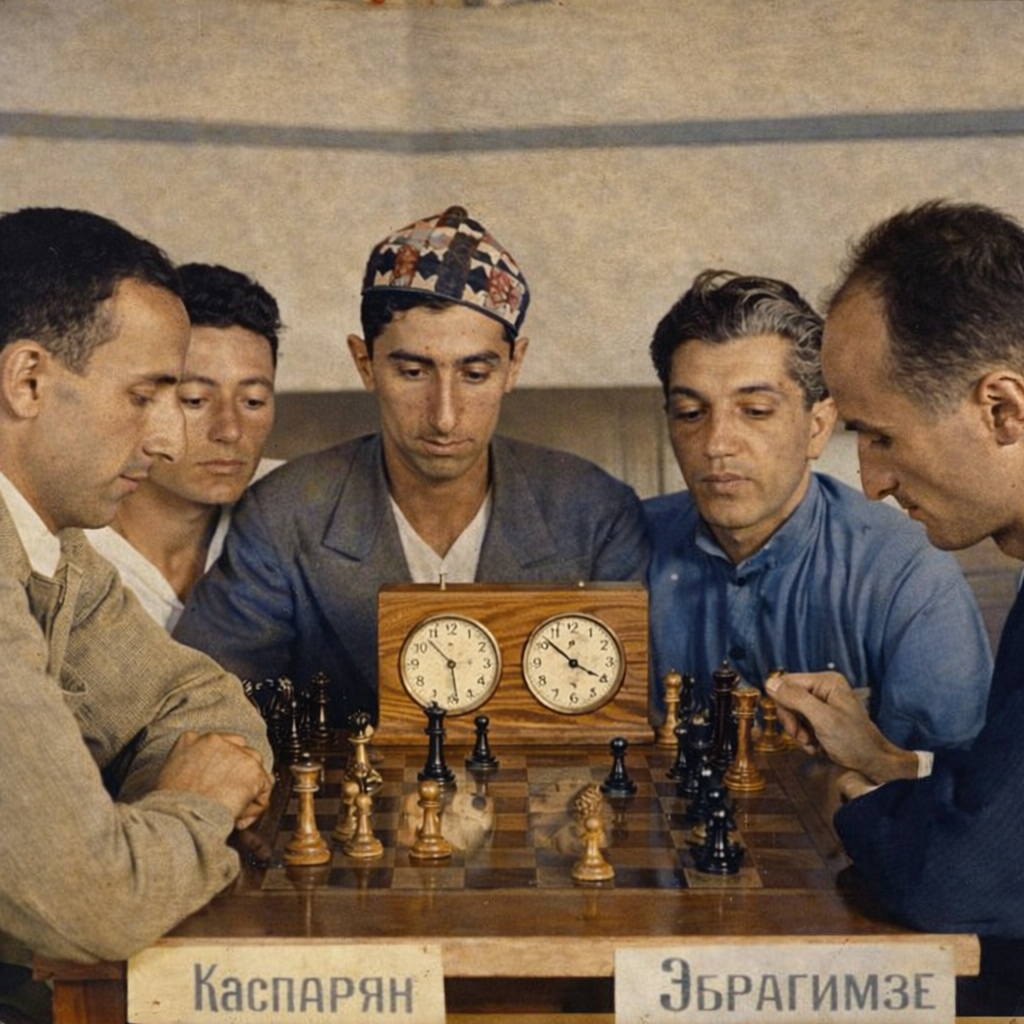
Kasparian vs Ebralidze in 1928.
Service in World War II
The outbreak of World War II interrupted Kasparyan’s chess career. He was drafted into the Red Army in July 1941 and served throughout the conflict. Stationed initially in Leninakan (Gyumri), he worked in communications and later helped maintain rail links in the Caucasus while his unit was involved in the defence of the region. Soviet accounts note that he participated in dangerous missions such as the defence of the Black Sea coast and the retreat from the Kerch Peninsula. For his service he was awarded several medals for courage. Remarkably, he still managed to play tournaments: in 1944 he won the Ordzhonikidze city championship and, late that year, competed in the Georgian championship, where he first encountered a promising teenager, Tigran Petrosian.
Post-War Chess and Rivalry with Petrosian
Returning to Yerevan after demobilisation in 1945, Kasparyan resumed competitive play. In 1946, he faced Tigran Petrosian in a match for the Armenian title; the teenager prevailed, signalling a generational shift. However, Kasparyan remained among the strongest masters for many years. He reached the final of the 15th USSR Championship in 1947, defeating players such as David Bronstein and finishing in mid-table. Later that year, he tied for second in the “Tournament of the Strongest Masters of the USSR” in Pärnu, Estonia, outscoring grandmasters Igor Bondarevsky and Salo Flohr. The Soviet Chess Federation selected him as a reserve for the national team that defeated Great Britain 15–5 in London.
Kasparyan continued to compete in USSR championship semi-finals and Armenian championships throughout the early 1950s, winning the Armenian title again in 1950 and sharing first place in subsequent years. In 1950, he was one of the inaugural recipients of the FIDE International Master title. By the mid-1950s, he recognized that his best playing days were behind him; he retired from regular tournament play in 1956, having won the Armenian championship ten times between 1934 and 1956. That same year, he was named an Honoured Master of Sport of the Armenian SSR.
Master of Endgame Composition
While Kasparyan was a formidable over-the-board player, his enduring fame rests on his endgame studies. As early as the 1920s, he was publishing compositions, and over his life, he created approximately 400–500 studies, more than half of which won prizes and awards. He won the USSR composition championship six times (1947, 1955, 1959, 1967, 1969, and 1971) and earned a silver medal in the third FIDE composition contest in 1962. His work was so widely respected that he topped the International FIDE Album ranking for compositions from 1914 to 1979. In 1956, FIDE awarded him the title of International Judge of Chess Compositions; in 1972, he became one of the first to be named a Grandmaster of Chess Composition. Chess historians consider him among the greatest endgame composers, noting that roughly 300 of his studies received prizes or honours.
Kasparyan also authored numerous books – sources cite around twenty-three volumes – covering endgame themes and historical studies. He mentored several prominent Armenian players, including Arshak Petrosian, Karen Movsisyan, Eduard Mnatsakanian, and Levon Grigoryan, thereby influencing later generations of Armenian chess. His pupils recalled that he emphasised creative problem-solving and precision, qualities evident in his own compositions.
Later Life, Recognition, and Legacy
Kasparyan spent his later years in Yerevan, continuing to compose and coach. He was celebrated nationally: Armenia issued a postage stamp in 2010 to mark the centenary of his birth, and Yerevan’s Olympic School of Chess was named in his honour. He passed away on 27 December 1995 in Yerevan and was buried at the Shaumyan-2 cemetery.
Genrikh Kasparyan is remembered as the “king of compositions” in Armenia. His combination of over the board success, wartime service, and lasting contributions to chess composition makes him a central figure in Soviet and Armenian chess history. Through his studies and students, his creative spirit continues to inspire chess enthusiasts around the world.
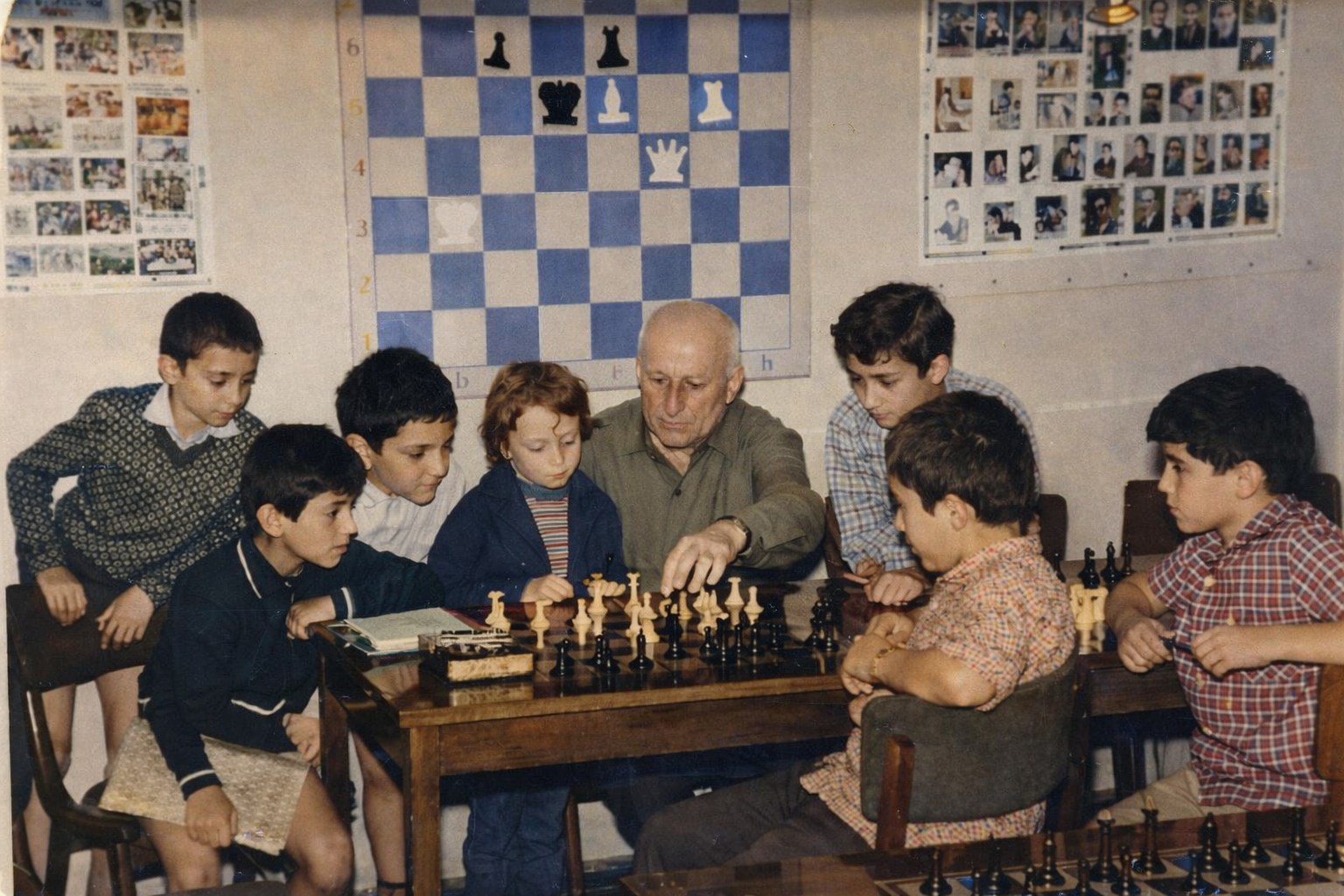
Kasparyan, Yerevan, 1973.
