Andor Lilienthal
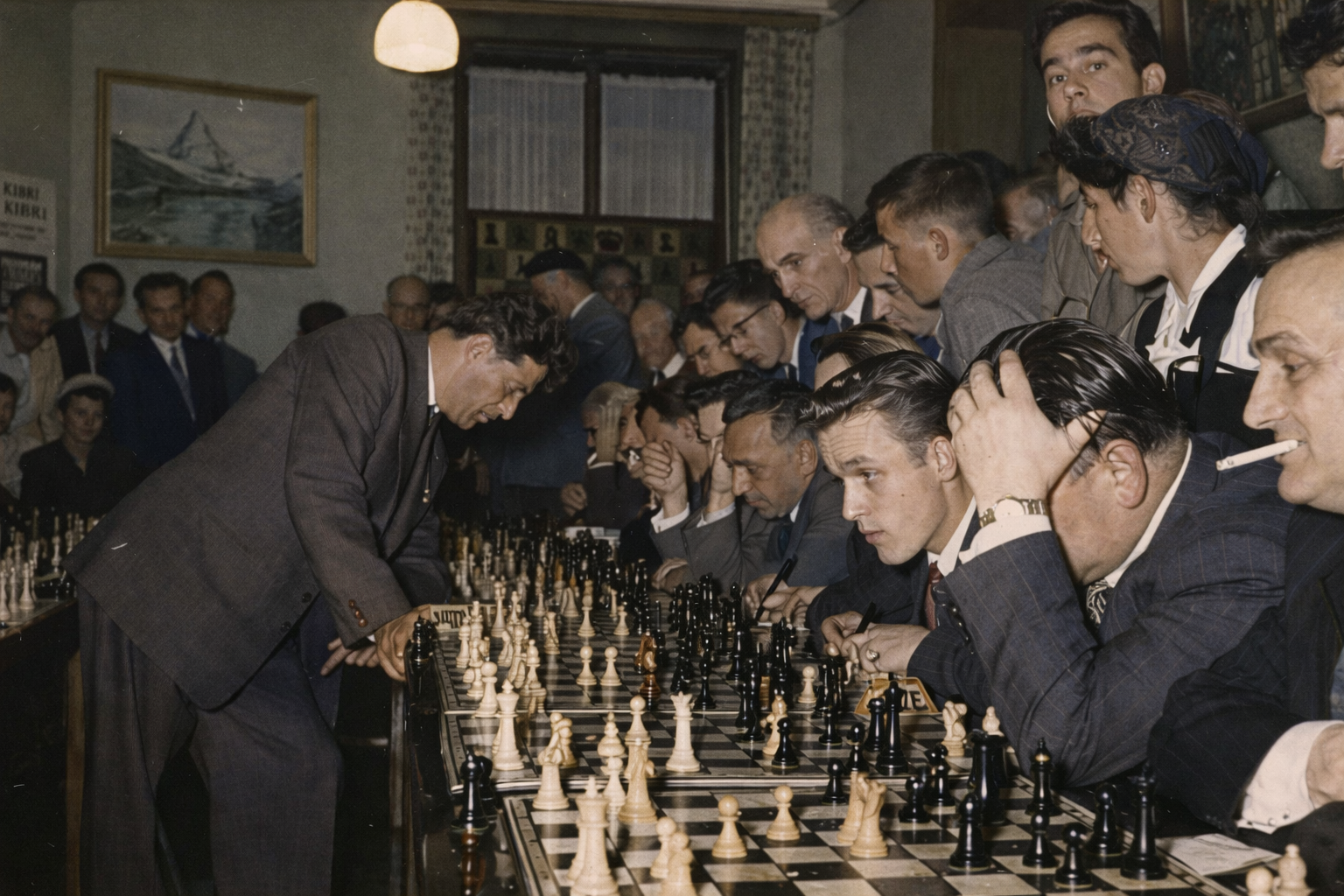
Andor Lilienthal, the standard spelling of the name you gave, is often remembered casually as the man who sacrificed his queen against Capablanca. That is true, but it is far too small a frame. He was an elite international master of the interwar years, an Olympiad star for Hungary, a Soviet championship co-winner, a 1950 Candidates participant, a trainer of Smyslov and Petrosian, a gifted annotator, and the last surviving member of FIDE’s original 1950 grandmaster class. Very few chess careers connect so many worlds at once: Budapest café chess, Parisian cosmopolitanism, Soviet elite competition, and the long afterlife of chess memory stretching from Lasker to Fischer.
Born in Moscow on 5 May 1911 to Hungarian Jewish parents and dead in Budapest on 8 May 2010, Lilienthal spent his life between national chess cultures rather than neatly inside one. He was taken back to Hungary as a small child and grew up in Budapest. He learned chess only at 16, which is unusually late for a future grandmaster, but advanced with startling speed. Early accounts place him first among Budapest café professionals and then on a migratory Central European route through Vienna, Berlin, and Paris. Historically, that matters: Lilienthal belongs to the mobile, multilingual Jewish-Central-European chess world between the wars as much as he belongs to any later Soviet narrative.
Paris was especially formative. Lilienthal later called the Café de la Régence his “chess university,” and he recalled an informal four-game blitz set there in which he beat Alekhine 3-1. That anecdote captures the texture of his formation. He did not emerge from a state academy or a carefully managed school of masters. He came up through public, practical, money-game chess, where reputations were made in smoke, speed, and improvisation. His education was social and combative before it was institutional.
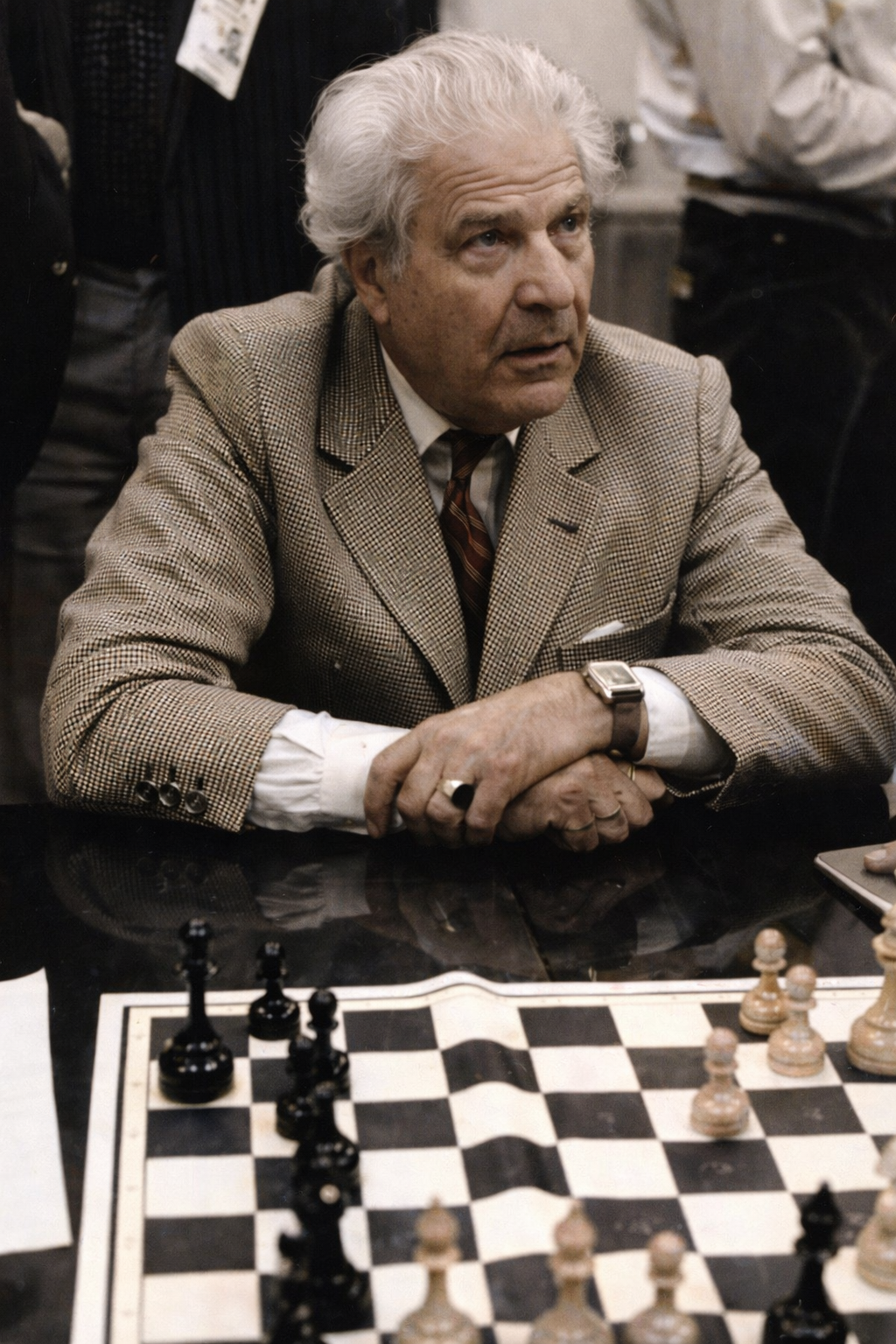
Rise into the elite
His ascent was fast enough to feel almost abrupt. In 1930 he won at Stubnianske Teplice ahead of Vasja Pirc and Salo Flohr. At Hastings 1933-34 he shared second with Alekhine, just behind Flohr. In 1934 he added first places at Ujpest and Barcelona. Then came the game by which posterity still recognizes him: the 26-move win over Capablanca at Hastings 1934-35, where Lilienthal shared fifth-sixth with Botvinnik but produced the immortal queen sacrifice beginning 20.exf6!!. By the middle of the 1930s he was not a picturesque outsider who had landed one upset. He was a fully established world-class tournament player.
The Olympiads make this even clearer. For Hungary he scored 10/13 on reserve board at Folkestone 1933, the best result on that board; 15/19 on second board at Warsaw 1935, again first on board; and 12/17 on first board at Stockholm 1937, where Hungary won team silver and Lilienthal posted the fourth-best first-board result. FIDE’s later retrospective gives him an overall Olympiad score of 75.51%. That is not the statistical residue of a colorful side character. It is the record of one of the most dependable international performers of the decade.
The move from roaming European professional to Soviet insider began at Moscow 1935. There he finished in the middle of a remarkable field and drew both Lasker and Capablanca. TWIC’s reconstruction of the event notes that he took up permanent residence in Moscow afterward; FIDE’s later profile adds the personal catalyst, that he fell in love there with Evgeniya, who became his wife. He became a Soviet citizen in 1939. Seen historically, Lilienthal’s career enacts a larger twentieth-century story: the absorption of a cosmopolitan prewar master into the Soviet chess machine, where some of his very best results were still ahead of him.
Soviet peak and competitive stature
His Soviet period was not a coda. It was his competitive summit. He finished fourth at Moscow 1936, shared third at the Leningrad/Moscow tournament in 1939, won the Moscow Championship in 1940, and tied for first in the 1940 USSR Championship with Igor Bondarevsky on 13.5/19, ahead of Smyslov, Keres, Boleslavsky, and Botvinnik. In 1941 he qualified for the USSR Absolute Championship, the compact super-elite event that effectively gathered the strongest Soviet players, and finished fifth of six. These are not fringe results. In the context of Soviet chess at that moment, they mark Lilienthal as a genuine top-tier grandmaster.
After the war he remained a serious force. Russian Chess Federation retrospectives note his participation in the famous USA-USSR radio matches of 1945 and 1946 and other major team matches of the period. Competitively, he finished third at the very strong Pärnu 1947, fifth at the 1948 Interzonal in Saltsjöbaden, and thereby qualified for the 1950 Candidates in Budapest, his only appearance at the final stage of the world championship cycle. He finished in the lower group there, tied on 7/18 with Szabo and Flohr in the ChessBase table, which effectively ended his realistic path toward a title match. Even so, his later career still had life in it: TWIC records a shared third at Moscow 1962.
That competitive arc matters because Lilienthal is often flattened into two images only: the Capablanca miniature, and the charming nonagenarian who knew everyone. The tournament record says otherwise. He was strong enough to break into the Candidates cycle, strong enough to tie for a Soviet championship, and durable enough to keep surfacing in high-level events long after his prime. His place in history is not ornamental. It rests on sustained results against the hardest opposition of his era.
Style, thought, and pedagogy
What kind of player was he? The easy answer is “tactician,” because the Capablanca game glows so brightly. But later masters who studied him saw something broader. In the foreword to the modern English edition of Lilienthal’s games, Douglas Griffin quotes Mark Dvoretsky’s judgment that the young Lilienthal was indeed a sharp attacking player, yet by the end of the 1930s he had achieved “creative harmony” and was producing classical positional games of high quality. Botvinnik described Lilienthal’s style as modest in the opening but strikingly original in the middlegame. Smyslov praised his intuition and his equal danger in positional and combinative play. Put together, those judgments suggest not a specialist, but an all-round master whose most distinctive quality was imaginative flexibility.
Lilienthal’s own self-description confirms that reading. His 1969 games collection, now available in English as Chess Survivor: The Last of the Greats, presents the games chronologically so the reader can follow what he calls his “creative path.” He explicitly characterizes the selection as varied: some games are governed by a single strategic idea from opening to endgame, some by sharp tactical skirmishes, and some by prolonged positional maneuvering. That is a revealing statement. Lilienthal did not understand his chess as a museum of sparkling combinations. He understood it as a developing body of thought. As a primary source, his book matters not just because the games are good, but because it is self-consciously pedagogical and historical at the same time.
The Capablanca game still deserves every ounce of its fame. At Hastings 1934-35, Lilienthal’s 20.exf6!! opened the e-file and turned Black’s lag in development into a fatal weakness. Capablanca resigned after 26...Kd7. Lilienthal later emphasized that the sacrifice worked not because it was flashy, but because the position justified it: the black king was vulnerable, development incomplete, and the e-file ready to become a blade. He also recalled that Capablanca smiled and congratulated him immediately. The game became immortal because it is not merely tactical candy. It is a miniature in which positional premise and tactical finish lock together like gears.
Contributions, legacy, and the strange ways memory works
If Lilienthal had stopped mattering as soon as his best tournament years passed, he would still merit a chapter in twentieth-century chess history. But he did not stop mattering. He became, instead, a transmitter. FIDE credits him with coaching Tigran Petrosian from 1951 to 1960 and serving as a second to Vasily Smyslov in Smyslov’s world championship matches against Botvinnik. TWIC and the 2024 English edition of his book likewise treat his work with Smyslov and Petrosian as central to his legacy. That two such different champions valued him is revealing. It suggests a master of unusual breadth, someone whose chess understanding could serve both Smyslovian harmony and Petrosianic restraint.
In 1976 he returned to Budapest, reportedly at his mother’s request, and remained there for the rest of his life. Russian Chess Federation retrospectives credit him with making a large contribution to Hungary’s chess boom in the later twentieth century, and they add a phrase that may be the best key to his biography: Lilienthal said he had “two homelands.” That is more than nostalgia. It is the right historical category. He was not simply a Hungarian player who later became Soviet, nor a Soviet grandmaster who happened to begin elsewhere. His life moved across chess cultures, and his identity never collapsed into just one of them.
He also became a living archive of chess memory. The 2024 English edition’s foreword stresses that he was one of the original 27 FIDE grandmasters in 1950 and the last survivor of that group, and that he met or played all the world champions of the twentieth century. Later reminiscence wrapped this in almost mythic form. When Bobby Fischer saw him in the audience during the 1992 return match against Spassky, Fischer reportedly identified him at once by blurting “Pawn e5 takes f6!”, a reference to the Capablanca game. Fischer later stayed with him for a month in Budapest. Whether one leans into the romance of that story or not, the underlying point is solid: Lilienthal became a human bridge between eras, the sort of figure who makes the distance from Lasker to Fischer feel suddenly small enough for conversation.
There is also a valuable historiographical wrinkle here, the kind of detail that gets lost when reputation hardens into legend. Some later retrospectives, including a FIDE profile and recent ChessBase writing, say that Lilienthal defeated Alekhine. The serious-game record most often cited today, however, shows a draw with Alekhine in Paris 1933 and a loss to him at Hastings 1933-34. Lilienthal’s own memoir is consistent with caution: among the games he selected, he explicitly notes one loss to Alekhine. The likeliest explanation is that his informal or blitz successes against Alekhine, especially the Café de la Régence story, were later flattened into the language of official victory. That does not shrink Lilienthal. It actually makes him a better historical subject, because it shows how chess culture turns lived experience into folklore.
Why is he still somewhat underremembered outside serious chess circles? My own reading is that he fell between the brightest lamps. He had no world-title match, no single postwar claim to be the best player alive, and a career narratively split between Hungarian and Soviet histories. He was neither the system-builder Botvinnik nor the tragic near-champion Keres nor the modernist martyr-hero Bronstein. But judged by the criteria historians actually value, strength of opposition, longevity, cross-cultural importance, pedagogical afterlife, and documentary richness, Lilienthal stands very high. He was not a charming survivor attached to one famous game. He was a major master whose games, students, and memories helped carry twentieth-century chess forward.
The title Chess Survivor is apt, but only if sharpened. Lilienthal did not merely survive the century. He carried pieces of its chess culture across borders, ideologies, and generations. He began in cafés, proved himself on the international circuit, matured inside Soviet elite competition, helped train champions, returned to Hungary as an elder statesman, and died in 2010 as the last living representative of FIDE’s first grandmaster cohort. In him, chess history does not feel like a row of disconnected reigns. It feels like one long, continuous conversation.
