Boris Gelfand
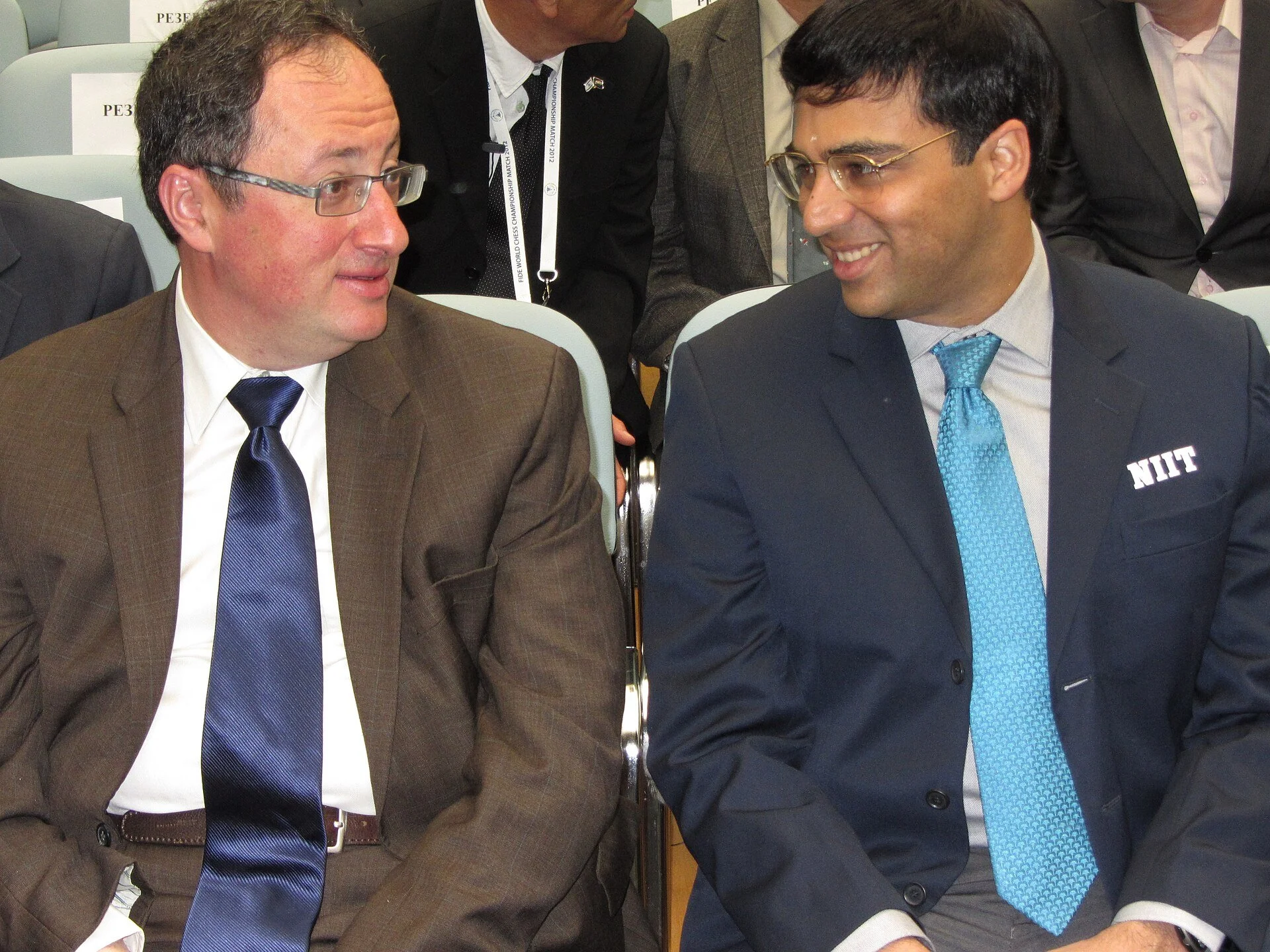
Boris Gelfand and Vishy Anand
Boris Gelfand is one of the most intellectually serious and historically revealing grandmasters of the modern era. Born in Minsk on June 24, 1968, he emerged from the late Soviet school, became a grandmaster in 1989, rose to world no. 3 in 1990, reached a peak classical rating of 2777 in 2013, challenged Viswanathan Anand for the World Championship in 2012, and on the current FIDE list remains Israel’s top-rated active player, rated 2635 in classical chess. He matters not only because of titles and rating peaks, but because his career forms a bridge between Soviet pedagogy, post-Soviet professional chess, and today’s deeply analytical training culture.
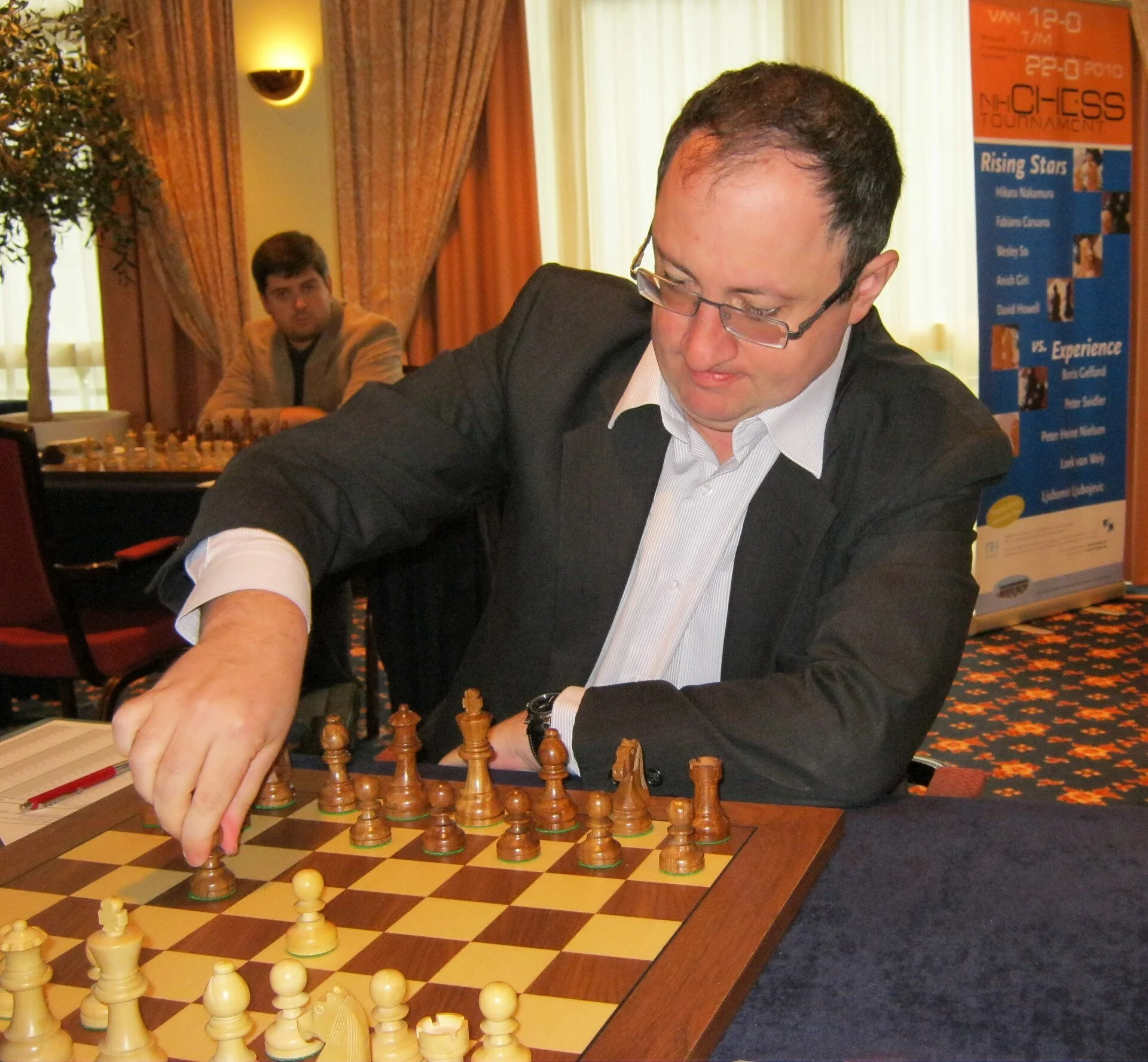
His formation was textbook Soviet in rigor but unusually intimate in texture. Gelfand has repeatedly linked the beginning of his chess life to a children’s book his father bought him, Journey to the Chess Kingdom; he studied very young, attended the Tigran Petrosian chess school from 1980 to 1983, and by his mid-teens was already collecting serious results: the Sokolsky Memorial in 1983, Belarusian championship titles in 1984 and 1985, the USSR Junior Championship in 1985, the European Junior title in 1987, and a tie for first in the 1988 World Junior, where he lost the title on tiebreak. The pattern is already visible here: technical depth, strategic seriousness, and almost no wasted motion.
The move from Soviet Minsk to Israeli chess culture enlarged his historical significance. Gelfand made aliyah in 1998 and later settled in Rishon LeZion, becoming the central elite figure in Israeli chess for a generation. That mattered because Israel had strong grandmasters but had not previously produced a player who would go all the way to a world title match. In Gelfand, Israeli chess acquired not merely a leading player but a national standard-bearer.
His rise to the elite was swift. By 1989, he was already a grandmaster; in 1990, he hit full world-class velocity, reaching no. 3 in the world, finishing second behind Garry Kasparov at both Linares and Dortmund, sharing first at the Manila Interzonal, and helping the USSR win Olympiad gold while going undefeated on board two. That year is the cleanest proof that Gelfand was never merely a “solid” player who aged into greatness. He was, from early adulthood, a genuine super-elite contender.
The 1990s and 2000s show the next layer of his profile: durability. He won the 1993 Biel Interzonal undefeated, then in the 1994 Candidates cycle defeated Michael Adams and Vladimir Kramnik before losing the final to Anatoly Karpov. Over the following decade, he kept reappearing in elite company and continued to win major events, including the Rubinstein Memorial in 1998 and 2000, Malmö in 1999, Pamplona in 2004, and Biel in 2005. In the 2007 World Championship tournament in Mexico City, he scored 8/14, level with Vladimir Kramnik and just behind Anand’s 9/14, finishing effectively tied for second and third on tiebreak. That long middle phase is essential to understanding him: Gelfand did not flash and disappear; he remained structurally relevant to the world-title conversation for nearly two decades.
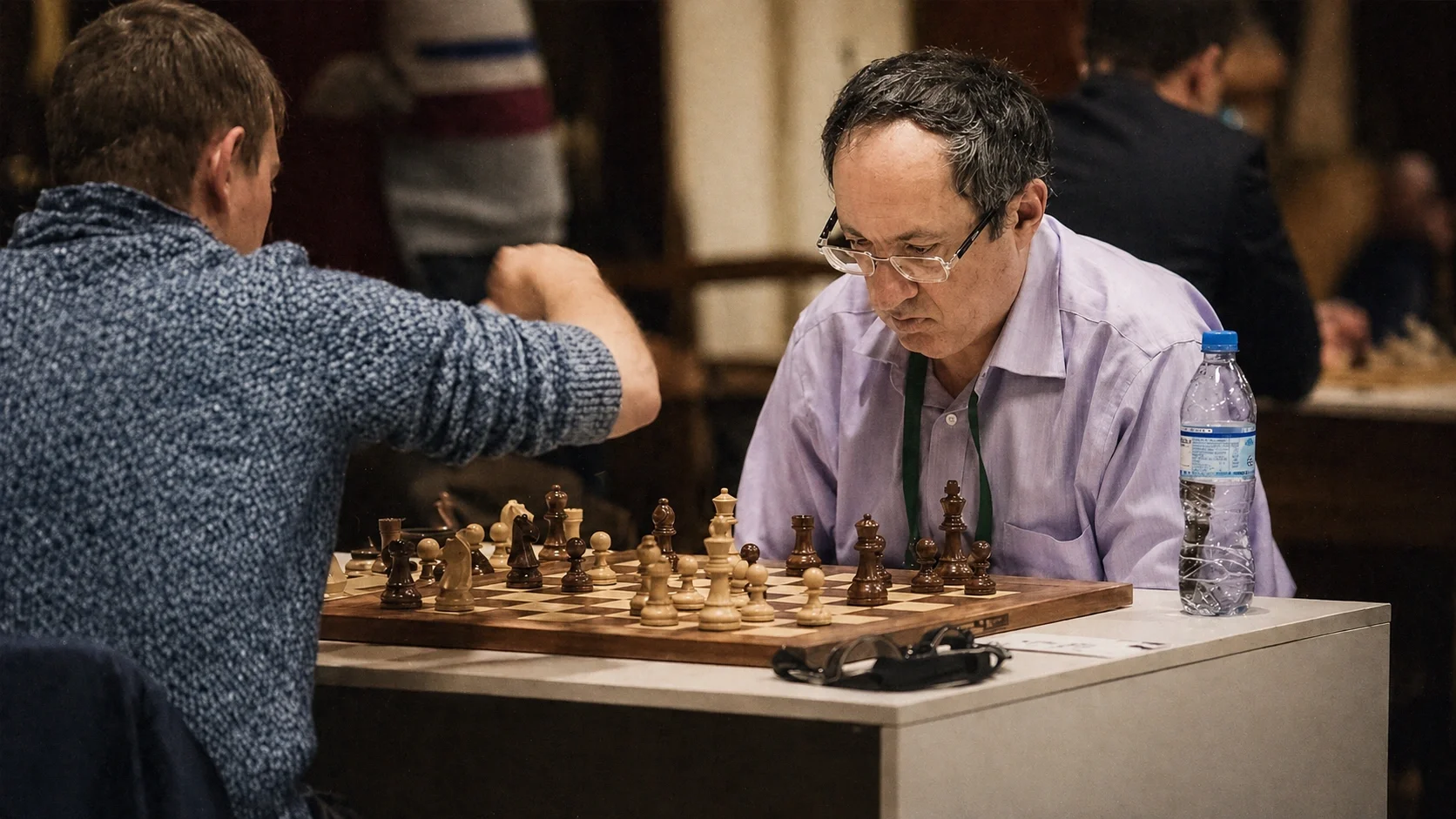
The great late-career crest came from 2009 to 2013. He won the 2009 FIDE World Cup by defeating Ruslan Ponomariov 7-5 after tiebreaks, then won the 2011 Candidates Matches by beating Shakhriyar Mamedyarov, Gata Kamsky, and Alexander Grischuk, earning the right to challenge Anand. In the 2012 World Championship match in Moscow, the classical portion ended 6-6 after twelve games; Anand then won the rapid tiebreak 2.5-1.5. Gelfand’s match is remembered for both its quality and its drama: he won game 7, then immediately lost game 8 in just 17 moves, the shortest decisive game in world championship history. Far from being the end of the story, he followed it with one of the finest years of his life in 2013, sharing first in the Alekhine Memorial, winning the Tal Memorial outright against a field including Magnus Carlsen and Anand, sharing first in the Paris Grand Prix, and reaching his peak rating of 2777.
His longevity is extraordinary. Chess.com’s profile notes that he remained in the world top 30 for nearly twenty-seven years, from January 1990 to October 2017, and FIDE’s own ratings retrospective places him in the world top 10 in 2001 while still listing him among active elite players decades later. This matters because longevity at that level is not just a matter of talent. It implies adaptation across opening revolutions, computer revolutions, political transitions, and generational turnover. Gelfand survived all of them.
As a player, he is often labeled “positional,” but that word is a little too small for him. Gelfand himself has resisted fixed stylistic branding, arguing in effect that each position demands its own strongest move, and strong observers have described him as both deeply classical and genuinely universal. His games reveal a player governed by strategic logic, an excellent sense of transformation, and unusual consistency in carrying out a positional concept once he has identified it. Databases of his play show recurring attachment to 1.d4 and Catalan-type structures as White and to defenses such as the Najdorf as Black, yet the 2012 match also showed his willingness to surprise at the highest level with Sveshnikov and Grünfeld choices. He belongs to that narrow class of grandmasters whose opening work, middlegame plans, and endgame technique feel like one continuous sentence rather than separate chapters.
His team career is nearly as impressive as his individual one. He played in 11 Olympiads across the Soviet, Belarusian, and Israeli phases of his career, including gold for the USSR in 1990. For Israel, he was a pillar, helping the team to silver in Dresden in 2008 and bronze in Khanty-Mansiysk in 2010; in Dresden, he also took individual silver on board one with a 2833 performance rating. Team results matter especially in Gelfand’s case because they reveal a trait visible throughout his career: he was not just a collector of personal results, but a stabilizing force, the kind of first board member who made a federation more dangerous simply by sitting down.
His contributions beyond over-the-board play are substantial and unusually important. Gelfand became one of the strongest chess authors of the last decade through books such as Positional Decision Making in Chess, Technical Decision Making in Chess, and Decision Making in Major Piece Endings, most of them produced with Jacob Aagaard. These books are not ordinary game collections. They are attempts to expose elite decision-making from the inside: how a world-class player weighs plans, converts small advantages, navigates technical endgames, and avoids what Gelfand calls zones where a single mistake can spoil the position. Positional Decision Making in Chess was named English Chess Federation Book of the Year, and US Chess praised the series for breaking new ground by giving readers rare access to top-echelon positional thinking. In an era when many chess books are either engine dumps or motivational varnish, Gelfand’s are serious manuals of judgment.
He has also become an influential teacher and mentor. ChessBase reported that in 2019 and 2020, he and Vladimir Kramnik worked with leading Indian juniors in Chennai, and later, in a report in The Indian Express, described Gelfand helping at the Westbridge Anand Chess Academy and occasionally with India’s national team training camp. The same report clearly describes his method: not merely giving moves but explaining decisions, dissecting recent games, and showing players how to adjust their thinking. Separate reporting has noted that R. Praggnanandhaa trained with him briefly. This is a fitting second life for Gelfand. His competitive virtue was never theatrical dominance; it was lucid thought under pressure. That virtue transfers beautifully to coaching.
There is also a cultural Boris Gelfand, not just a competitive one. His 2012 title match inspired the documentary Album 61, built partly around the 61 photo albums his father kept chronicling his development, and the film’s premise captures something central about him: Gelfand’s career can be read not only as a sequence of tournaments, but as a story about memory, family discipline, migration, and the survival of a certain old-world seriousness inside modern chess. His world-title run also helped spark fresh interest in chess in Israel, where he explicitly hoped his success would broaden respect for the game.
So the best way to understand Boris Gelfand is this: he was not the defining conqueror of his age, but he was one of its defining intelligences. He is a world-championship challenger, a World Cup winner, a Candidates winner, a decades-long elite player, a national icon in Israeli chess, a major team competitor, a first-rate author, and a mentor to the next wave. Plenty of players leave behind brilliant games. Gelfand leaves behind something rarer: a model of how to think, how to persist, and how to turn chess from performance into craft.
