David Bronstein
Early Life and Education
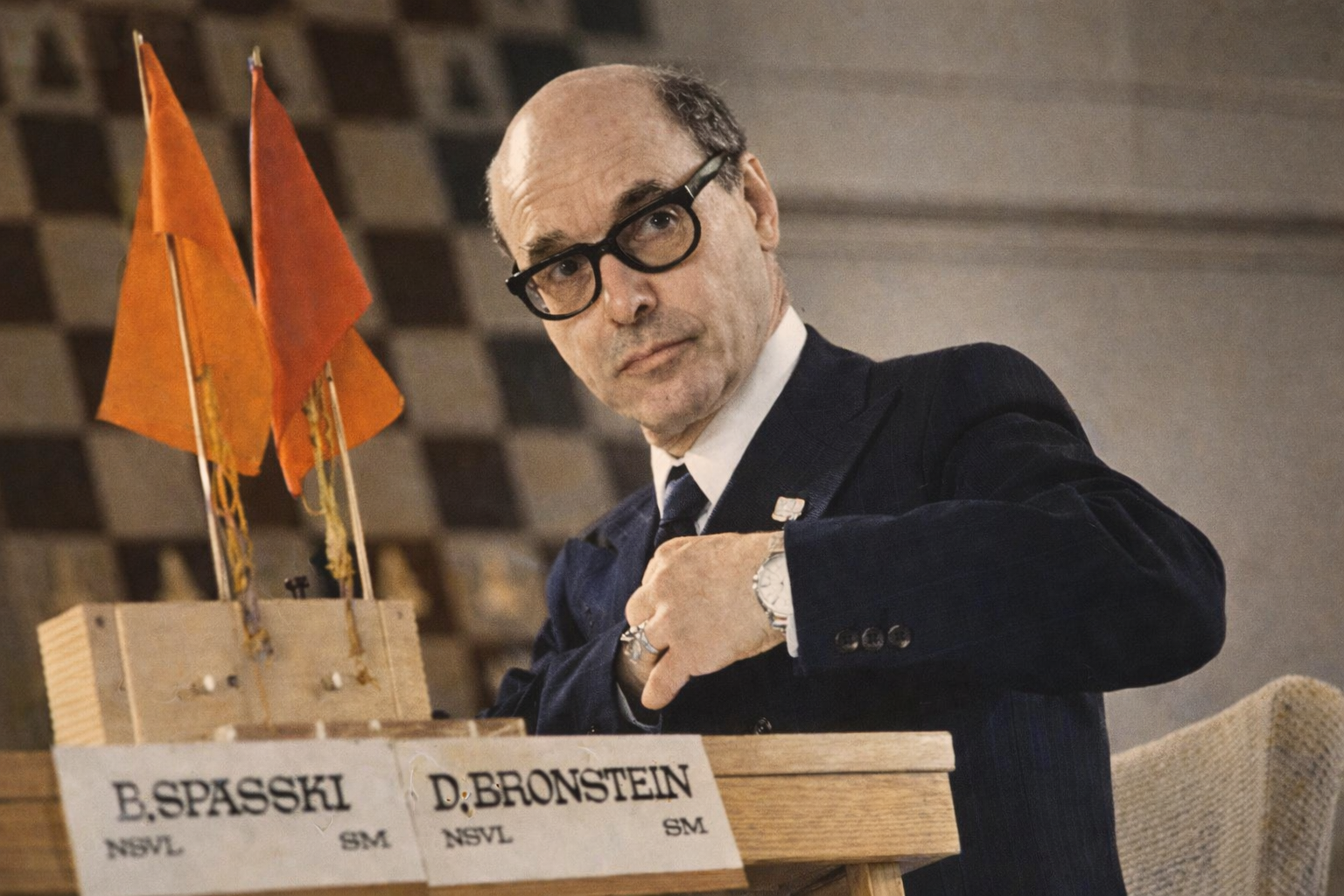
David Ionovich Bronstein was born on 19 February 1924 in Belaya Tserkov, Ukraine (then part of the Soviet Union). Shortly after, his family moved to Kyiv, where young David learned chess at age six from his grandfather. He grew up in a Jewish family during a perilous era; in 1937 his father, Johonon Bronstein, was arrested as an “enemy of the people” under Stalin’s purges. (Notably, Leon Trotsky’s original surname was Bronstein, and it was rumored that David’s family was related to Trotsky—though Bronstein later expressed doubt about this connection.) His father spent seven years in the Gulag before being released in 1944 due to ill health. These harsh experiences and a keen intellect shaped Bronstein’s character early on.
In Kyiv, Bronstein’s chess talent flourished. As a teenager he trained under the renowned master Alexander Konstantinopolsky, and by age 15 he placed second in the Kyiv city championship. At 16, he earned the title of Soviet Master after finishing runner-up (behind his close friend Isaac Boleslavsky) in the 1940 Ukrainian SSR Championship. His formal education was disrupted by World War II – he had planned to study mathematics at Kyiv University, but the 1941 Nazi invasion intervened. Bronstein was deemed unfit for military service due to poor eyesight; instead, he worked in a military hospital and on rebuilding projects during the war. Despite the turmoil, Bronstein continued to hone his chess, emerging from the war years as one of the Soviet Union’s brightest young masters.
Rise in Soviet Chess and Road to the World Championship
After World War II, Bronstein quickly ascended the ranks of Soviet chess. In his first USSR Championship final (Moscow 1944) he made an impression by defeating the tournament winner (and future world champion) Mikhail Botvinnik in their individual game. By 1945, Bronstein placed third in the Soviet Championship and earned a spot on the Soviet team for the famous 1945 USA–USSR radio match, where he won both his games. He soon proved himself a mainstay among the Soviet elite with strong showings in team matches and domestic events. Bronstein tied for 1st place in the 1948 Soviet Championship (with Alexander Kotov) and again in 1949 (with Vasily Smyslov), confirming his status as a top Soviet grandmaster. In 1950 he was awarded the title of International Grandmaster by FIDE.
Bronstein’s biggest breakthrough came in the 1950 Candidates Tournament—the event to decide the challenger for the world title. Held in Budapest, it ended in a tie for first between Bronstein and his friend Boleslavsky. In a hard-fought playoff match in Moscow later that year, Bronstein prevailed, earning the right to challenge World Champion Mikhail Botvinnik. At 26 years old, Bronstein thus became the Soviet Union’s great hope to continue Soviet dominance of the championship established by Botvinnik in 1948. Notably, the Soviet chess establishment was ambivalent about Bronstein’s candidacy: he was brilliant but also the “Jewish son of a state criminal” (as his father’s status was viewed), in contrast to Botvinnik, a model Soviet citizen and Communist Party member. This dynamic set the stage for one of the most dramatic world championship matches in chess history.
The 1951 World Championship Match vs. Botvinnik
Bronstein’s title match against Mikhail Botvinnik took place in Moscow in 1951. It was a grueling 24-game contest that swung back and forth between the two evenly matched opponents. Bronstein approached the match with ambitious preparation and psychological insight. He deliberately steered the games into unusual opening variations – often adopting Botvinnik’s own preferred lines rather than those Bronstein had played previously – in order to surprise the champion. This strategy succeeded in unsettling Botvinnik, who had been inactive in competition since 1948. The games were fought hard “to a clear finish” with no quick grandmaster draws. In fact, every game except the finale featured dynamic, double-edged play. Bronstein’s tactical genius shone especially: four of his five victories in the match came from deep combinational attacks that brought decisive results before the adjournment (i.e. without needing next-day analysis).
Midway through the match, each player had held the lead at different times. A critical moment came in Game 6: in a level endgame position, Bronstein mysteriously fell into a 45-minute think and then blundered catastrophically, losing immediately. This uncharacteristic error puzzled observers (one anecdote suggests Bronstein may have felt someone in the audience, possibly an “unofficial” presence, influencing his nerves). Indeed, Bronstein’s father – still officially banned from Moscow due to his past imprisonment – was secretly in the audience during the match, placed conspicuously in his son’s line of sight. Whether this was intended as intimidation or simply allowed as a favor, the psychological weight on Bronstein was immense. Nevertheless, Bronstein demonstrated resilience. In Game 9, after a miscalculation left him a full rook behind with little compensation, his inventiveness was enough to bamboozle Botvinnik and escape with a draw – a testament to Bronstein’s resourcefulness even in lost positions.
As the match neared its conclusion, Bronstein held a slender lead. After 22 games, the score stood 11½–10½ in Bronstein’s favor. He needed only one point from the final two games to become world champion. Botvinnik, however, won Game 23 in an tense endgame, leveling the match. The 24th and final game was drawn after a battle where neither player risked everything. The match thus ended tied 12–12 (each had won 5 games with 14 draws), meaning Botvinnik retained his title by rule. Bronstein had come within a hair’s breadth of the crown – one accurate move in Game 23 might have altered chess history.
Controversy and Psychological Pressure
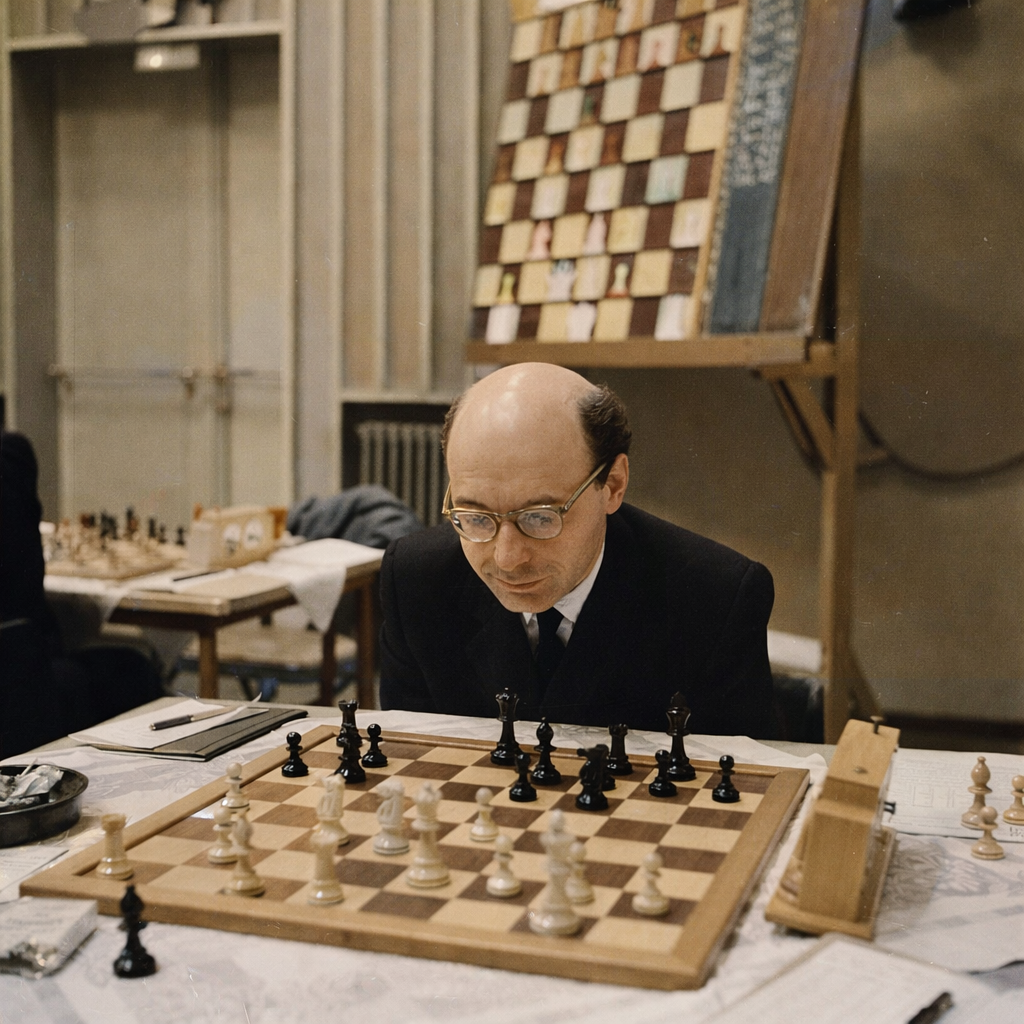
The 1951 match has long been the subject of speculation and intrigue in chess history. Given the political context, Soviet authorities were reportedly nervous about the prospect of Botvinnik losing to Bronstein, who did not fit the ideal Soviet image. Decades later, Bronstein addressed the inevitable question: was he pressured or even forced to throw the match? In his memoirs, Bronstein stopped short of confirming any outright conspiracy, but he did write: “I was subjected to strong psychological pressure from various sources… It was entirely up to me to yield to that pressure or not”. He cryptically added that he had “reasons not to become the World Champion” because the title came with heavy bureaucratic obligations that did not suit his free-spirited character. This statement suggests that Bronstein felt a mixture of external pressure and personal reluctance. Chess historians still debate the extent of Soviet interference; Bronstein himself preferred to “leave it at that”.
Regardless of the rumors, Bronstein’s performance in 1951 was extraordinary. He demonstrated that his fluid, creative style could hold its own against Botvinnik’s rigorous scientific approach. Many regard him as the greatest player never to become World Champion, and indeed for the rest of his life Bronstein rued missing not the title per se (which is temporary), but “not having the lifelong title of ex-World Champion”. Chess legend Garry Kasparov, a fervent admirer, opined that based on play alone “Bronstein should have won the 1951 match”. The narrow defeat did nothing to diminish Bronstein’s legacy as a chess artist at the pinnacle of the game.
Post-1951 Career and Major Tournaments
Although he never again played a world championship match, Bronstein remained a top contender through the 1950s and into the 1960s. In the 1953 Candidates’ Tournament in Zurich, he once again came agonizingly close to another title shot. Bronstein fought for first place throughout the event and finished tied for 2nd–4th, just two points behind Smyslov. (He, Paul Keres, and Samuel Reshevsky all trailed Smyslov, who earned the right to challenge Botvinnik.) Bronstein’s brilliant play in Zurich was immortalized by his own pen (see Writings section below). However, behind the scenes the Soviet team dynamic was complex. It has since emerged that Soviet chess officials pressured their players to collude at Zurich 1953 – specifically, urging quick draws among Soviets and fierce play against the non-Soviet (Reshevsky) to ensure a Soviet winner. In his final book, Secret Notes (2007), Bronstein revealed that he and Keres were pressured to agree short draws with Smyslov in the closing rounds, to smooth Smyslov’s path to first place ahead of Reshevsky. Bronstein complied with these directives to an extent (he did defeat Reshevsky in their critical game – see Game 2 below), but such collusion left a sour taste. He later called the Zurich tournament “very special in a negative sense” due to the behind-the-scenes machinations.
Bronstein continued to be a formidable competitor in subsequent world championship cycles, though often thwarted by circumstance. He won the Gothenburg Interzonal 1955 undefeated, but in the 1956 Candidates (Amsterdam) he had to settle for a tie for 3rd–7th. In the 1958 cycle, Bronstein narrowly missed qualifying for the Candidates: at the Portorož Interzonal he was leading the field but lost his final game to an unknown Filipino player, Rodolfo Cardoso, in a distraction-filled environment (a thunderstorm knocked out power during play). This upset cost him a Candidates spot by half a point. In the 1962 cycle, Bronstein failed to advance out of the Soviet Zonal, and in 1964 he again came heartbreakingly close – at the Amsterdam Interzonal he scored well but was a victim of the FIDE rule limiting three qualifiers per country: he finished behind three fellow Soviets (Smyslov, Tal, Spassky) despite a high placing. Bronstein’s final Interzonal was in 1973 (Petropolis) at age 49, where he finished a respectable 6th.
Outside the world championship, Bronstein amassed a superb tournament record. He twice won the USSR Championship (1948 and 1949, both tied for first) and was runner-up twice more (1957 and the 1964–65 final). He dominated team events: representing the USSR in four Chess Olympiads (1952, 1954, 1956, 1958), he won four team gold medals and never lost a single game until his final Olympiad (an astounding +19 –0 =29 overall record). In the 1954 USSR–USA team match in New York, Bronstein achieved a perfect 4–0 score on second board. He also notched numerous international tournament victories over the years. For example, Bronstein took first at Hastings 1953–54 (England) and Belgrade 1954, and later won events such as Gotha 1957, East Berlin 1968, and Sarajevo 1971, among others. Even as late as the mid-1970s, he was competitive: in 1976 he tied for first at a strong tournament in Wijk aan Zee, and remarkably in 1994–95, at age 70, he tied for first in the Hastings Swiss Open. Bronstein remained an active and beloved figure in chess well into his senior years, playing in small open tournaments alongside amateurs simply “because he loved playing chess”. He passed away in December 2006 in Minsk, Belarus, leaving behind a legacy of brilliance that spanned over five decades.
Contributions to Chess Theory and Innovation
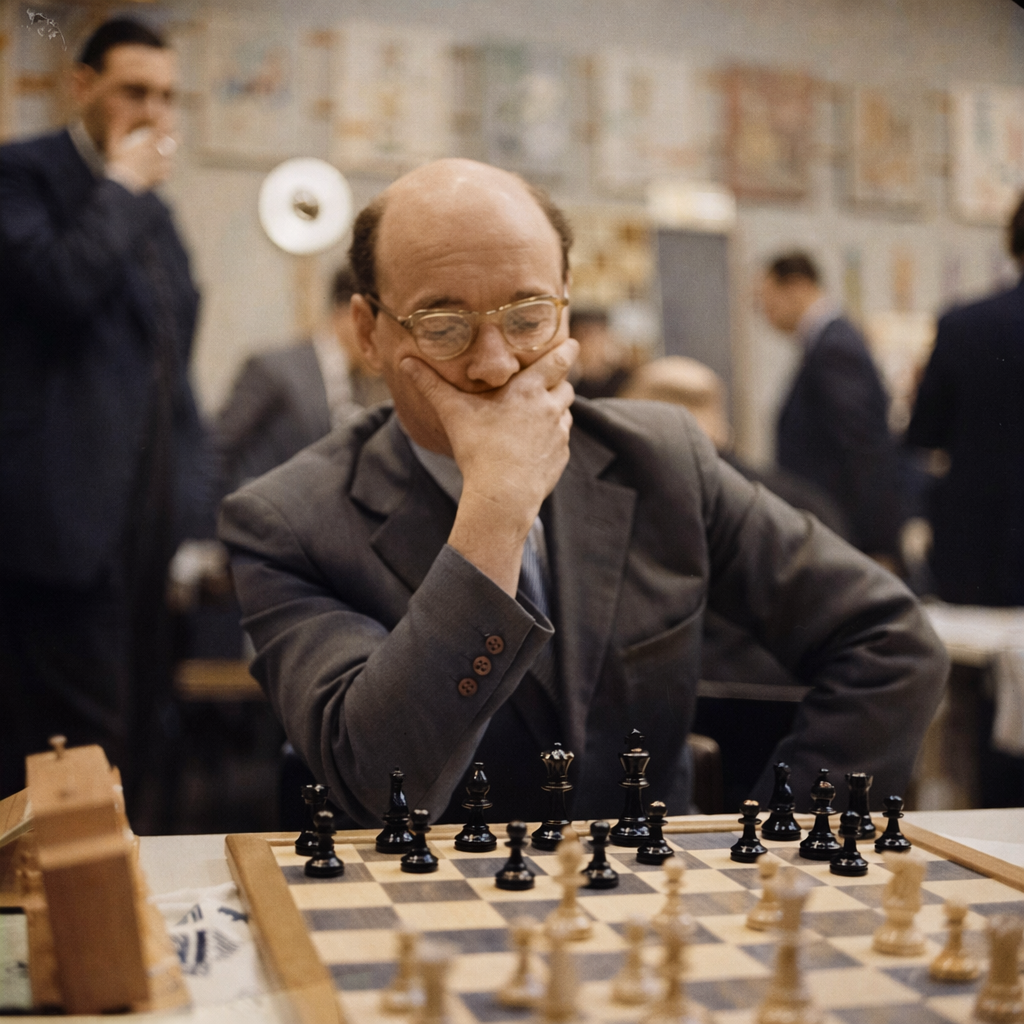
Bronstein’s influence on chess theory is profound, spanning openings, endgames, and even time-control rules. He was a natural experimenter who sought creative paths in every phase of the game.
Opening Innovations: Perhaps Bronstein’s most significant theoretical contribution was his pioneering work on the King’s Indian Defense. In the 1940s, the King’s Indian (a counterattacking defense as Black against 1.d4) was viewed with skepticism by many top players, considered a risky and “irregular” line. Bronstein, together with his friend Boleslavsky, transformed the King’s Indian from an obscure system into a fearsome mainstay of grandmaster practice. He persistently employed and refined this defense against elite competition, demonstrating its viability through numerous brilliant games. The dynamic kingside assaults and pawn storms typical of the King’s Indian suited Bronstein’s fighting style. Thanks in large part to him, future World Champions like Tal, Fischer, and Kasparov would adopt the King’s Indian as a key weapon. Bronstein’s name is attached to opening ideas in other systems as well. For example, in the Caro–Kann Defense, the aggressive 4…Nf6 line in the Classical Variation (1.e4 c6 2.d4 d5 3.Nc3 dxe4 4.Nxe4 Nf6) with 5.Nxf6+ gxf6 is known as the “Bronstein–Larsen Variation”, reflecting Bronstein’s and Bent Larsen’s advocacy of this daring setup. Bronstein also loved gambits and offbeat attacks: he frequently experimented with the King’s Gambit and even the eccentric Bronstein Gambit (1.d4 Nf6 2.g4!?), though he mostly reserved such romantic openings for casual or speed games. His theoretical bent was not just in inventing moves, but in demonstrating by example that dynamic, sacrificial play in the opening could be perfectly sound.
Middlegame and Endgame Concepts: Bronstein was celebrated as a tactical genius and an artist of the middlegame. He had a rare ability to conjure unexpected ideas and find resources in complex positions. Many of his games feature imaginative sacrifices – from pawns to full exchanges – for long-term positional compensation. For instance, in the first game of his 1950 Candidates playoff, he famously offered a far-sighted exchange sacrifice, giving up a rook for a minor piece to shatter Boleslavsky’s pawn structure and seize the initiative, leading to a beautiful strategic victory. Such ideas were ahead of their time and have since become standard weapons in modern chess. In simple looking positions, Bronstein always looked for hidden dynamics. It is ironic that Botvinnik criticized Bronstein for allegedly underestimating endgames and “lacking ability in simple positions”, because Bronstein often excelled at unorthodox endgame play. On multiple occasions he saved half-points from objectively lost endgames by setting ingenious traps and complications (as in the 1951 Game 9 escapade where, a rook down, he still managed a draw through tactical trickery). Bronstein had deep insight into the practical side of endgames: for example, he understood the power of connected passed pawns as compensation for material. In a 1954 game against Miguel Najdorf (see Game 1 below), Bronstein sacrificed a piece to obtain three united passed pawns on the queenside, noting that “in the endgame, three connected passed pawns are generally superior to a knight or bishop”. However, he also cautioned that in the middlegame the extra piece can counterattack before the pawns become mobile. This kind of nuanced evaluation was a hallmark of Bronstein’s analytical contributions. If Bronstein had a relative weakness, it was classical technical endgames (where Botvinnik indeed managed to outplay him in 1951 by grinding down nearly equal endings). But in dynamic endgame situations with pieces still on the board, Bronstein’s creativity often carried the day. His games and writings stressed active piece play over passive defense – a principle now common in endgame manuals.
Time Control Innovation: Beyond the board, Bronstein was an innovator in how chess is played. He is credited with inventing the “Bronstein delay” method of time control on chess clocks. This timing system, now standard in many digital clocks, adds a fixed delay per move to avoid losses on time in won positions. Unlike a simple increment that always adds a full preset time, Bronstein’s idea was that if a player moves faster than the delay, only the actual time used is added – meaning one cannot increase one’s clock time by playing ultra-fast moves. For example, with a 10-second Bronstein delay, if a player uses 5 seconds on a move, 5 seconds (not the full 10) is returned to the clock; if they use the full 10 or more, then 10 seconds is added after the move. This elegant solution (sometimes called “delay” or “Bronstein mode”) prevents flag-fall in completely won positions while also discouraging abuse of the clock. Bronstein proposed such ideas long before digital clocks existed – a forward-thinking attempt to improve competitive fairness. Chess historians note that Bronstein and Bobby Fischer independently developed the modern increment/delay concepts that are now ubiquitous in chess clocks. The Bronstein delay stands as a direct, practical legacy of his innovative mind.
Chess Writing and Literary Legacy
In addition to his over-the-board artistry, Bronstein was a highly esteemed chess author and teacher. He wrote a number of influential books that are cherished by chess historians and enthusiasts alike. His most famous work is “Zurich International Chess Tournament 1953”, originally published in Russian as Международный турнир гроссмейстеров (1956) and later translated as The Chess Struggle in Practice. This book, a round-by-round account of the legendary 1953 Candidates Tournament, is widely considered one of the greatest chess books ever written. Bronstein annotated all 210 games of the event, sharing profound insights into the middlegame plans and psychology of the contenders. Rather than presenting dry analysis, Bronstein’s writing invites the reader to “watch ’em play” and enjoy the drama of each battle. His style is vividly instructive and entertaining, emphasizing ideas over exhaustive theory. As GM Alex Yermolinsky noted, Bronstein’s book shows an “absolute disregard for dogmatic theorizing” and simply lets the games speak, which has helped generations of players to appreciate chess at a deeper level. Many consider Zurich 1953 the finest tournament book in chess literature; it went through countless reprints in the Soviet Union and remains a staple on chess bookshelves worldwide. (Bronstein later revealed that the literary polish of the book was aided by co-author Boris Vainstein, who contributed much of the elegant prose, while Bronstein provided the analysis and commentary. Vainstein’s name was left off the original edition due to his own troubles with Soviet authorities.)
Bronstein authored or co-authored several other classics. His “The Sorcerer’s Apprentice” (co-written with Tom Fürstenberg, 1995) is a delightful collection of his best games, filled with anecdotes and “easy-to-understand annotations” explaining his creative thought process. He published a witty instructional book called “200 Open Games”, presenting 200 games beginning with 1.e4 e5 (double king-pawn) with lively commentary that highlights the ideas behind the moves. In “Modern Chess Self-Tutor” (1995), Bronstein delved into how grandmasters actually decide on moves, sharing his views on chess psychology and decision-making. True to his reputation as an openings pioneer, he wrote “Bronstein on the King’s Indian” (1999), distilling decades of experience with that defense. Even in his later years, Bronstein continued writing: “Secret Notes” (2007, published posthumously) gives memoir-like reflections on players like Larsen, Spassky, Korchnoi, and reveals behind-the-scenes stories (including the collusion at Zurich 1953). Another work, “Chess in the Eighties”, co-authored with a psychologist, discusses the evolution of chess as a sport versus an art, and Bronstein laments the increasingly competitive, money-driven aspect of chess at the expense of creativity. This theme was dear to Bronstein – he always championed the artistic beauty of chess over pure result-oriented play.
Beyond books, Bronstein was for many years a columnist in the Soviet newspaper Izvestia, where he reached a wide audience with instructional columns and commentary on current chess events. His writings are marked by a conversational tone, humor, and a love for the game that inspires readers. For example, Bronstein once advised an eager young player: “You do not analyze during a game; you analyze before and after. During the game, you just play.” – encapsulating his philosophy of intuitive creativity at the board. Bronstein’s literary legacy, crowned by Zurich 1953, has influenced countless chess enthusiasts and even other great players (Fischer and Kasparov both admired his books). Today he is remembered not just as a great player, but as a great teacher of the game through his writings.
Soviet Chess Politics and Personal Struggles
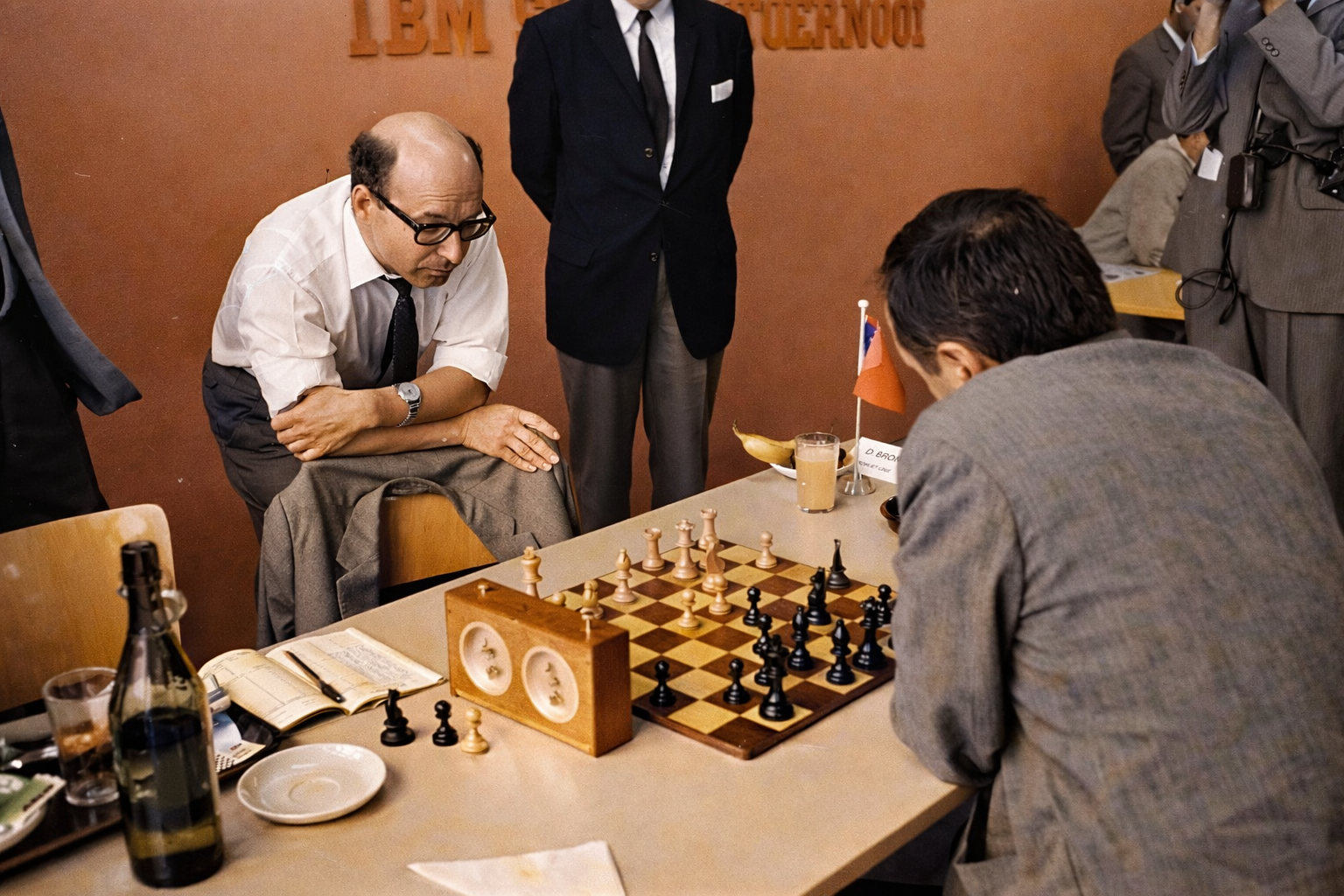
As a leading Soviet grandmaster in the Cold War era, Bronstein inevitably found himself entangled with the politics of the Soviet chess hierarchy. His career offers a fascinating case study of an independent, creative spirit navigating the constraints of an authoritarian system that both celebrated and controlled its chess stars.
From the outset, Bronstein’s background made the authorities wary. He was Jewish and his family had been persecuted (his father’s unjust imprisonment in 1937 was only officially acknowledged as wrongful decades later). Moreover, the mere possibility that Bronstein might be related to Leon Trotsky – a chief enemy of Stalin – cast a shadow of suspicion. In the late 1940s, Stalin elevated chess as a matter of state prestige (the “Five Year Plan” for chess) with the goal of Soviet dominance. Botvinnik’s world championship victory in 1948 was heralded as a triumph of the Soviet system. When Bronstein earned the right to challenge Botvinnik in 1951, Soviet chess apparatchiks grew uneasy. Botvinnik was the model Soviet citizen-champion – an “ideal” Communist who even sent Stalin a telegram of gratitude after a tournament win. Bronstein, by contrast, did not fit the mold: not a Party member, of suspect family lineage, and artistically minded, he was less politically reliable. How would it look, officials wondered, if the cherished world title passed to Bronstein? This backdrop fueled the psychological pressures surrounding the 1951 match (discussed earlier) and may explain certain anomalies. It is telling that Bronstein’s parents were seated prominently during the match – possibly a reminder of what was at stake. After the narrow outcome, Botvinnik remained champion, which surely relieved the Soviet establishment. Bronstein himself later intimated that becoming World Champion in those times would have forced him into an “official world of chess bureaucracy” that he did not desire.
In the years that followed, Bronstein’s relationship with Soviet authorities remained delicate. Although he continued to compete and represent the USSR (loyally contributing to team victories), he often faced bureaucratic hurdles. A notable example was the rule limiting the number of Soviet players who could advance from Interzonals, which cost Bronstein a spot in the 1964 Candidates despite his high finish. Some contemporaries felt such rules were sometimes applied to sideline “undesirable” contenders. Bronstein also experienced long periods of being refused permission to travel internationally, especially in the 1970s. The most blatant incident came in 1976 when Viktor Korchnoi, a leading Soviet grandmaster, defected to the West. The Soviet Chess Federation circulated a letter condemning Korchnoi, expecting all Soviet masters to sign. Bronstein boldly refused to sign this denunciation. The repercussions were swift: he was stripped of his stipend (Soviet masters were state-salaried) and banned from competing abroad for several years. Only in the mid-1980s, with Gorbachev’s perestroika, was this ban lifted. Bronstein’s principled stand for a friend (he respected Korchnoi) over political expediency was characteristic of his independent streak – but it undoubtedly hurt his chess career in terms of opportunities lost.
Despite these constraints, Bronstein remained, at least publicly, a patriot of Soviet chess. He trained younger players, participated in domestic events, and contributed to the USSR’s chess prestige. However, one senses a degree of tragedy in how the “Soviet chess establishment heaped indignities on him” after 1951. If he had been world champion, as Bronstein himself mused, perhaps he would have been treated with more respect and freedom. Instead, he was often on the margins of favor. Chess historian William Hartston noted Bronstein’s eccentricity and brilliance were always in evidence, even when the Soviet officials looked askance at him. In sum, Bronstein’s place in Soviet chess history is that of a revered yet somewhat rebellious figure – a creative genius who contributed immensely to Soviet chess glory, but who also stood up quietly against the system’s excesses and paid a price for it. His experiences reflect the broader theme of the individual versus the state, played out on the 64 squares of the chessboard.
Style and Notable Games
Bronstein’s chess style was a unique blend of imagination, daring tactical genius, and profound understanding. He was often called a true chess artist, able to produce games of great beauty. To illustrate his style and contributions, we examine a few of his notable games (with brief annotations):
Game 1: Bronstein vs. Miguel Najdorf, Buenos Aires 1954 (USSR vs. Argentina team match) – Queen’s Gambit Declined. Bronstein, playing White, launched a creative pawn sacrifice in the middlegame and later sacrificed a knight for three connected passed pawns on the queenside. In his own analysis, Bronstein explained the critical evaluation: “In a case where three united passed pawns are pitted against a minor piece, the pawns are generally superior to either a knight or bishop in the ending”, because once queens are exchanged those pawns become an unstoppable force. However, in the middlegame the extra piece can be used for defense or counterattack before the pawns advance, so the timing of such a sacrifice is crucial. In this game, Bronstein timed it perfectly – the trio of pawns marched down the board, tying up all of Najdorf’s pieces. The game ended in a brilliant strategic win for Bronstein, as the pawns proved stronger than Black’s knight, showcasing his foresight in balancing material vs. dynamic factors. This encounter is often cited as a model for positional pawn sacrifices and the power of connected passed pawns.
Game 2: Samuel Reshevsky vs. Bronstein, Zurich Candidates 1953 – King’s Indian Defense, Fianchetto Variation. This game took place in the tense final rounds of the 1953 Candidates Tournament. Reshevsky, the American grandmaster, was a key rival in the standings, and Soviet authorities had reportedly ordered Bronstein to win in order to derail Reshevsky’s chances. Rising to the occasion, Bronstein (Black) gave “everything he had” in a complex King’s Indian battle. In the game, Reshevsky adopted a solid fianchetto setup, but Bronstein generated a fierce attack on the kingside, characteristic of the King’s Indian at its best. He sacrificed a pawn (and later an exchange) to open lines against White’s king. The pressure mounted move by move. Despite Reshevsky’s stout defensive efforts, Bronstein’s initiative broke through – he won material back and continued pressing until Reshevsky’s position collapsed. Bronstein’s victory was crucial in ensuring a Soviet (Smyslov) won the tournament, and it exemplified his clutch play under directive. Grandmaster Ulf Andersson later singled out this game as his personal favorite by another player, admiring how Bronstein handled the attack and the circumstances. The game is a sterling example of Bronstein’s dynamic attacking style and his ability to play for a win on demand. It also reflects the political undercurrent: Bronstein was effectively carrying the hopes of the Soviet camp in that pivotal game, and he delivered in brilliant style.
Game 3: Itzak Aloni vs. Bronstein, Moscow Olympiad 1956 – King’s Indian Defense, Sämisch Variation. Facing Israeli master Aloni, Bronstein (as Black) crafted one of his most virtuosic combinations. In a sharp Sämisch-line King’s Indian, Bronstein boldly sacrificed three pawns in the early middlegame to rip open lines on the queenside – a highly unusual motif, since King’s Indian attacks typically occur on the kingside. By giving up these pawns, Bronstein gained rapid development and open files towards the White king which had castled long. Spectators were astonished at the audacity: few players would part with three pawns with no immediate gain in sight. Yet Bronstein’s intuition proved correct. The borrowed time allowed his pieces to swarm into White’s position. The culmination was a beautiful assault that saw Aloni’s king hunted across the board. According to contemporary commentary, this “virtuoso game” featured Bronstein at his magical best, ultimately checkmating Aloni after the sacrificial storm. The game vividly demonstrates Bronstein’s trademark – sacrifice for initiative – and his willingness to defy materialistic conventions in pursuit of the attack. It remains a favorite in anthologies of brilliant games, illustrating that for Bronstein, chess was about momentum and imagination more than material balance.
(For further study: Bronstein’s oeuvre contains dozens of gems. Notably, his win as Black against Botvinnik in Game 22 of the 1951 World Championship featured a “very deep combination” exploiting a back-rank weakness. Another famous example is Bronstein’s win over Luděk Pachman at Prague 1946, a stunning tactical onslaught that won global acclaim. And in a 1962 game versus Korchnoi, Bronstein executed a double-rook sacrifice combination that he considered one of his finest. Bronstein’s games continue to be analyzed and admired, rewarding those who seek creative inspiration.)
Legacy and Conclusion
David Bronstein’s legacy in chess is secure as that of a creative genius, a revered author, and a beloved personality of the game. In the pantheon of chess greats, he holds a special place: he showed that art and imagination can thrive even at the highest levels of competitive chess. Bronstein’s near-miss in 1951, tying a world championship match, has often earned him the bittersweet title of “the strongest player never to become World Champion”. Indeed, at his peak he was fully equal to the best in the world. But Bronstein’s impact cannot be measured only in titles. He inspired future generations through his brilliant games and seminal writings, emphasizing creativity over pragmatism. Players like Tal and Fischer drew on ideas that Bronstein pioneered. His innovations in openings and dynamic play have become integral to modern chess theory, and the Bronstein delay time control is a lasting contribution to how the game is played.
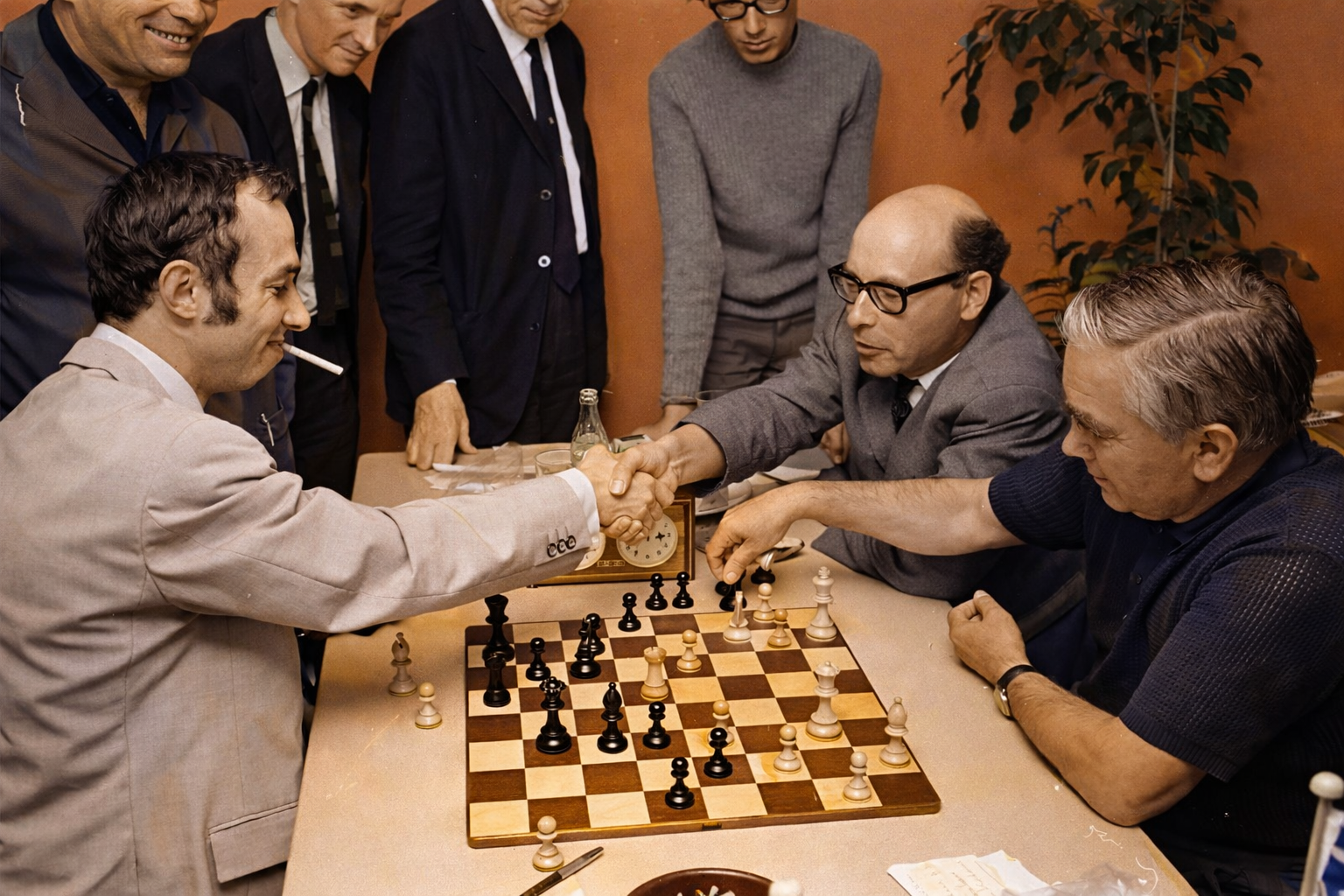
Within the Soviet chess saga, Bronstein’s story also stands as a testament to personal integrity. He navigated a challenging political landscape without compromising his principles or his artistic identity. As an “artist-grandmaster,” he cherished the joy of chess above all. Well into old age, Bronstein was famous for his impish enthusiasm, giving simultaneous exhibitions and baffling young opponents with undiminished ingenuity. Approachable and witty, he became something of an elder statesman of creative chess. Chess historians and enthusiasts continue to celebrate Bronstein for the richness of his play and thought. His classic books, especially Zurich 1953, continue to enlighten new students of the game. In the final analysis, David Bronstein left a mark not just by his results, but by enlarging the horizon of what was possible on the chessboard. His life in chess – from prodigy in Kyiv, to challenger of Botvinnik, to wise storyteller – embodies the drama and beauty of 20th-century chess history. As Bronstein himself once implied, champions come and go, but the legacy of a true chess artist endures. In Bronstein’s case, that legacy is one of unending creativity and inspiration.
Sources:
William Hartston, “David Bronstein: Obituary – Artist among chess grandmasters deemed the finest player never to have won the world championship,”The Independent (UK), 7 Dec 2006.
Geoff Chandler, “Grand Master (David Bronstein),”Textualities (2006).
Tartajubow, “David Bronstein – Author,”Tartajubow On Chess II blog (1 Feb 2018).
David Bronstein – English Wikipedia article (accessed Nov 2025).
David Bronstein & Tom Fürstenberg, The Sorcerer’s Apprentice (Cadogan, 1995) – memoir and game collection.
David Bronstein, Secret Notes (Ed. Olms, 2007) – posthumous autobiography with Sergei Voronkov.
Mikhail Botvinnik, Botvinnik’s Best Games 1947–1970 (Batsford, 1972) – Intro by Victor Baturinsky quoting Botvinnik on 1951 match.
Edward Winter, “David Bronstein” – Chess Notes Archive (for historical context on Bronstein-Botvinnik anecdotes and Soviet chess politics).
