Eduard Gufeld
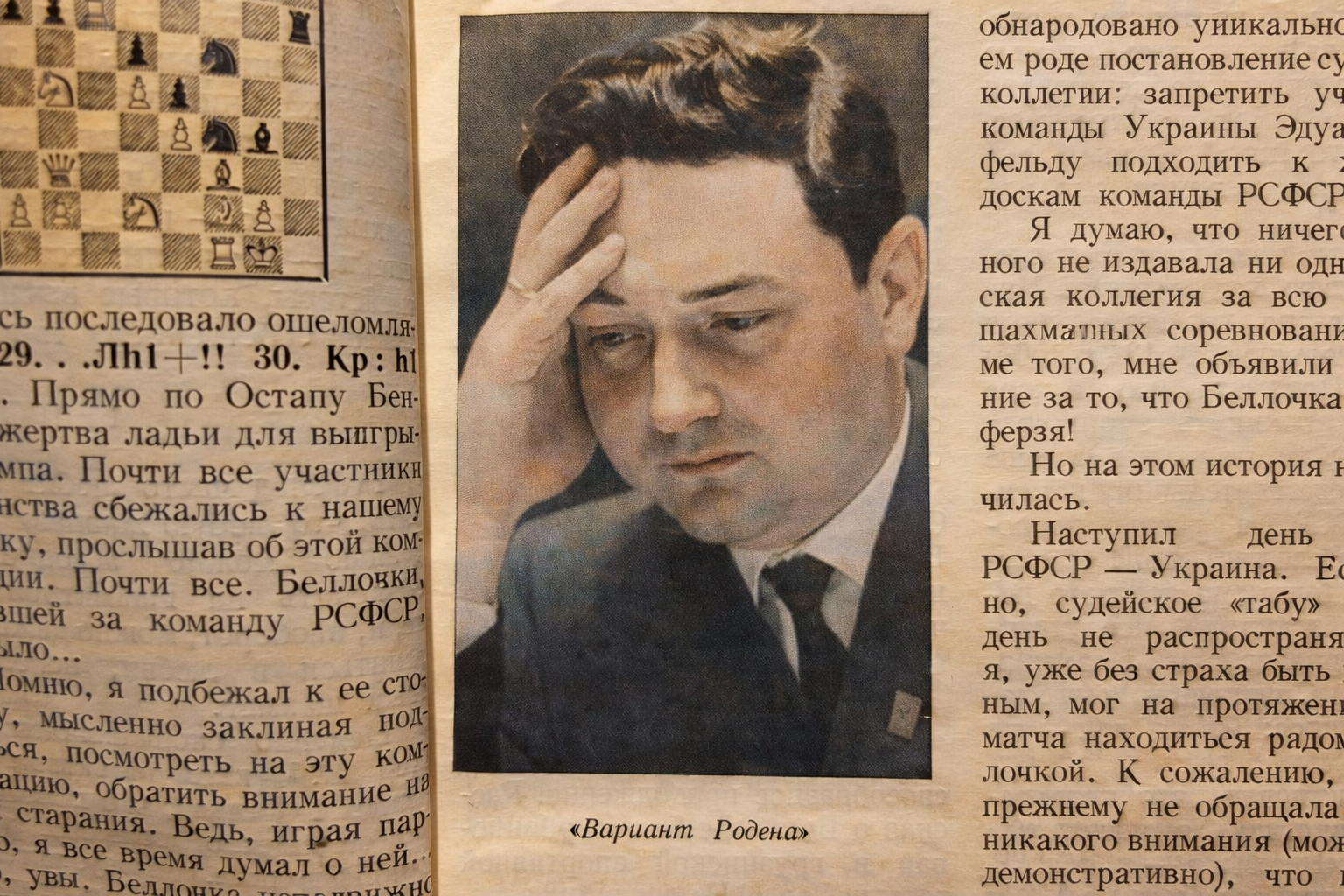
Eduard Gufeld, born in Kyiv on March 19, 1936, and died in Los Angeles on September 23, 2002, was one of the most hybrid figures in twentieth-century chess. He was a strong Soviet grandmaster, later affiliated in official records with Georgia and then the United States; a major trainer of elite players; a journalist and lecturer; a hugely prolific and sometimes polarizing author; and a lifelong defender of the idea that chess should be valued not only as competition, but also as art. At his peak, he reached 2570 and world no. 22 on the official January 1977 rating list, which says a great deal about his place in history: not quite a permanent member of the absolute super elite, yet unmistakably world-class.
A serious profile of Gufeld needs one source-critical caution at the outset. He did not merely leave a record for others to interpret; he actively shaped his own legend, especially through autobiographical and game-collection books built around signature masterpieces such as the Bagirov game he called his “Mona Lisa” or “La Gioconda.” Later reviewers admired the energy and charm of that self-presentation, but some also complained about recycled material, self-dramatization, and uneven analysis. Even the size of his bibliography is unstable in the sources, which variously count roughly fifty books, fifty-seven by 2000, more than eighty, or more than one hundred, probably because different tallies include different co-authored works, revised editions, translations, and reissues.
Gufeld’s childhood was marked by the catastrophe that shaped so many Soviet lives. When the German invasion began, he was five years old; he and his mother were evacuated from Kyiv to Samarkand, while his father was killed at the front during the first year of the war. He returned to Kyiv in 1946, and that movement from wartime rupture to postwar rebuilding formed the backdrop to everything that followed.
In postwar Kyiv, he first showed real promise in football before chess took hold. A cousin introduced him to the game, and he trained with a serious lineage of Kyiv masters, including A. Olshansky, E. Polyak, Isaac Lipnitsky, and Abram Khavin. At seventeen, he won the Ukrainian youth championship, later served in the army, and graduated from the pedagogical institute in Cherkasy. That last detail matters more than it may seem: Gufeld was not only a player who later happened to teach, but someone whose formation already bent toward pedagogy, demonstration, and explanation.
Gufeld became an International Master in 1964 and a Grandmaster in 1967. By modern standards, that can look late, but contemporaries and later historians stressed that Soviet players had far fewer opportunities than modern professionals to collect international norms. The better measure of his strength is domestic. He played in eight USSR Championships, qualified repeatedly through the brutal Soviet system in the late 1950s and 1960s, and achieved his best result with shared 7th-8th place in the 1963 championship, a performance later described as worth more, in historical context, than many ordinary grandmaster norms. He spent much of his prime in the same national ecosystem as Tal, Spassky, Leonid Stein, and Polugaevsky, which helps explain why a career of genuine world-class strength could still look historically under-decorated.
He was also excellent in team play. On the Soviet student team, he helped win the World Student Team Chess Championship in 1961 and 1962, scoring 18 points from 22 games overall. The detailed record is sharp-edged and impressive: 10.5/12 in Helsinki in 1961 and 7.5/10 in Mariánské Lázně in 1962. For a country that treated chess as a major cultural arena, that was not ornamental success. It marked him as a fully trusted representative of Soviet strength.
His individual tournament career confirms the picture of a player who hovered just outside the innermost circle but remained dangerous for decades. He finished second at the 1974 Capablanca Memorial in Camagüey, placed first or shared first at events such as Tbilisi 1974, Barcelona 1979, Tbilisi 1980, Havana 1985, Wellington 1988, Canberra 1988, and Alushta 1993, and peaked officially at 2570 and world no. 22 in January 1977. He also scored wins over an imposing roll call of contemporaries, including Vasily Smyslov, Mikhail Tal, Boris Spassky, Viktor Korchnoi, David Bronstein, Svetozar Gligorić, and Lev Polugaevsky. That resume places him securely inside the upper tier of Soviet grandmaster culture, even if he never became a permanent Candidates player.
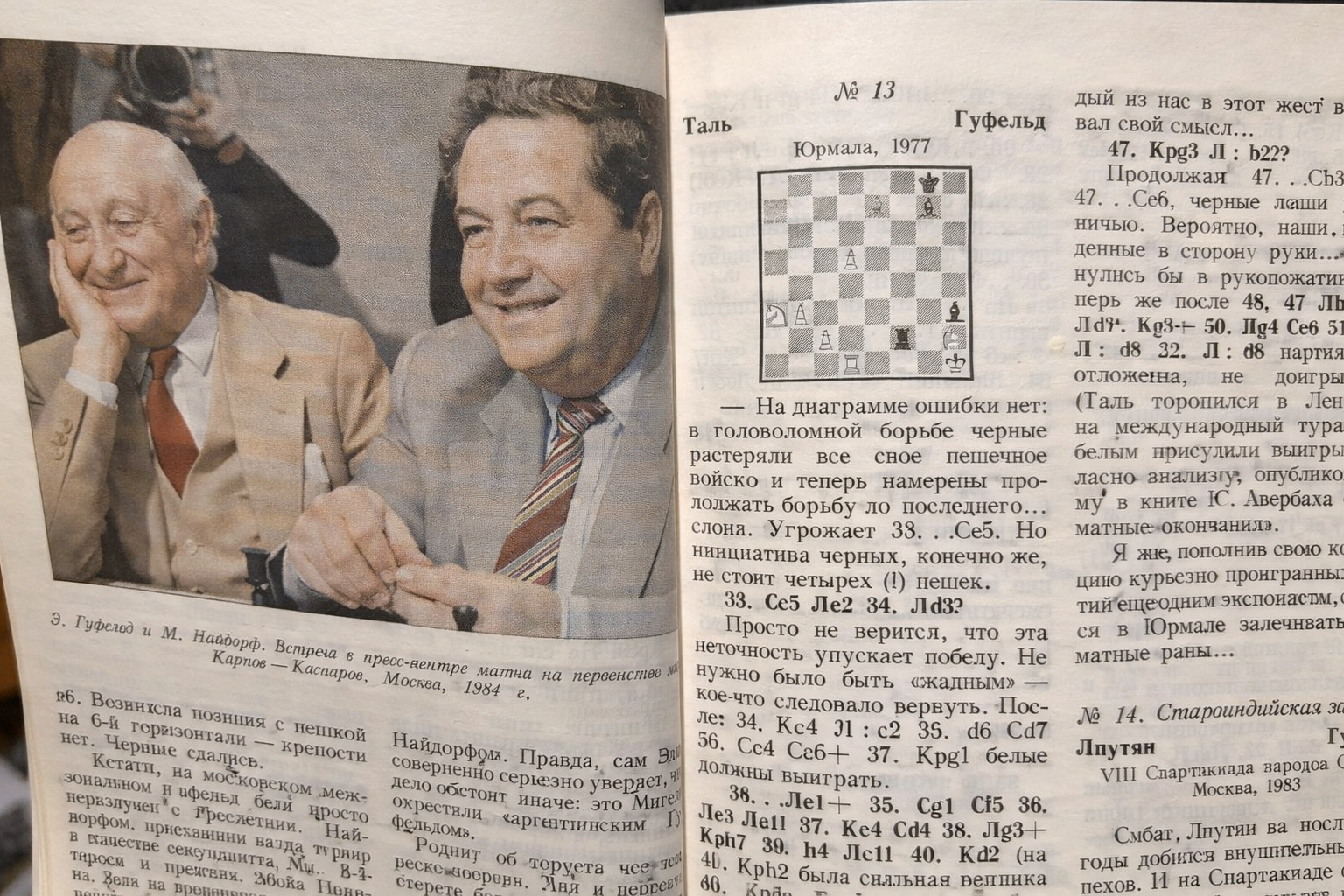
Gufeld’s chess personality was vivid enough that it became attached to a piece. He loved the kingside-fianchetto bishop, especially in the King’s Indian and the Sicilian Dragon, so strongly that Russian accounts speak of the “Gufeld bishop.” He was a committed enthusiast of both the King’s Indian Defense and the Dragon throughout his career, and former student Vanessa West later remembered that he taught the dark-squared bishop as the key strategic and imaginative force in many such positions, something worth serious material concessions to preserve. This was not just repertoire. It was a worldview centered on dark-square initiative, dynamic imbalance, and positions that felt alive rather than antiseptically correct.
The single game that best condensed that worldview was his victory with Black over Vladimir Bagirov at Kirovabad in 1973. Gufeld turned that game into a lifelong emblem, repeatedly calling it his “Mona Lisa” or “La Gioconda,” and later built book titles around the same metaphor. The game’s fame came not only from tactical violence in a King’s Indian Sämisch structure with opposite-side castling, but from what Gufeld made it mean: a claim that one beautiful game can justify a chess life more enduringly than a stack of correct but forgettable results.
That idea was not a private quirk. Gufeld stated it openly. In later reflections, he argued that chess contains three inseparable elements, “art, science, [and] sport,” and insisted that Elo ratings measure only the sporting fraction. He was similarly hostile to sudden-death time controls, which he thought reduced a serious intellectual art to a scramble of mistakes. One can disagree with his purism, but it is central to understanding him: Gufeld did not treat beauty as decorative frosting on top of competitive success. He treated beauty as a core criterion of value.
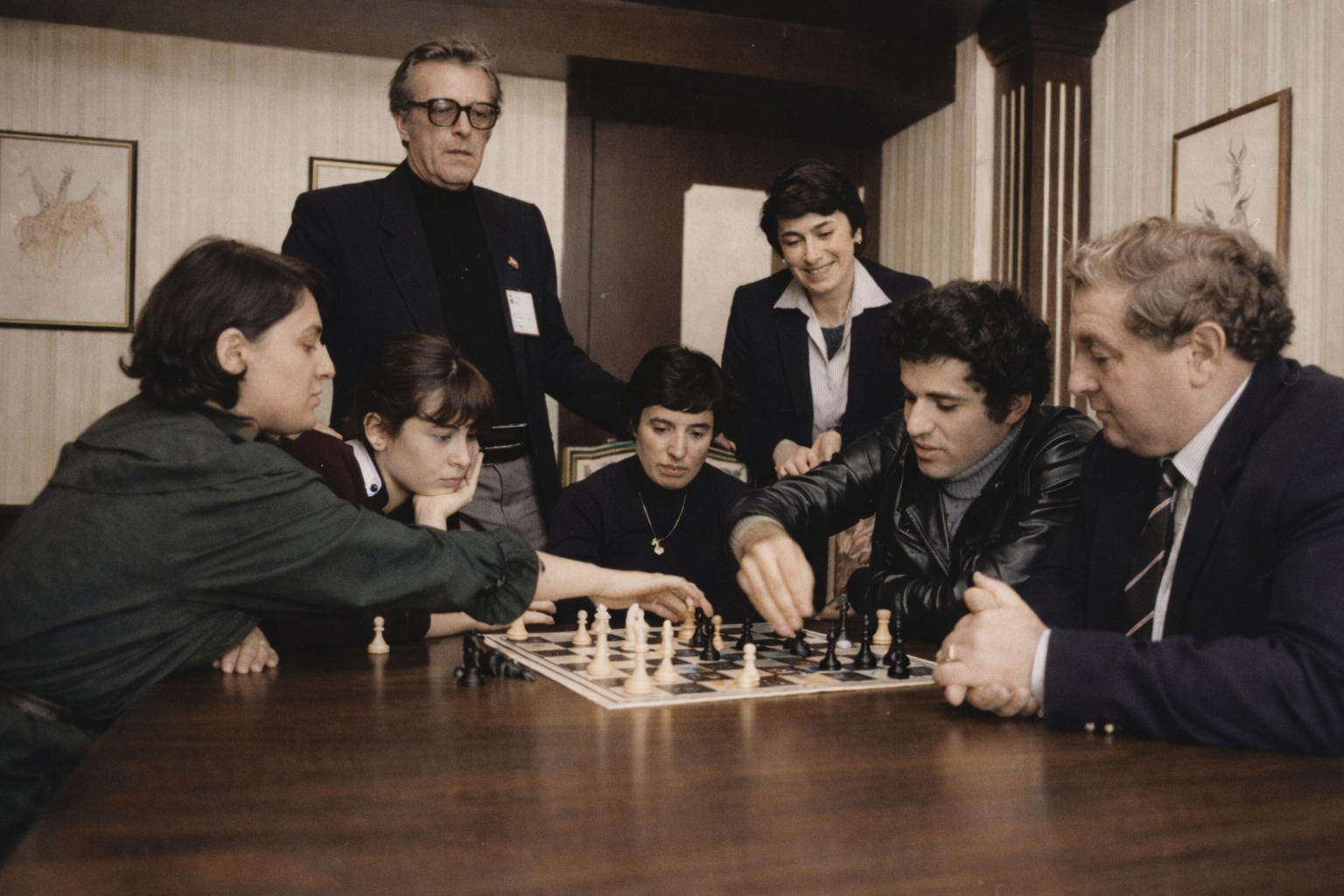
If one asks where Gufeld’s historical weight really lies, coaching is the first answer. ChessBase’s retrospective credits him with more than fifteen years of work alongside Efim Geller, one of the great Soviet grandmasters, and with helping the young Maia Chiburdanidze, who became Women’s World Champion in 1978. Chiburdanidze later said, in substance, that before Gufeld, her chess had been immature and that she owed her development into a world champion to his training. The World Chess Hall of Fame likewise notes that he helped guide her through four successful title defenses.
His official honors reflect that standing. He was named Merited Coach of the Georgian SSR in 1977 and Merited Coach of the USSR in 1981, received the medal “For Distinguished Labor” in 1985, worked with the Georgian women’s team, coached the Soviet women at the 1982 and 1984 Olympiads, held senior team responsibility with Soviet men in 1985, and served on FIDE commissions. Memorial accounts also credit him with helping start a FIDE committee devoted to chess art and exhibition, which perfectly matched his lifelong insistence that chess should be staged and remembered as culture, not only as sport.
There is a sharp psychological insight, recorded via Genna Sosonko, that helps explain why Gufeld mattered so much as a trainer. Sosonko’s view was that Gufeld’s emotional excess could interfere with his own tournament results, but that the same emotional abundance became an asset in the training room, where inspiration, confidence, and imaginative permission matter enormously. That diagnosis fits the evidence well. Gufeld may not always have optimized himself, but he was unusually gifted at energizing others.
Students also remembered that his lessons emphasized the spirit of positions rather than dead memorization. Recollections in US Chess describe him teaching the King’s Indian not as a spreadsheet of variations, but as a living organism with the dark-squared bishop at its center. That helps explain how one man could be useful both to a future world champion and to ordinary juniors in a local classroom.
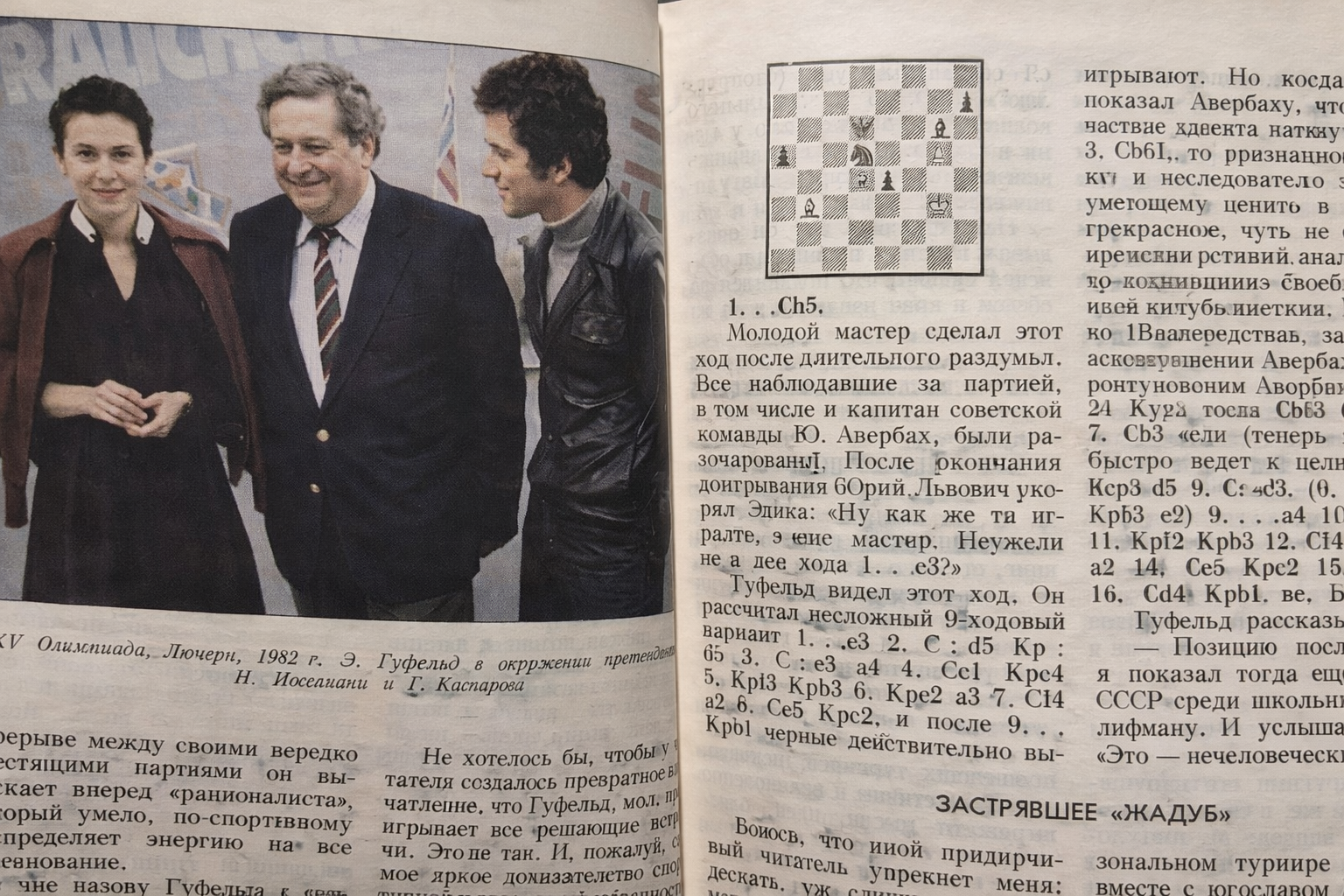
Gufeld’s written output is immense, though the exact total depends on how one counts. The Russian Chess Federation profile says he wrote around fifty books; a 2016 ChessBase retrospective counted fifty-seven by 2000; a Los Angeles Times obituary cited more than eighty books and 3.5 million copies sold; and a ChessBase memorial pushed the total to more than one hundred titles. The disagreement is best understood as bibliographic fog generated by a prolific multilingual author who produced solo books, co-authored manuals, revised editions, reissues, and translations across several chess cultures.
The range of those books matters. Representative titles include The Sicilian for the Tournament Player (1989), Exploiting Small Advantages (1985), Russian Handbook of Chess Openings (1995, with Vladimir Kalinichenko), The Art of the King’s Indian (2000), and Chess: The Search for Mona Lisa (2001). US Chess also described him as a writer on biography, theory, practice, and even the Russian edition of the Encyclopedia of Chess Openings. He did not write in a single register. He moved restlessly among opening theory, middlegame instruction, biography, memoir, aphorism, and annotated brilliancy.
Those books also performed a transmission function. By writing repeatedly on the Sicilian, the King’s Indian, and general opening reference works, Gufeld helped spread an aggressive Soviet opening culture to club and tournament players far beyond the Soviet Union. The mixture of theoretical manuals and performative narrative voice is one reason his reach was wider than his tournament ranking alone would predict.
The honest scholarly verdict, however, is mixed. The Russian Chess Federation profile itself notes that not all of his books “stood the test of time”; John Watson praised Chess: The Search for Mona Lisa as entertaining and substantial, and perhaps Gufeld’s best work in that vein, yet criticized the broader corpus for repeated recycling, self-dramatization, and uneven technical reliability. TWIC’s obituary made a similar point, calling his output prolific but variable. That combination is revealing. Gufeld was not a sterile reference writer; he was a performer on the page. At his best, that produced unusually memorable chess literature. At his worst, blur, duplication, and overstatement crept in.
Beyond books, he functioned as a roaming public voice of chess. Obituary sources describe him as a journalist, lecturer, and world traveler who visited more than one hundred countries. ChessBase’s memorial called him a “born salesman of chess,” which may be the most accurate compact description anyone found. The phrase captures both his strength and the reason some contemporaries felt ambivalent. He could light up a room, convert casual listeners into enthusiasts, and turn chess into a story about beauty and character. But he also marketed his own myth energetically, sometimes too energetically for sober tastes.
Gufeld’s last major reinvention came in the United States. In October 1995, he arrived in Los Angeles to visit his sister Lydia Valdman, liked the climate, found work, and stayed. In Hollywood, from an apartment building on North La Brea Avenue, he ran the GM Gufeld Chess Academy, gave lessons and simultaneous exhibitions, and built a new local reputation from scratch. His official rating history mirrors the larger biographical arc with unusual clarity: Soviet, then Georgian, then American.
This American chapter was not merely ceremonial. He continued to compete seriously and won the Western States Championship in Reno in 1998 as well as the 35th American Open in 1999. In February 2000, Chess Life put him on its cover under the line “The Beauty of Chess,” which felt less like a slogan than a compressed biography. He died in Los Angeles on September 23, 2002, at Cedars-Sinai after a massive stroke and coma, but even in the final years, he remained active as a teacher, lecturer, and tournament presence.
Gufeld left behind a reputation that is warmer and more divided than ordinary grandmaster remembrance. Kasparov later praised his humor, devotion to chess, and faith in beauty and harmony. Sosonko emphasized the productive side of his emotionality. Other contemporaries and reviewers, by contrast, found him loud, self-promoting, or analytically unreliable. These views do not cancel each other out. They describe the same man from different angles. Gufeld was theatrical, emotionally porous, and almost constitutionally incapable of treating chess as a dry profession. That made him magnetic to some people and exhausting to others.
The cleanest way to place Eduard Gufeld in chess history is not to ask whether he was “great enough” by world-title standards. By that narrow measure, he was a very strong grandmaster who stopped short of the innermost circle. The more revealing question is what functions he served in chess culture. He was a bridge figure: between Soviet elite competition and global popularization, between opening theory and storytelling, between grandmaster practice and the institutional rise of Georgian women’s chess, between tournament ambition and the defense of beauty as a criterion of value. Few players of his exact strength class left so many footprints in so many different rooms.
So the deepest profile of Gufeld is this: he was not merely a player with some good tournaments and one immortal game. He was a maker of chess culture. He taught future champions, carried opening systems into popular literature, lectured across the world, built institutions, and argued stubbornly that chess should be remembered for originality and beauty as much as for rank and result. His legacy, then, is not only the Bagirov masterpiece or the shelf of books with his name on them. It is the larger idea he kept staging, again and again, in different countries and roles: that chess is a serious art practiced by flawed, vivid human beings, and that a life in chess can matter even without a crown.
Sources
Russian Chess Federation. “Eduard Gufeld.” Ruchess.ru. Accessed 2026. https://ruchess.ru/persons_of_day/gufeld/?sphrase_id=252199
ChessBase. “Eduard Y. Gufeld: The Ultimate Chess Romantic.” ChessBase.com. Accessed 2026. https://en.chessbase.com/post/eduard-y-gufeld-the-ultimate-chess-romantic
Los Angeles Times. “Eduard Gufeld, 66; Chess Grandmaster, Teacher, Author.” LA Times, September 26, 2002. https://www.latimes.com/archives/la-xpm-2002-sep-26-me-gufeld26-story.html
OlimpBase. “Eduard Gufeld – Elo History and Team Chess Results.” OlimpBase.org. Accessed 2026. https://www.olimpbase.org/Elo/player/G/Gufeld%2C%20Eduard.html
WorldCat. “Works by Eduard Gufeld.” WorldCat.org. Accessed 2026. https://worldcat.org/oclc/60031245?utm_source=chatgpt.com
The Week in Chess. “TWIC 412: Obituary of Eduard Gufeld.” Accessed 2026. https://theweekinchess.com/html/twic412.html
US Chess Federation. “Meet Vanessa West on Chess Writing & Winning.” USChess.org. Accessed 2026. https://www.uschess.org/index.php/June-/Meet-Vanessa-West-On-Chess-Writing-Winning.html
