Lev Polugaevsky
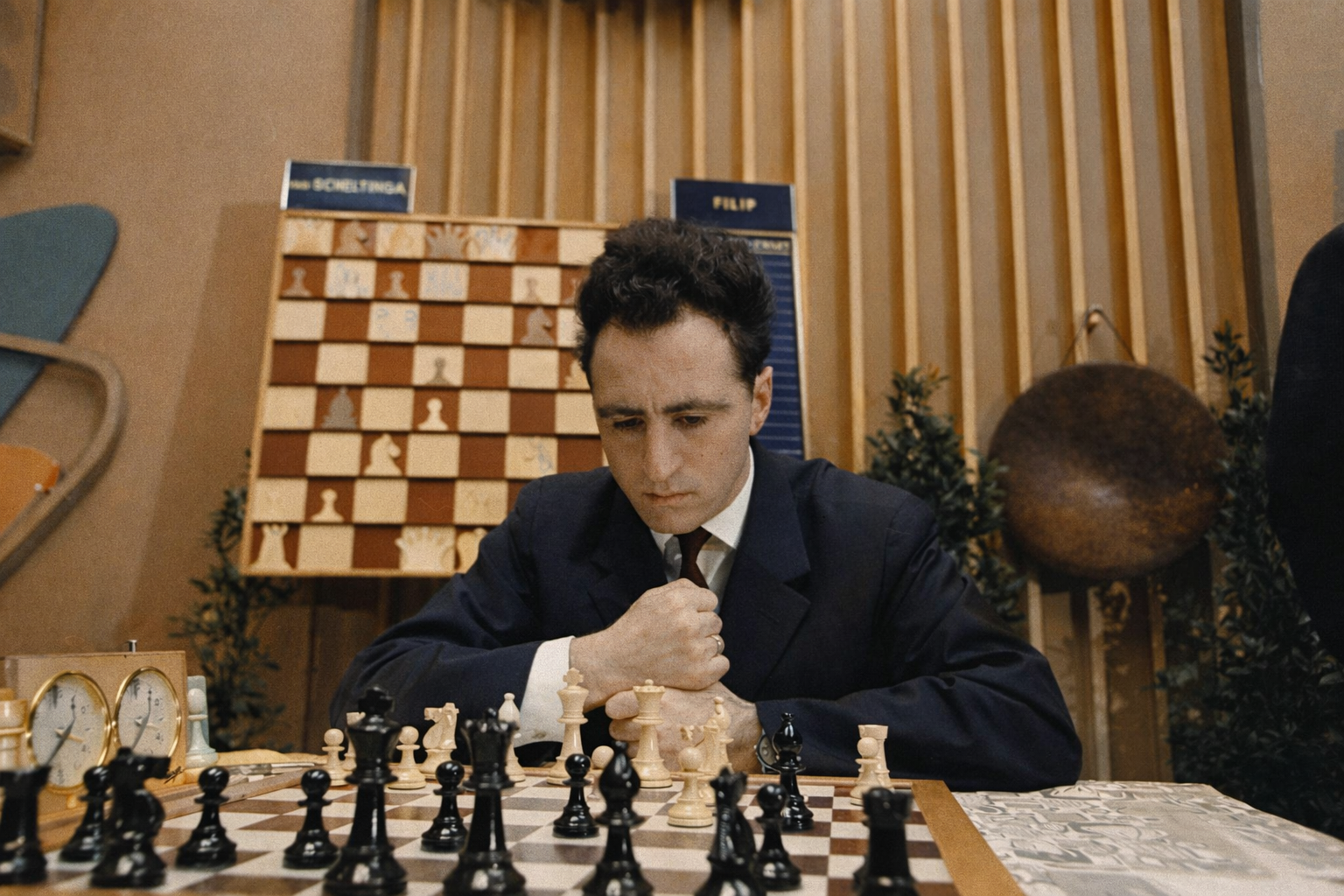
Polugaevsky in Beverwijt, 1966
Lev Abramovich Polugaevsky belongs on the short shelf reserved for players who were not only elite competitors but also architects of modern chess thought. Born in Mogilev in 1934 and evacuated during World War II to Kuybyshev, he learned chess there, trained under Alexy Ivashin, Lev Aronin, and for a period Rashid Nezhmetdinov, studied industrial thermal engineering, and continued to work full-time as an engineer until 1973. Aronin’s own expertise in the Najdorf helped steer Polugaevsky toward the Sicilian that became his lifelong laboratory. What makes his biography distinctive is precisely that fusion of engineer and artist: his chess was built from disciplined analysis, yet it usually appeared on the board in positions of maximum instability.
He was not an overnight prodigy of the usual Soviet legend-making sort. His first USSR Championship appearance came in 1956; he became an International Master in 1961 and a Grandmaster in 1962. Once established, though, he was astonishingly consistent. Contemporary reporting noted that across 20 Soviet Championships, from 1956 to 1983, he never once finished with a minus score. The title count needs a scholarly footnote: some sources call him a two-time Soviet champion, others a three-time champion, because he finished first or tied first in 1967, 1968, and 1969, but the 1969 shared first with Tigran Petrosian ended with Polugaevsky losing the playoff. Outside the USSR, his victories and first prizes ranged across decades, including Mar del Plata 1962 and 1971, Beverwijk 1966, Amsterdam 1972, Wijk aan Zee 1979, Biel 1986, Haninge 1988, Reykjavik 1990, and Aruba 1992.
His world championship record explains both his stature and his tragedy. The uncontested core is that he reached the Candidates’ matches in 1974, 1977, and 1980. In 1974, he qualified through the Petropolis route and lost to the young Anatoly Karpov 5½-2½. In 1977, he beat Henrique Mecking 6½-5½, then lost to Viktor Korchnoi 8½-4½ in the semifinals. In 1980, he defeated Mikhail Tal 5½-2½ and again lost to Korchnoi, this time narrowly, 7½-6½. Some later summary pages describe him as a “four-time” Candidate, but the standard match record repeatedly cited by mainstream chess sources is the three-cycle sequence above. The point that matters most is not the count but the company: Polugaevsky’s road to the crown kept running into Karpov and Korchnoi at their fiercest.
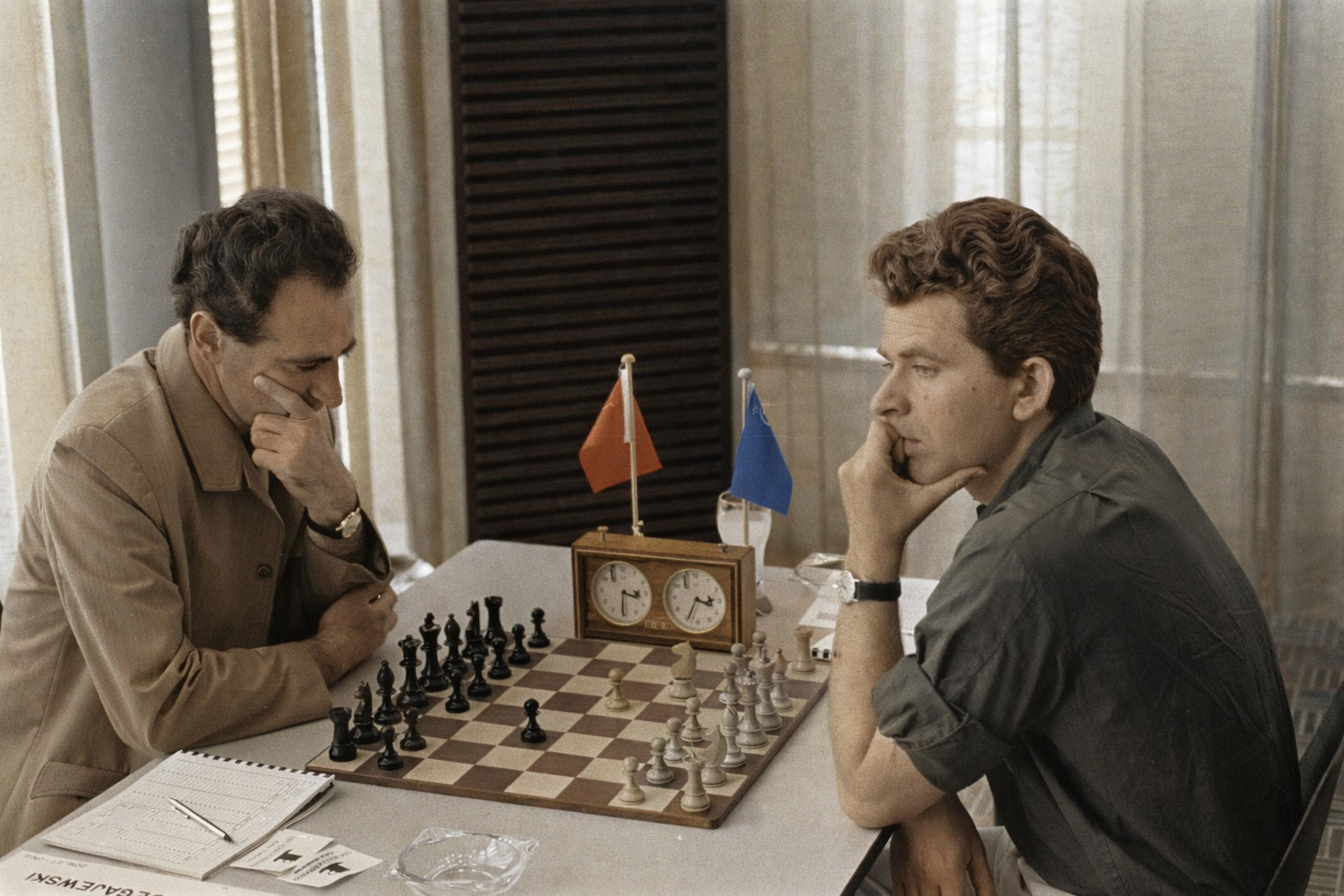
Polugaevsky and Spassky in Amsterdam, 1970
Those near-misses were not nostalgic inflation. On FIDE’s first official rating list in 1971, he was already among the world’s top five at 2640. The official July 1972 list placed him tied for third on rating with Petrosian at 2645, and the January 1976 list again placed him tied for third at 2635, though some modern databases sort tied players as fourth. However, one orders the ties, Polugaevsky spent years inside the small ring immediately below the world champions themselves. He was not just strong enough to upset the elite; he was, for a sustained period, part of the elite.
As a team player, he was equally substantial. He represented the Soviet Union in seven Olympiads, from Havana 1966 through Thessaloniki 1984, winning team gold six times and team silver once; he also played in both USSR vs. Rest of the World matches. Even in Buenos Aires 1978, when Hungary finished ahead of the USSR, Polugaevsky still took the individual silver medal on third board. This matters because his legacy is sometimes flattened into a single opening line, when in fact he was also one of the Soviet system’s most dependable big-match professionals.
Polugaevsky’s style is often reduced to “opening preparation,” which is true but incomplete. Obituaries emphasized his prowess in counterattack, and later chess writing remembers him as a player who could convert home analysis into positions that still required nerve, imagination, and precision. Two games tell the story. The famous 1969 win over Tal is remembered for deep preparation, flowering into a sacrificial attack. The 1981 win over Eugenio Torre in the Botvinnik Semi-Slav is still cited as one of the great opening novelties of the era, built around a long-prepared exchange sacrifice. These are not the games of a mere memorizer. They are the games of a theoretician who could make theory breathe fire.
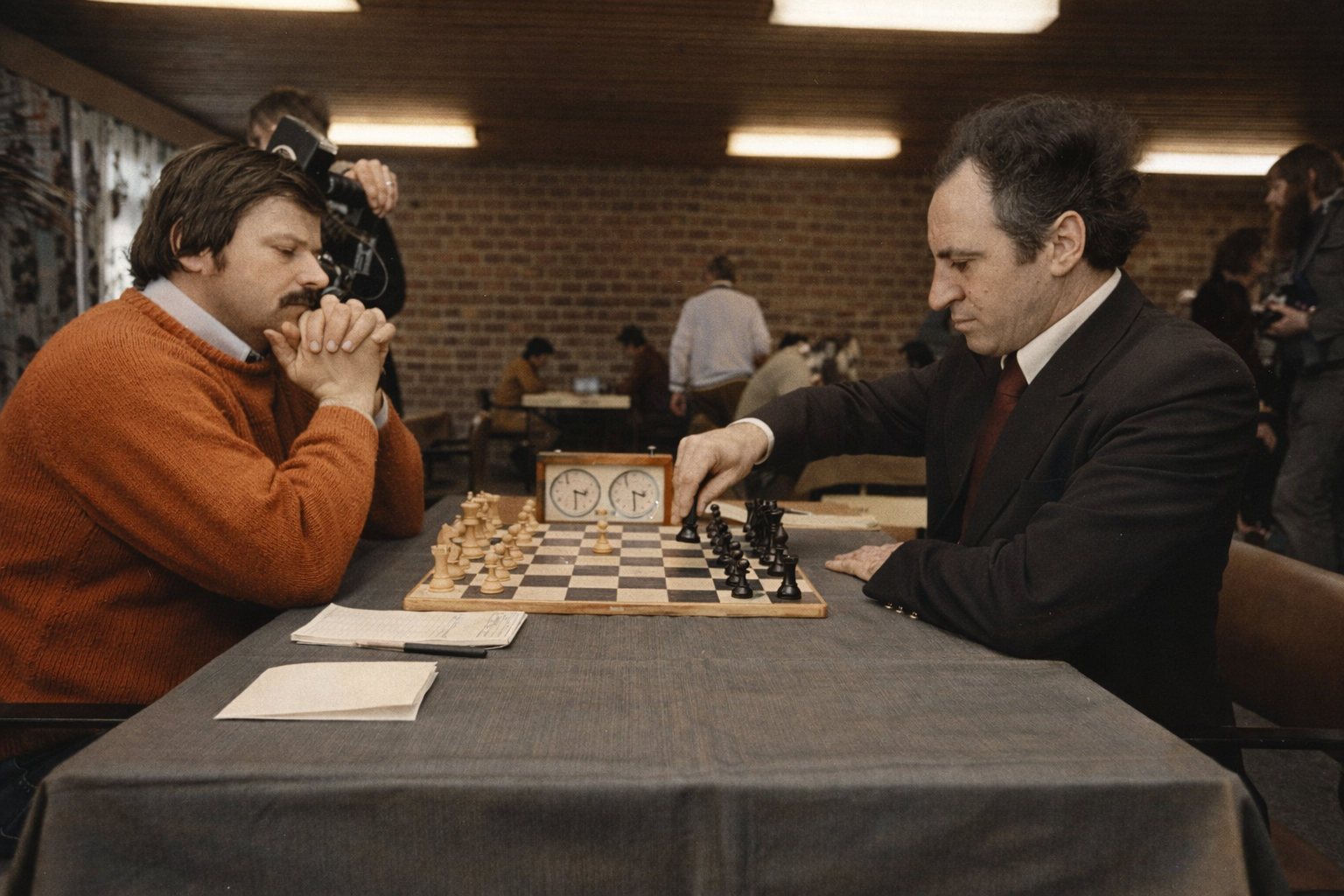
Hort and Polugaevsky at Wijk aan Zee, 1979
His single largest contribution was the Polugaevsky Variation of the Najdorf: 1.e4 c5 2.Nf3 d6 3.d4 cxd4 4.Nxd4 Nf6 5.Nc3 a6 6.Bg5 e6 7.f4 b5. Together with Yuri Shaposhnikov, he began serious work on 7...b5 in the late 1950s, first used it in Soviet Championship play in 1959, and returned to it over the course of decades of analysis and tournament play. In his own recollection, the line became a kind of “second self,” and whenever theory pronounced it refuted, he looked for “a refutation of the refutation.” That mindset is the heart of his historical importance. Polugaevsky did not merely discover a sharp variation. He modeled opening analysis as a long, revisable research program, years before engines made such work ubiquitous.
His books are almost as important as his tournament record. Grandmaster Preparation became a classic because it does not read like a dry manual; it opens the laboratory door and lets the reader see how a grandmaster tests, doubts, repairs, and re-tests an idea. Grandmaster Performance organized his best games by theme, The Sicilian Labyrinth extended his life’s work on Sicilian structures, and Art of Defence in Chess reminds us that he was not merely a cult hero of attacking theory. He understood defense as a central intellectual virtue in chess. In that sense, Polugaevsky was one of the great pre-engine writers on what serious analysis actually feels like from the inside.
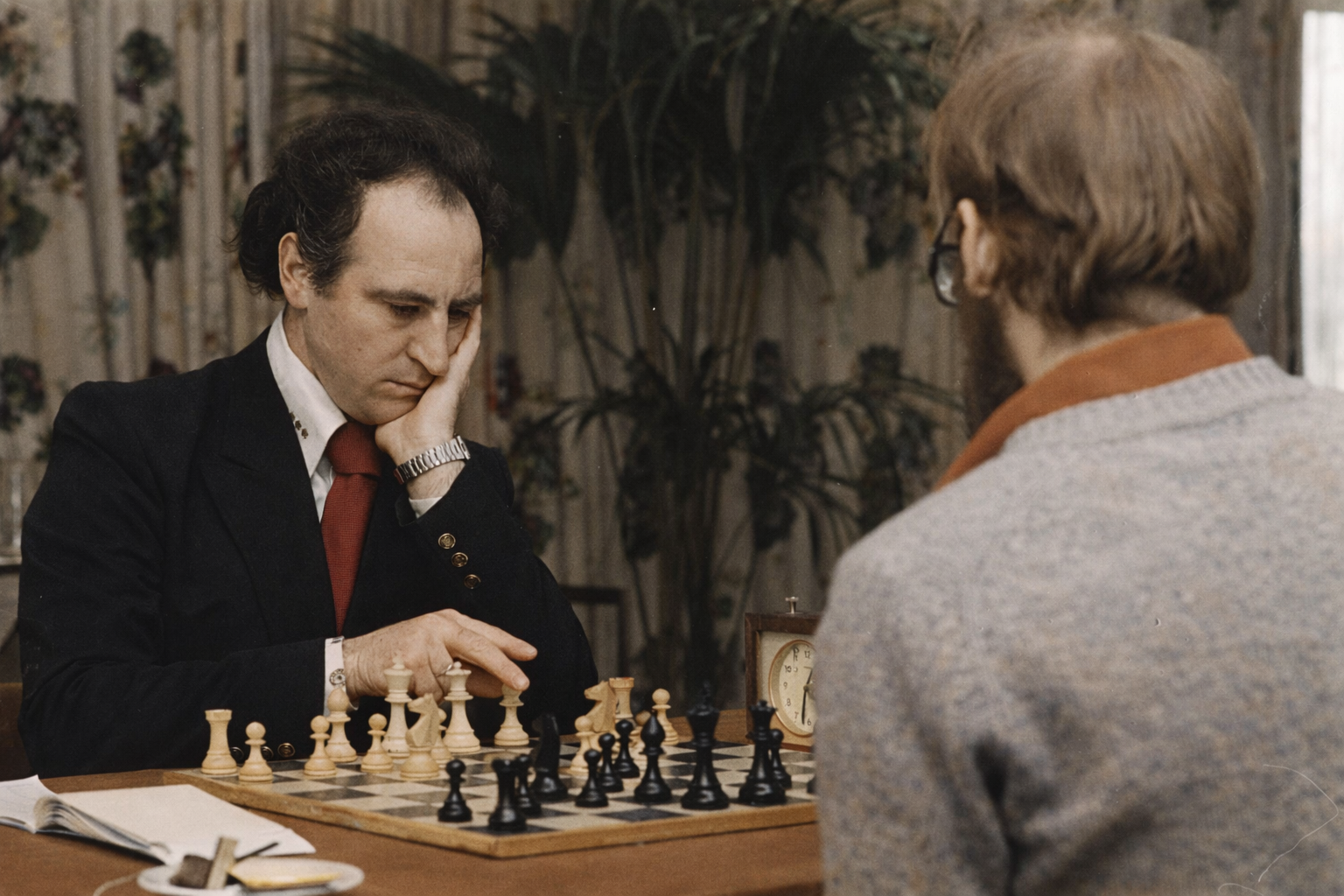
Polugaevsky and Hubner, 1979
What people most often forget is the breadth of his later career. He remained tournament-relevant into the late 1980s and early 1990s, moved to France in 1989, coached players such as Joël Lautier, and worked in Karpov’s championship orbit as a second and trainer. In 1994, an elite Sicilian-themed tournament in Buenos Aires was organized for his 60th birthday, a tribute so specific it almost feels like literature: an entire event built around the opening most associated with his name. He was already too ill to play. He died in Paris on 30 August 1995 of a brain tumour.
The cleanest academic judgment is this: Polugaevsky was not merely a great non-champion, but a formative figure in the professionalization of chess preparation. His legacy lives in four places at once: in results, because he was a genuine world-class player for decades; in theory, especially the Najdorf; in literature, because he wrote some of the most revealing books ever produced by a top grandmaster; and in institutional memory, as seen in his 2024 induction into the World Chess Hall of Fame. If many strong players are remembered for what they won, Polugaevsky is remembered even more for how he worked. That is a rarer kind of greatness.
Sources:
“In Memory of Lev Polugaevsky,” ChessBase, https://en.chessbase.com/post/in-memory-of-lev-polugaevsky
“Obituaries: Lev Polugaevsky,” Los Angeles Times, 10 September 1995, https://www.latimes.com/archives/la-xpm-1995-09-10-mn-44299-story.html
FIDE Museum – FIDE Historical Ratings, https://museum.fide.com/fide-history
World Chess Hall of Fame – Lev Polugaevsky Profile, https://worldchesshof.org/inductee/lev-polugaevsky/
“A Love Story: Lev Polugaevsky’s Grandmaster Preparation,” ChessBase, https://en.chessbase.com/post/a-love-story-lev-polugaevsky-s-grandmaster-preparation
The Week in Chess (TWIC) Archive, https://theweekinchess.com/html/twic51.html
