Efim Geller
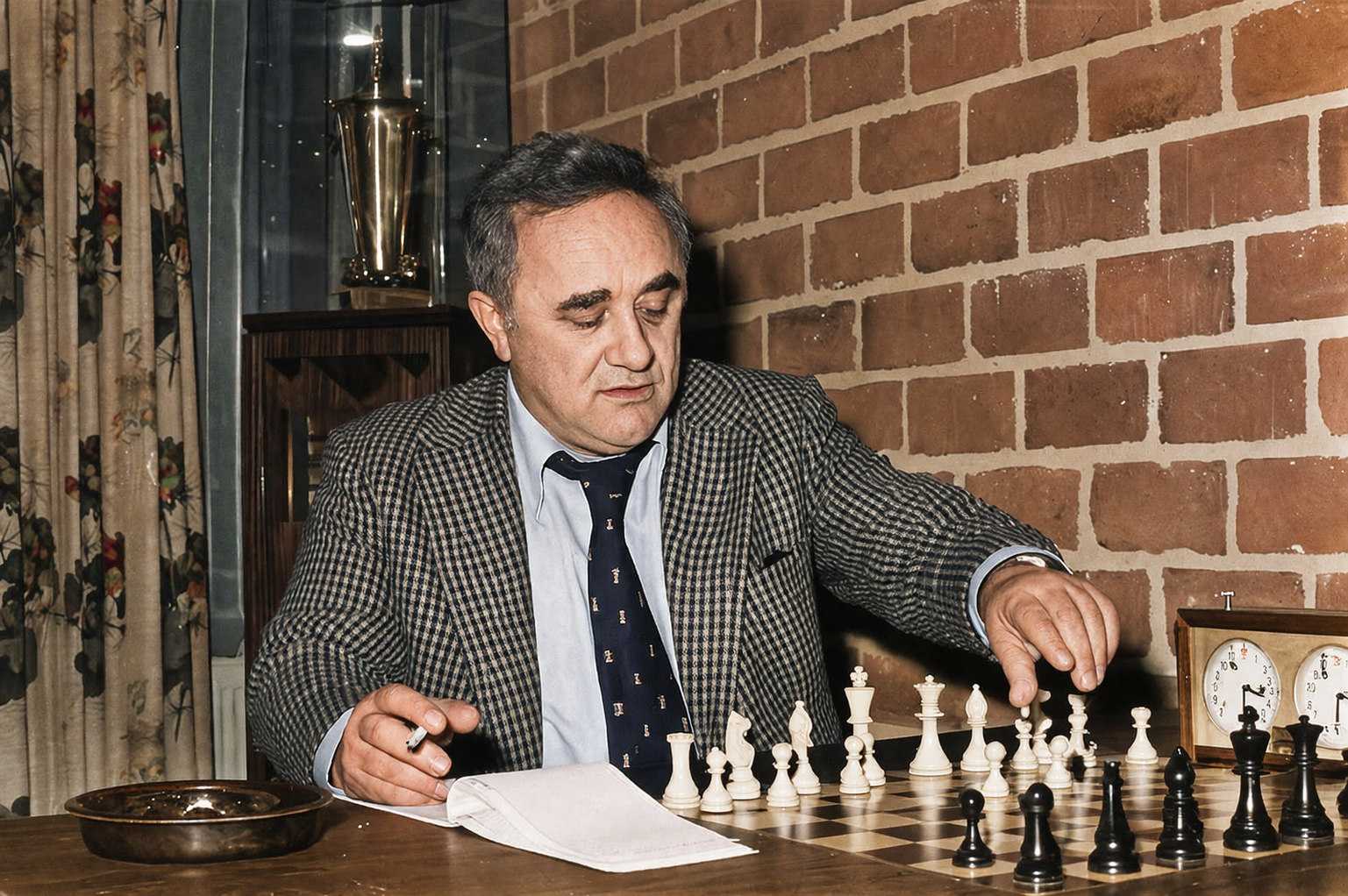
Efim Geller was one of the strongest chess players never to become world champion, but that description is still too small for him. He was at once a world-class tournament player, a serial world-championship contender, one of the Soviet school’s most important opening analysts, and a trusted second whose ideas circulated far beyond the games he personally played. Born in Odessa in 1925 and active at the highest level for decades, Geller qualified for the Candidates six times, won the Soviet Championship twice twenty-four years apart, defeated eight world champions in serious play, and finished his life with a reputation that led to his induction into the World Chess Hall of Fame in 2024.
Geller was born in Odessa, a city that mattered in Soviet chess culture because it produced players of unusual practical energy and theoretical independence. Russian Chess Federation material describes him as an athletic and lively boy who played football and represented Odessa in basketball; it also notes that his father was a strong amateur player and a student of Boris Verlinsky. During the Second World War, Geller served as a mechanic at an airfield, and the same source emphasizes that even in wartime he kept studying chess literature. That combination matters: athletic toughness, self-directed study, and the discipline of analysis became permanent features of his chess identity.
His real breakthrough came not in a junior event that neatly announced a prodigy, but in the furnace of Soviet elite competition. The Russian Chess Federation’s retrospective on Geller calls his appearance in the 1949 USSR Championship Final a sensation, which is a fair summary: by entering that event as a dangerous attacking master and then proving he belonged among the country’s best, he effectively launched himself into the hardest domestic circuit in the world. In the Soviet context, this was not a minor credential. The USSR Championship was often stronger than most international tournaments, and success there was a better predictor of world-class strength than a good many foreign titles.
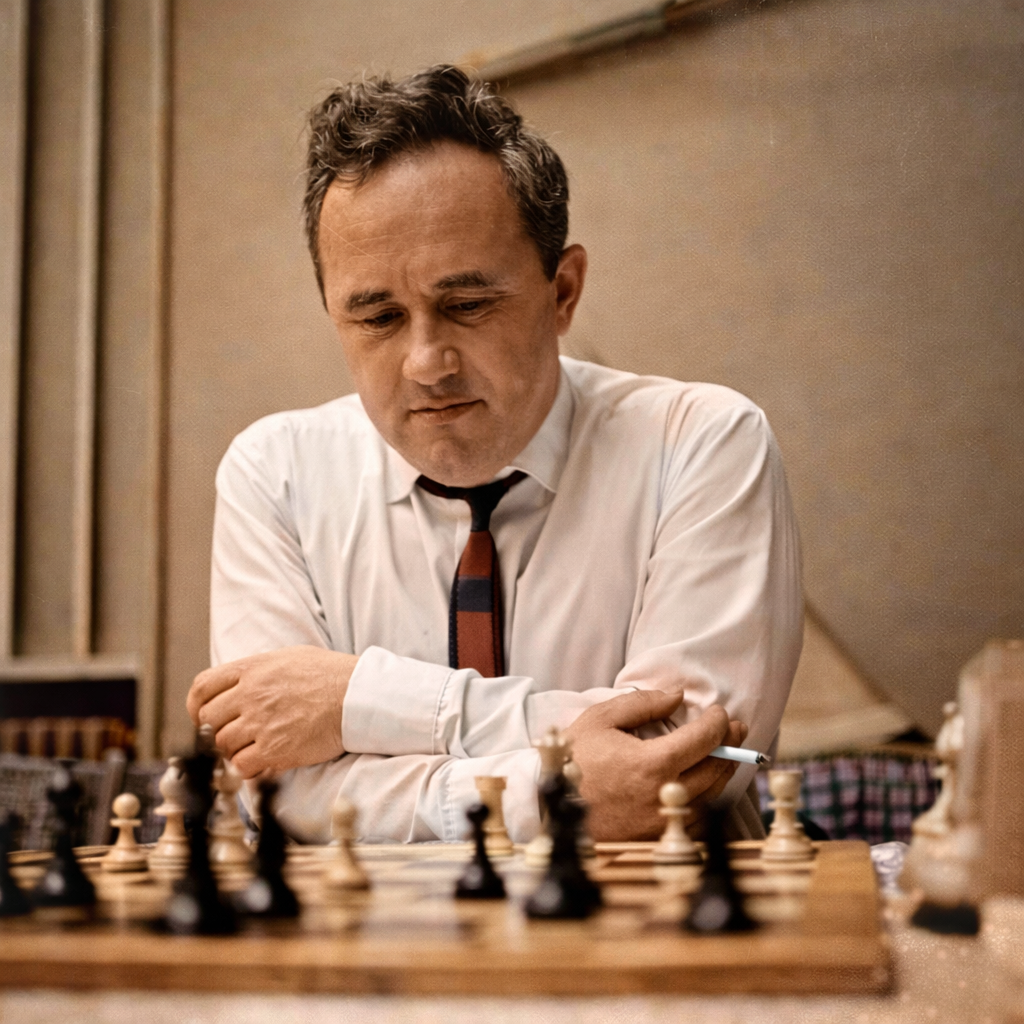
By the early 1950s Geller was no longer merely a Soviet talent but an international force. He played a key role for the Soviet team at the 1952 Olympiad, scoring 10.5/14 according to the Russian Chess Federation, and he quickly became a recurrent figure in the world championship cycle. The World Chess Hall of Fame notes that he qualified for the Candidates six times: 1953, 1956, 1962, 1965, 1968, and 1971. That number alone places him in the narrow inner circle of postwar elite players. Repeated qualification in that era meant surviving the strongest qualification structure in chess history, usually against a field saturated with Soviet grandmasters plus the best non-Soviet challengers.
His Candidates record shows both how close he came and why his career can feel tragic in retrospect. In Amsterdam 1956, FIDE’s historical account notes that Geller led after the first half of the tournament before fading and finishing third. In Curaçao 1962, he came even closer: FIDE records that Petrosian won with 17.5/27, while Keres and Geller tied for second and third just half a point behind. That was probably the nearest Geller came to a world-title match. In other words, he was not merely a perennial outsider. He was, at moments, one of the likeliest men on earth to challenge for the crown.
The shift from Candidates tournaments to Candidates matches after 1962 changed the shape of his opportunities but not his relevance. FIDE’s history of the cycle notes that the controversial 1962 event led to a match format from 1965 onward. In that first match cycle, Geller defeated former world champion Vasily Smyslov by 5.5-2.5 in the quarterfinals, a result confirmed by Russian Chess Federation material, before losing in the semifinal to Boris Spassky, who then went on toward the title. His later cycles were similarly blocked by the fact that he lived in a forest of giants: Petrosian, Spassky, Korchnoi, Tal, Keres, and then Fischer crowded the same historical lane. Geller was strong enough to become champion in many eras, but he played in one of the most congested periods chess has ever known.
Geller’s two USSR Championship titles neatly capture both his brilliance and his longevity. He first won the title in 1955, taking a playoff from Smyslov, and then won it again in 1979 at Minsk. The span between those victories is remarkable on its own. The Soviet Championship was not a ceremonial national event; it was an annual gauntlet populated by world title contenders and future super-grandmasters. To win it in the mid-1950s already certified world-class stature. To win it again in 1979, against a younger generation that included figures like Yusupov, Balashov, and the young Kasparov, demonstrated that Geller was more than a man of one peak. He had staying power, analytical adaptability, and a competitive metabolism that outlived fashions.
One reason Geller has always been revered by players more than by casual fans is that his strength appears with unusual clarity when one studies whom he beat. The World Chess Hall of Fame states that he defeated eight world champions and held a lifetime plus score of +5 -3 =2 against Bobby Fischer. An Independent obituary likewise stressed that he took games from every world champion from Botvinnik to Karpov and singled out his favorable records against Botvinnik, Smyslov, Petrosian, and Fischer. A plus score against Fischer is not trivia. Fischer was a predator who left very few peers with any statistical comfort at all, and Soviet teams were notably glad to have Geller around when Fischer was in the field.
Ratings and retrospective measures support the same conclusion. OlimpBase’s FIDE rating history shows Geller among the official top ten in the early rating era, including a share of sixth on the January 1971 list, a share of eighth in January 1976, and a share of tenth in January 1981. Chessmetrics, a retrospective model rather than an official list, ranks him as high as world no. 2 in mid-1963. One should distinguish official and retrospective systems, but both point the same way: Geller spent a very long time in the tiny band of players who could realistically win super-tournaments and threaten the world championship.
At the board, Geller combined force with preparation. He is often remembered as an attacking player, and that is true, but it undersells the architecture behind the attacks. His best games are not usually romantic improvisations in the older sense; they are highly prepared, strategically justified assaults in which opening detail flows into middlegame initiative. He excelled in positions where concrete calculation and structural understanding had to cooperate. That made him especially dangerous in sharp Sicilians, King’s Indian structures, and complex central battles where a single tempo could have long theoretical consequences. Russian Chess Federation commentary on him repeatedly highlights not only his practical strength but also his status as a celebrated opening specialist and analyst to whom other Soviet masters turned for advice.
This is where Geller’s importance becomes larger than his tournament table. Botvinnik’s famous judgment, repeated by the Russian Chess Federation and later ChessBase, was that “before Geller, we did not understand” the King’s Indian Defence. The claim should not be read literally as if nobody had ever played the opening before him. Its real meaning is theoretical: Geller helped make the King’s Indian and related dynamic systems intelligible and respectable at the highest level of Soviet chess. ChessBase’s historical discussion of his centenary likewise credits him with major contributions not only to the King’s Indian but also to the Sicilian, the Ruy Lopez, the Slav, and the Queen’s Gambit. In Soviet chess culture, where opening work was a collective industry, that made him one of the chief engineers rather than merely one of the drivers.
Edward Winter’s historical materials preserve an even more revealing contemporary evaluation: Botvinnik described Geller as “our leading theoretician,” adding that Geller’s ideas about openings and the transition from opening to middlegame had become common knowledge. Even allowing for the rhetoric of praise, this is a striking formulation. Geller was not just a brilliant analyst in private notebooks. His analyses diffused into the shared bloodstream of master chess. Part of why later generations can forget the original source is precisely that his ideas became absorbed into orthodoxy.
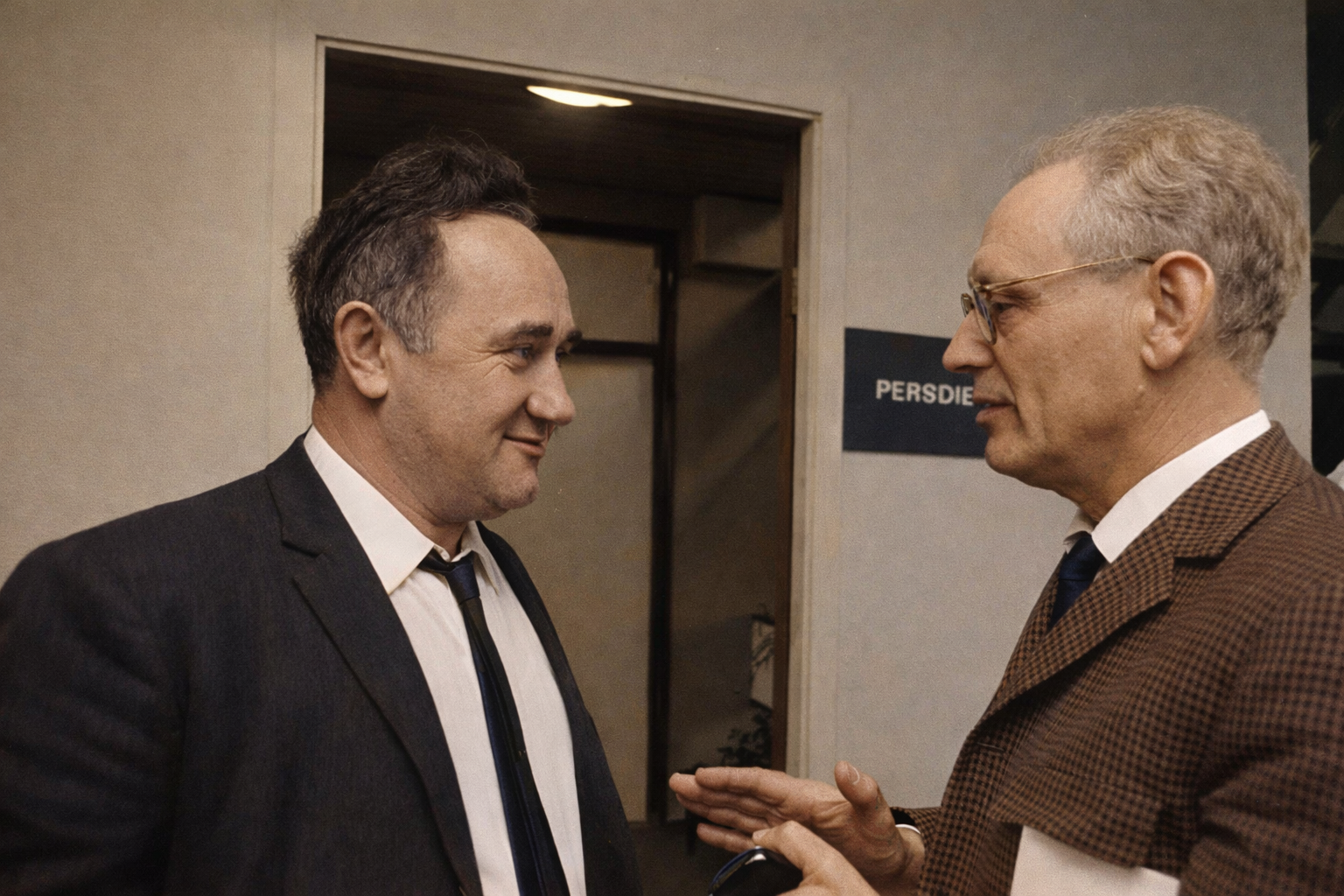
Geller also mattered as a champion's helper. Russian Chess Federation sources emphasize that other masters sought him out for advice on meeting Fischer and Bent Larsen, that he contributed to preparatory work in the 1970 USSR vs. Rest of the World match, and that he later worked with Rafael Vaganian before joining Boris Spassky’s team for the 1972 world championship match. Secondary accounts further note that Geller assisted several world champions or challengers across different periods. Even without overstating the point, the pattern is plain: the Soviet chess establishment treated him as a reservoir of hard opening knowledge and practical strategic counsel. That is one of the surest institutional signs of chess authority.
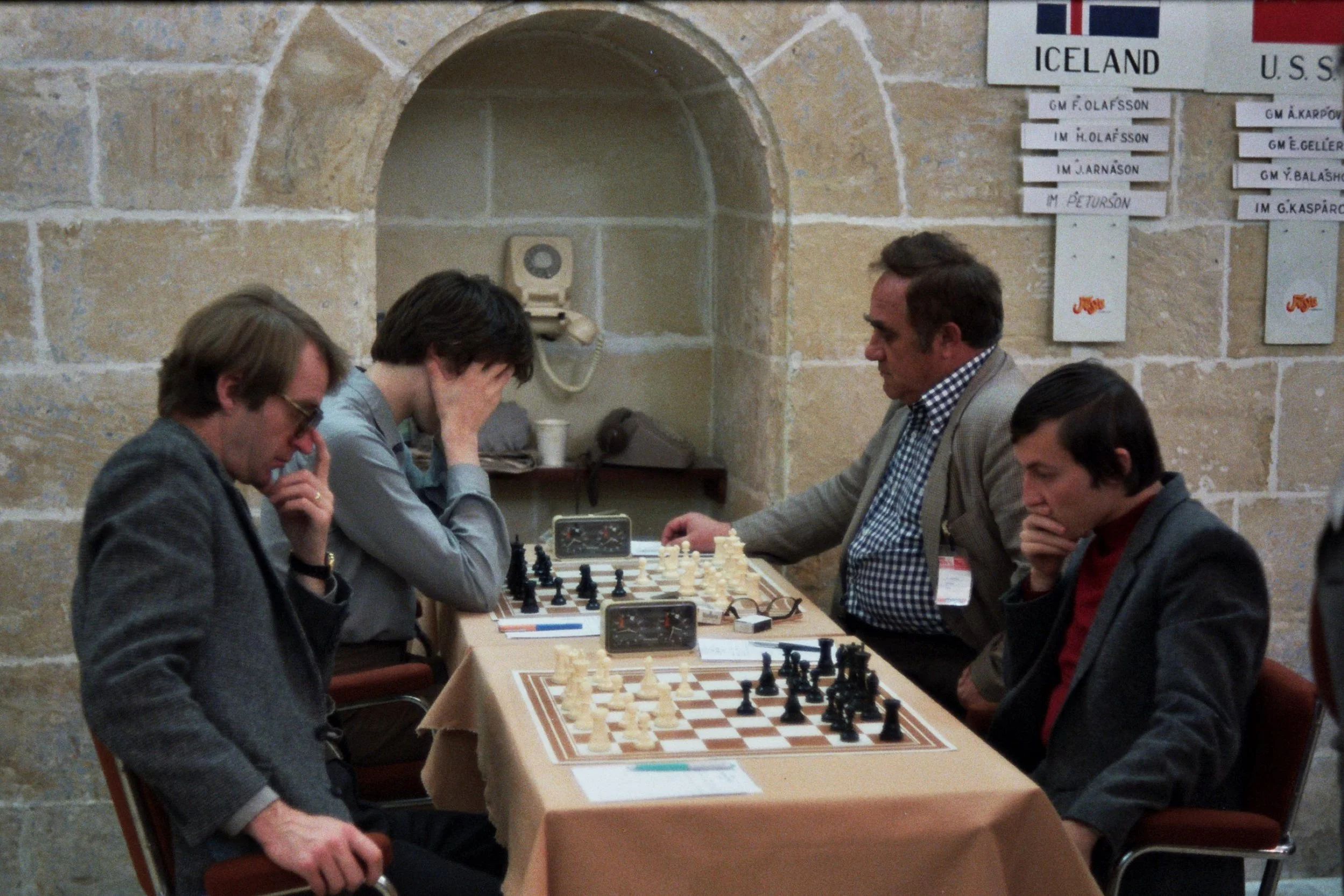
His team record was similarly distinguished. At the 1962 Olympiad in Varna, OlimpBase gives him 10.5/12 on reserve board, enough for individual gold. At the 1980 Olympiad in Valletta, he scored 6.5/9 on fourth board and tied for silver, showing that even late in his career he remained a world-class team asset. He also won individual board golds at the European Team Championship, including Oberhausen 1961 and Kapfenberg 1970. OlimpBase’s aggregate Olympiad statistics credit him with a career percentage of 75.7%, one of the best long-run marks among major Olympiad players. This was not a brief blaze. It was a long-burning furnace.
Geller’s contributions were not confined to tournament and team play. He also wrote serious chess books, including Grandmaster Geller at the Chessboard and The Application of Chess Theory. The titles themselves are telling. They reflect the two poles of his identity: practical grandmaster experience and a constant urge to generalize, explain, and systematize. For a player of Geller’s type, authorship was an extension of analysis. He belonged to the Soviet tradition in which games, opening novelties, and training ideas were not just played but studied, codified, and passed on.
In later life, Geller remained active and decorated. Official FIDE material on the World Senior Championship lists him among the past champions, with the title in 1992. He died in 1998, but his standing has only solidified since then, culminating in his induction into the Hall of Fame in 2024. That recognition fits the historical record well: Geller’s legacy lies not merely in what he won, but in how deeply he shaped elite chess thought while remaining, for decades, one of the world’s most feared tournament professionals.
The cleanest way to place Efim Geller is this: he was a central craftsman of postwar chess modernity. As a competitor, he stood just below the world-title summit for an extraordinarily long time. As a theoretician, he helped redefine how top players handled dynamic openings and the passage from preparation into battle. As a second and analyst, he strengthened not only his own games but the games of other great players. And as a historical figure, he embodies a specifically Soviet paradox: a man could be immense, indispensable, and still not become world champion because the ecosystem around him was crowded with other immortals. That is why serious chess history keeps returning to him. He was not a footnote to the champions. He was one of the people who made championship chess what it was.
