Leonid Stein
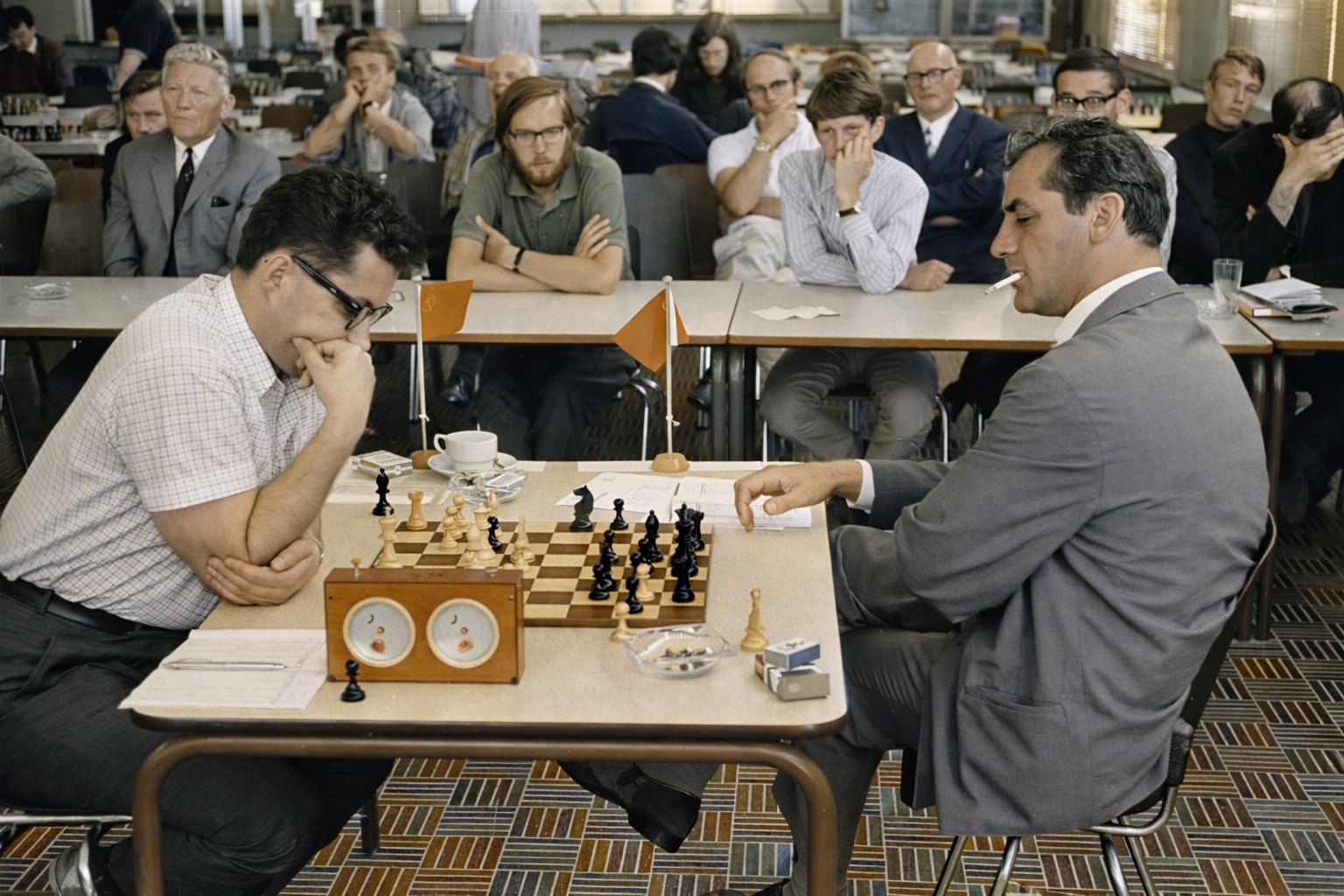
(Luděk Pachman?) left, and Leonid Stein (right)
Leonid Stein belongs in the first rank of great Soviet players, even if his name is invoked less often in the West than those of Botvinnik, Tal, Petrosian, Spassky, or Korchnoi. A three time USSR champion, a repeated Interzonal contender, an Olympiad gold medalist, and a player admired by both Anatoly Karpov and Bobby Fischer, Stein was one of the strongest grandmasters of the 1960s and early 1970s. His career was shaped by two forces at once: extraordinary creative power at the board, and extraordinary bad luck away from it. He rose late, peaked quickly, was repeatedly blocked by the structure of the world championship cycle, and died in 1973 at just thirty eight, on the eve of what many contemporaries regarded as another major title run.
What makes Stein historically important is not only that he won great events, but that he represented a distinct strand of Soviet chess culture. He was an attacking player, yet not a romantic throwback in the careless sense. Contemporary recollections and later assessments consistently emphasize both his tactical eye and his positional sense. Karpov described him as a player with “a subtle sense of positioning with mutual chances and a sharp tactical eye,” while Vlastimil Hort remembered him as a world class grandmaster with a “fantastic flair for the attack.” Taken together, these judgments suggest that Stein stood at a productive midpoint between Tal’s wildest volatility and the more controlled, exacting methods of the later Soviet school.
Stein was born on 12 November 1934 in Kamenets-Podolsky. During the Second World War his family was evacuated to Central Asia, and afterward relocated to Lvov, where his chess education truly began. By the standards of elite Soviet chess he started late, entering chess school around age thirteen, but he improved fast. The Russian Chess Federation’s retrospective account names Alexey Sokolsky as his formative early teacher and Yuri Sakharov as another major influence. That matters, because Stein’s career is often misremembered as pure instinct. In fact, he emerged from a serious Ukrainian and Soviet training environment, and his later games show not just imagination but disciplined preparation and strong opening culture.
His rise was not smooth. While serving in the army he became champion of the Armed Forces and won a national “Candidates for Master of Sport” event, achievements that hardened his competitive character. After demobilization, however, he was disqualified in 1958 for playing cards during a competition and missed the Ukrainian championship final. That episode is revealing. Stein was gifted, but he was not a polished prodigy protected from error. He was a late maturing player, sometimes impulsive, who had to fight his way into the Soviet elite through setbacks that would have derailed many careers. The following year he recovered, took the Master title path seriously, and pushed into the Soviet championship system.
By 1959 and 1960 Stein was no longer a provincial talent but a genuine force. He qualified into the Soviet championship structure, became champion of Ukraine, and by the 1961 USSR Championship had broken into the very top echelon. In that event he shared the bronze medal with Efim Geller, defeated Tigran Petrosian during the tournament, and, as the Russian Chess Federation notes, pushed Boris Spassky out of Interzonal qualification. Stockholm 1962 followed, where Stein scored 13.5/22 and tied for the final qualifying places. He then won the ensuing playoff, scoring 3/4 against Pal Benko and Svetozar Gligorić. Even so, FIDE’s country quota on Soviet qualifiers kept him out of the Candidates, and Benko advanced instead. Stockholm also brought Stein the grandmaster title.
That episode established the central tragedy of Stein’s career. He was strong enough to qualify for the Candidates, but the structure of the world championship cycle repeatedly turned Soviet depth into a personal obstacle. The same basic pattern returned in Amsterdam 1964. There Stein finished fifth with 16.5/23, behind four players clustered on 17, a result that would have been enough for a non Soviet player to remain in the cycle, but the quota rule again left him outside. Mikhail Tal later described Stein as the “superfluous” Soviet, a player whose place was good enough in sporting terms but insufficient under the federation cap. This is one of the clearest cases in modern chess history where a player’s strength and his official progress diverged sharply.
Yet Stein was not merely a victim of the system. He was also one of its greatest conquerors. He tied for first in the 1963 USSR Championship at Leningrad and won the subsequent playoff against Boris Spassky and Ratmir Kholmov, completed in early 1964. He then won the Soviet title outright at Tallinn in 1965 and repeated at Tbilisi in 1966. The Soviet Championship was often, in practical playing strength, comparable to or stronger than many world class international events. To win it three times in four years was an extraordinary feat. Stein was not a fringe contender. He was, for a sustained period, one of the very best players in the strongest chess nation in the world.
His international tournament record confirms that standing. In addition to the Soviet titles, Stein won or shared first at Moscow 1967, a supertournament staged for the fiftieth anniversary of the October Revolution; Hastings 1967-68; Kecskemét 1968; Tallinn 1969; the Alekhine Memorial in Moscow in 1971, shared with the young Anatoly Karpov; and Las Palmas 1973, shared with Tigran Petrosian. The Alekhine Memorial result is especially telling: Stein and Karpov finished first on 11/17, ahead of Smyslov, Petrosian, Spassky, Tal, Hort, Bronstein, and Korchnoi. That was not merely a good week. It was proof that even in the early 1970s, when a new generation was emerging, Stein was still fully world class.
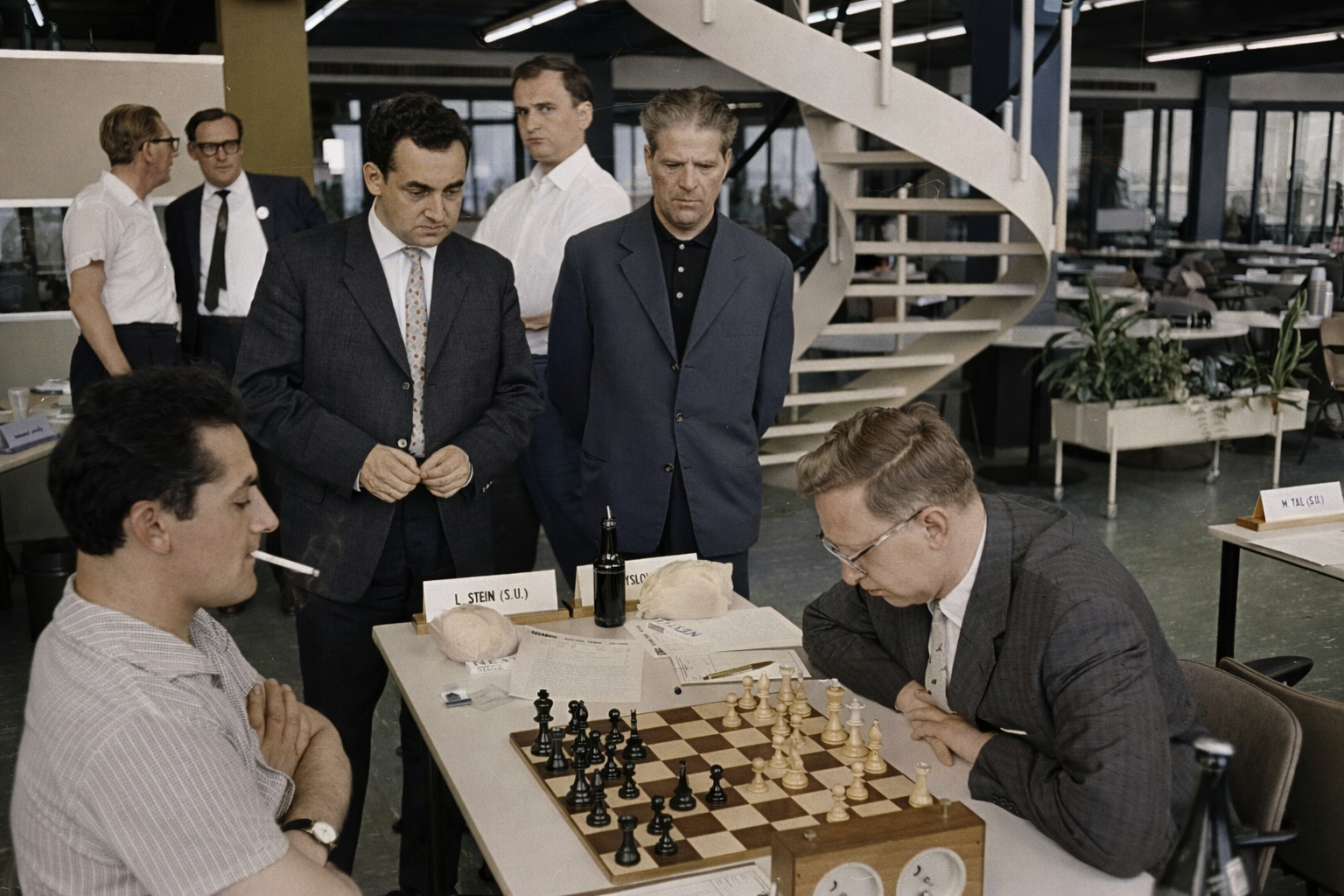
(Left to right) Stein, Taimanov, Ivkov, Lilienthal, Smyslov - Interzonal, Netherlands, 1964
He was also a distinguished team player. Stein scored 9.5/12 on board one for the Soviet Union at the 1961 World Student Team Championship, helping the USSR to gold. At the 1964 Tel Aviv Olympiad he scored 10/13 on first reserve and took individual gold on that board while the Soviet team won team gold. At Havana 1966 he scored 9/12 on board four, good for individual silver, and again helped the USSR to team gold. He also contributed to Soviet victories in the 1965 European Team Championship at Hamburg and the 1970 European Team Championship at Kapfenberg. These results matter because Soviet selectors were ruthless. Stein kept making those teams because he kept justifying selection among an absurd concentration of elite talent.
The one major failure that was not caused by the quota rule came in the 1967 cycle. At Sousse he scored 13/21 and tied with Samuel Reshevsky and Vlastimil Hort for the last qualifying places. In the 1968 Los Angeles playoff he shared first on 4/8, but Reshevsky advanced on the better tiebreak from the main Interzonal. Even here, however, the point is not that Stein fell short of the required level. Rather, he lived almost continuously at the border of world championship qualification, repeatedly entering the final calculation, repeatedly strong enough to contend, and repeatedly denied the clean passage that history tends to remember.
Stylistically, Stein was one of the most dangerous practical players of his time. He excelled in sharp openings, especially the King’s Indian, the Grünfeld, and the Sicilian, but his attacks were rarely unsound flurries. Later commentary continued to identify him as a great predecessor in modern dynamic King’s Indian play, and even short retrospective sketches emphasize that he was feared for his ability to seize the initiative quickly and decisively. The best description may be that Stein made complex chess look natural. He often gave the impression not of calculating more than everyone else, but of seeing the right attacking geometry sooner.
That is why he was so admired by peers. Karpov’s tribute emphasized the distinctiveness of Stein’s contribution to chess, calling it “considerable, peculiar, notable and, in its own way, inimitable.” Fischer, who knew Stein from tournament and blitz play, sent condolences after his death and called him “a wonderful grandmaster and a good friend.” The Russian Chess Federation also records that Fischer once proposed an off cycle match with Stein, though Stein, burdened by the dense Soviet schedule of championships, team events, zonals, and Interzonals, was unable to take it up. Whether or not one treats that proposed match as a near missed historical event, the anecdote captures Stein’s standing. Fischer did not extend that kind of respect lightly.
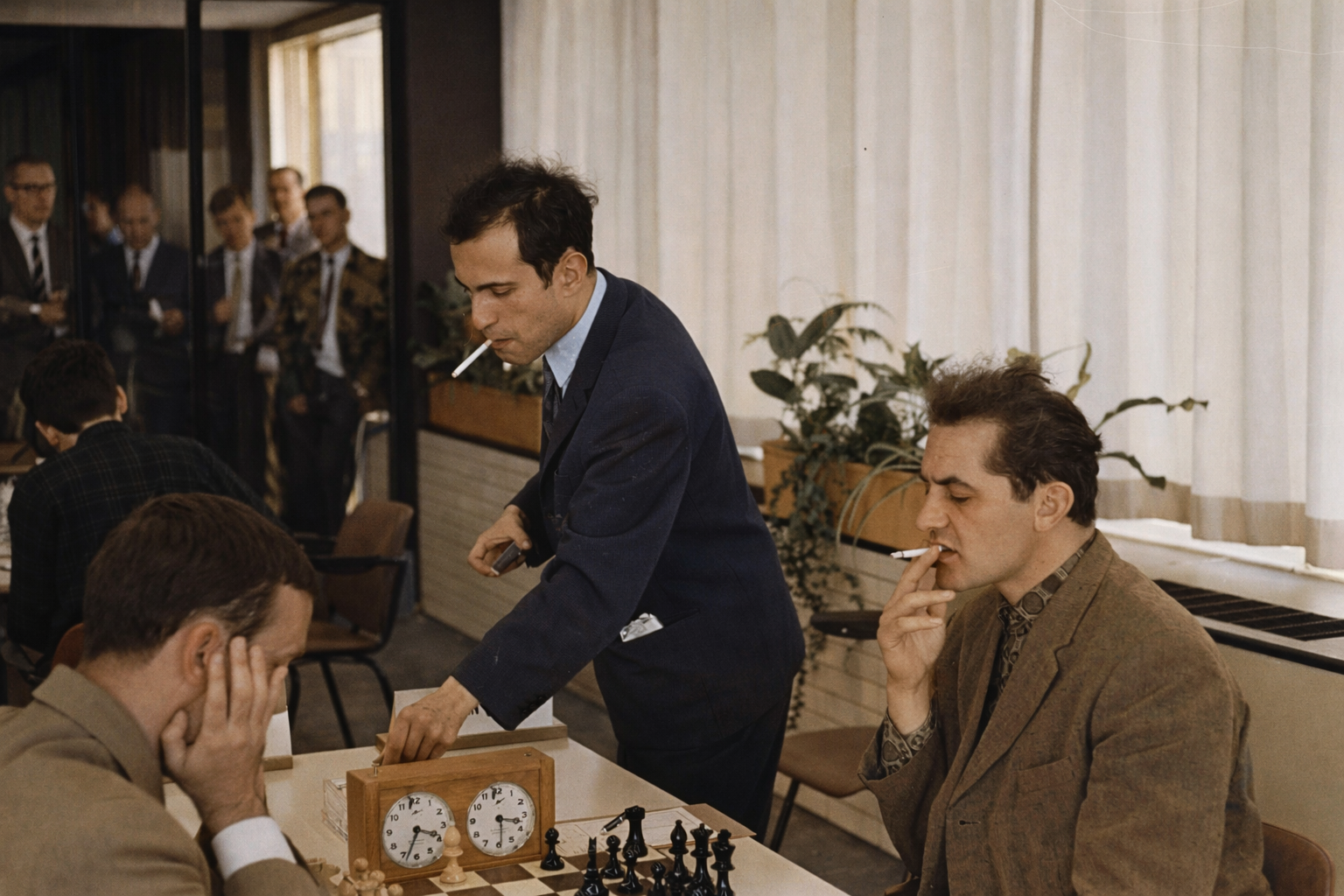
Mikhail Tal and Leonid Stein
Stein’s final years suggest that more remained to be done. He was only a reserve in the 1970 USSR versus Rest of the World match at Belgrade and played just once, losing a spectacular game to Bent Larsen. But his form soon recovered. In 1971 he shared first with Karpov at Moscow, and in 1973 he shared first with Petrosian at Las Palmas. He was due to travel to Bath for the European Team Championship and then onward to the Petropolis Interzonal, where contemporary retrospectives place him among the serious favorites. Instead, he died suddenly in Moscow on 4 July 1973 at the age of thirty eight. Later recollections offered differing explanations and speculations, but the central fact is plain: one of the world’s strongest grandmasters was gone just before another world championship campaign.
His legacy is therefore double. On the chessboard, Stein left a body of games that remains valuable for students of dynamic but responsible attacking play. Historically, he stands as one of the great uncrowned players of the Soviet era, perhaps the clearest example of a grandmaster whose official world championship record understates his actual strength. He was not an almost man in the ordinary sense. He won the Soviet Championship three times, beat elite contemporaries, shone in team competition, and repeatedly proved he belonged in the final stages of the title cycle. What he lacked was not class, but time, and in several cases a fair path. That is why Leonid Stein still matters. He was one of the strongest men in the world, and history never quite got the full measure of him.
