Vasyl Ivanchuk
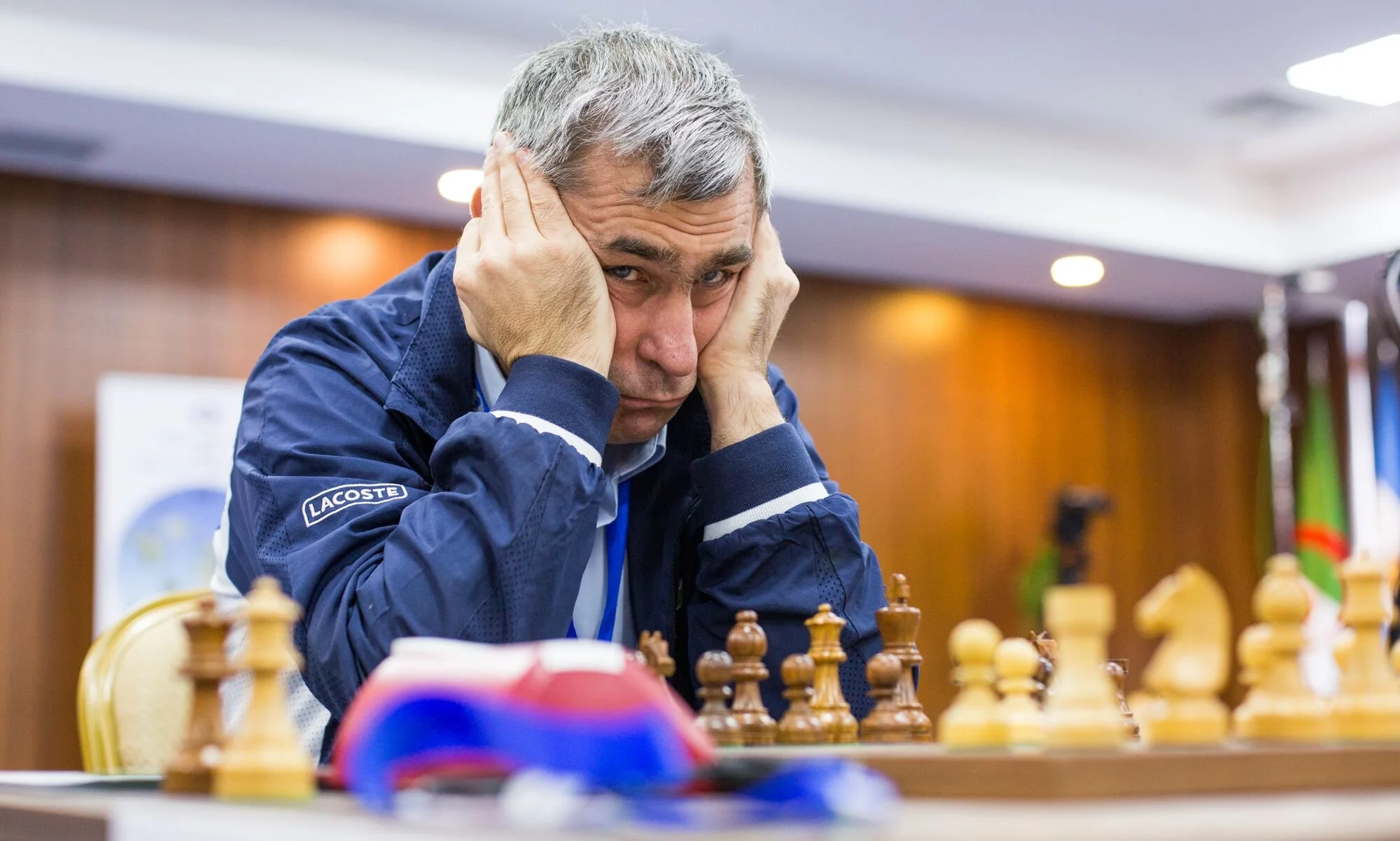
Vasyl Ivanchuk is one of modern chess’s great refusals to fit neatly inside a single label. Born on 18 March 1969 in Kopychyntsi, he became a grandmaster in 1988, rose to world no. 2 on three separate occasions, reached a peak FIDE rating of 2787 in October 2007, played the 2002 FIDE World Championship final, and, as of March 2026, still holds a 2624 standard rating, ranked no. 104 among active players in the world and no. 5 in Ukraine. That is already a first-rank career. What makes him historically fascinating is that the statistics, impressive as they are, still feel like a reduced file of a much larger soul.
The academically serious way to read Ivanchuk is not as “a great player who never became undisputed world champion,” though that is part of the story. It is to read him as a complete chess phenomenon: junior prodigy, supertournament winner, world blitz and rapid champion, opening explorer, team anchor for both the Soviet Union and Ukraine, and a cultural emblem of chess as imagination under pressure. ChessBase’s recent profile calls him a “living legend,” emphasizes his universal style and love of imaginative sacrifice, and notes that he has defeated every classical and FIDE world champion from Anatoly Karpov through Magnus Carlsen. FIDE’s 2023 support letter, meanwhile, matter-of-factly identifies him as the 2016 World Rapid Champion and a four-time Olympiad gold-winner, which is a concise summary of how official chess itself classifies his stature.
His origin story already contains the seeds of the later Ivanchuk. According to a 2025 ICC profile, he began at age six after receiving a magnetic chess set for his birthday; his father, Mikhail, taught him the basics, his mother, Maria, took him to a local library for Journey to the Chess Kingdom by Averbakh and Beilin, and the young Ivanchuk quickly fell under the spell of Alexander Alekhine’s combinations. It is hard to imagine a neater preface to a career that would oscillate between rigorous knowledge and sudden pyrotechnic invention.
His rise through youth chess was extremely fast. ChessBase records that he broke out in 1987 as European Junior Champion, then tied for first in the 1988 World Junior but lost the title on tiebreak to Joël Lautier. The same source notes that he rose into the world top 10 later in 1988, while his official FIDE profile confirms the title sequence of IM in 1987 and GM in 1988. In other words, Ivanchuk did not spend long as a promising prospect. He moved almost immediately into the category of serious world-class player.
Even before his individual legend fully crystallized, team events revealed something essential about him. At the 1988 Olympiad in Thessaloniki he scored 6½/9 as the Soviet Union’s second reserve on the gold-medal team. At the 1989 World Team Championship in Lucerne he scored 6½/7 on first reserve, the best result on that board. Team chess would remain one of the clearest mirrors of his greatness, because it showed that beneath the aura of unpredictability there was also extraordinary competitive usefulness.
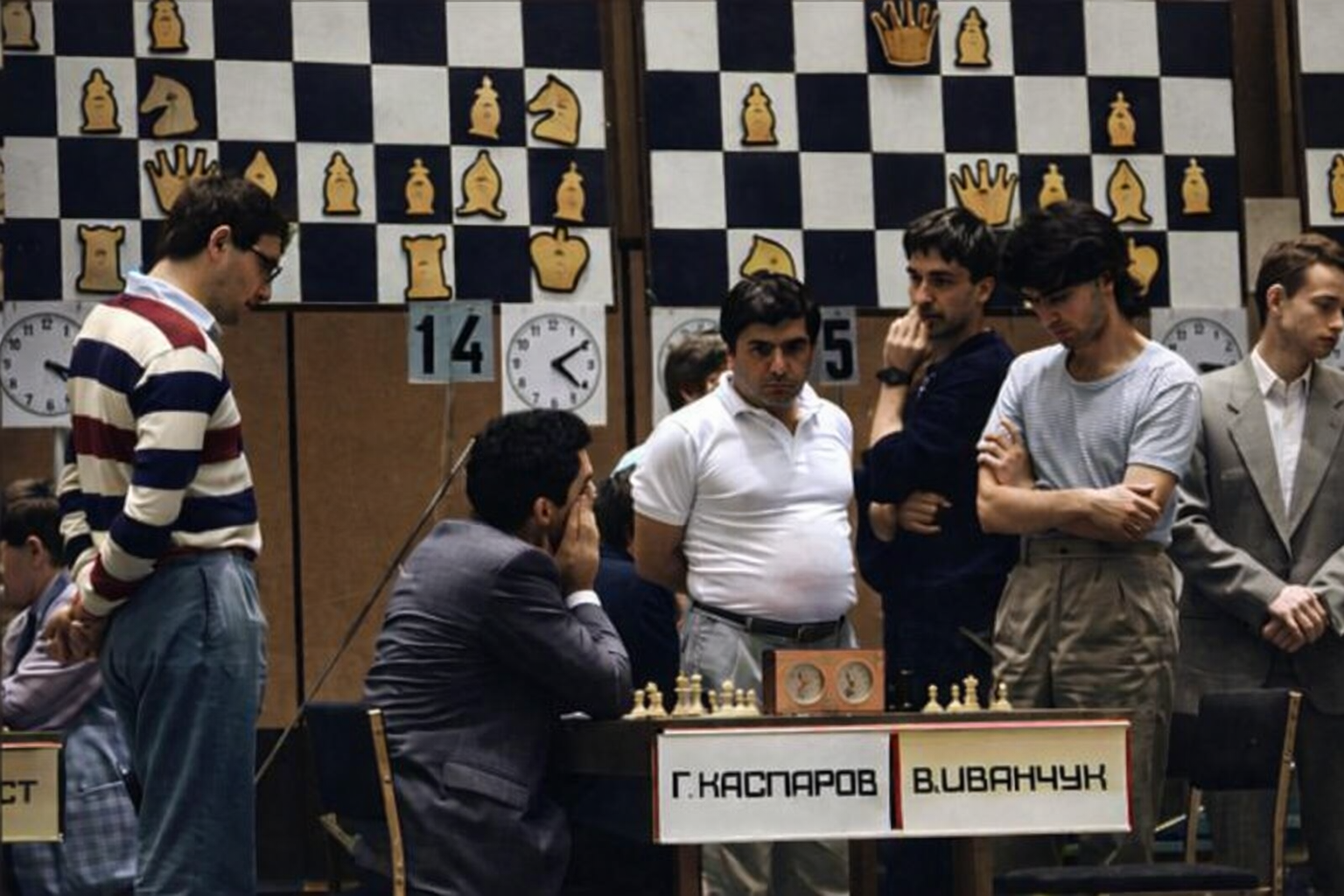
Kasparov and Ivanchuk, Moscow, 1988
The event that forced the wider chess world to fully reckon with him was Linares 1991. At just 21, Ivanchuk won one of the strongest tournaments on earth, defeating reigning world champion Garry Kasparov in their direct encounter. This was not a charming upset in a second-tier field. It was a frontal breakthrough in a tournament dense with elite opposition. From there, the world no. 2 ranking was not a one-time spike: he reached that station in 1991, 1992, and again in 2007.
World championship cycles, however, never bent to him as cleanly as tournament play often did. ChessBase’s 2013 Candidates portrait notes that he reached the quarterfinals of the 1991-93 Candidates and lost narrowly to Artur Yusupov, 5½-4½. That pattern, being strong enough to arrive deep into the cycle but not always to convert the final pressure points, would become one of the major themes of his career.
His closest approach to the title came in the 2001-02 FIDE knockout World Championship. FIDE’s archive shows that he defeated Viswanathan Anand 2.5-1.5 in round six, only to lose the final to Ruslan Ponomariov by 4½-2½. This matters because it proves that Ivanchuk was not merely a “tournament genius” in the casual sense. He was fully capable of surviving the brutal narrowing funnel of championship competition and reaching the very last match.
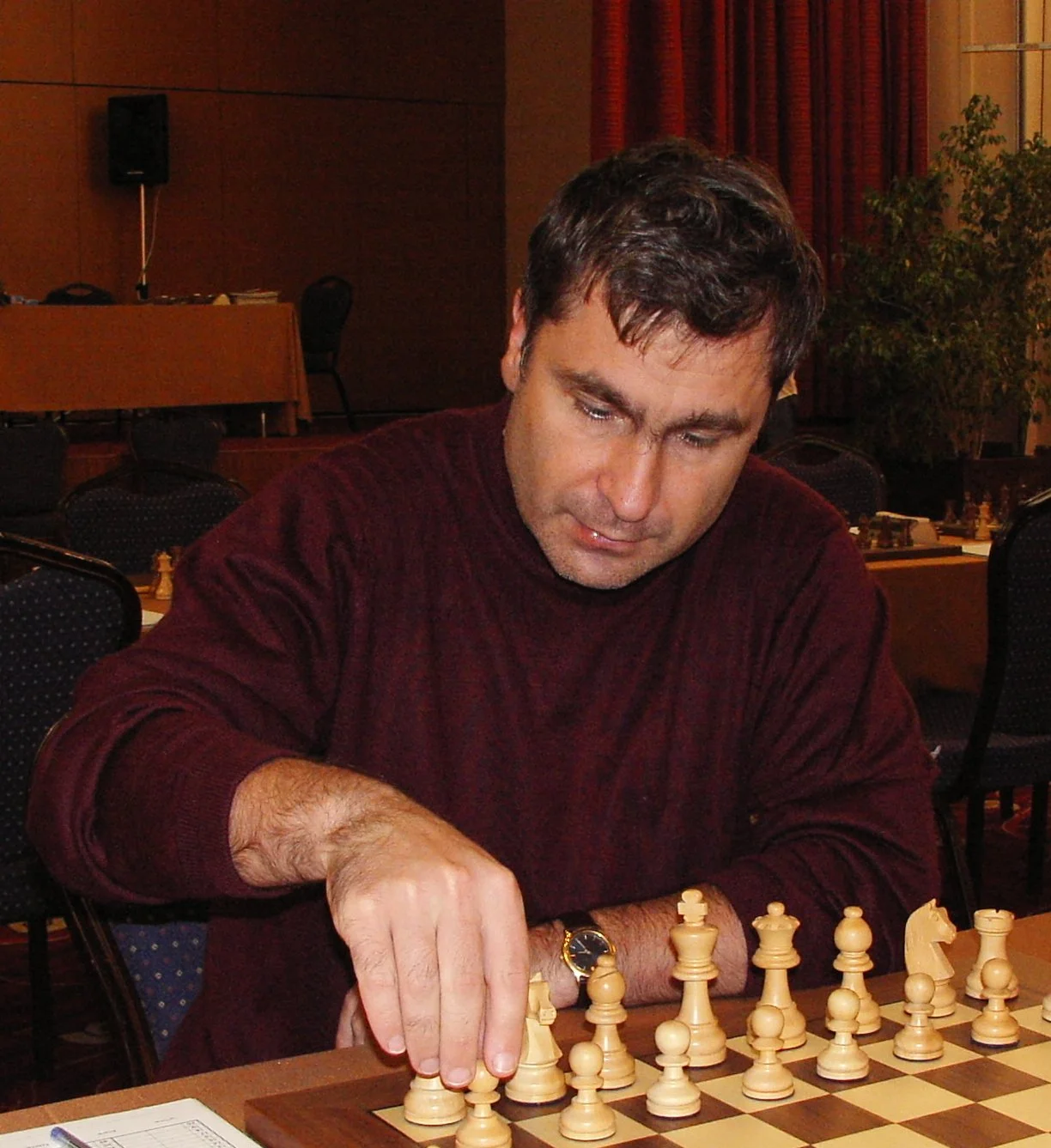
Once you stop staring only at the missing classical crown, the career becomes an avalanche. He won the European Individual Championship in 2004. In Moscow in 2007 he captured the World Blitz Championship with 25.5/38, finishing ahead of Anand. In Doha in 2016 he won the World Rapid Championship with 11/15, taking the title on tiebreak after a shaky final day and two closing wins. These are not side quests. They demonstrate that Ivanchuk’s excellence extended across time controls and across different kinds of elite fields.
His list of major tournament victories also stretches across eras and geographies. FIDE reported his 2008 M-Tel Masters win at 8/10, including a devastating first half of the event. Later that same year, ChessBase reported that he won the Tal Memorial by a full point, a result that lifted him back to live no. 2. His relationship with Havana became almost novelistic in its durability: FIDE described his 2010 Capablanca Memorial win as his fourth title there, while ChessBase recorded an eighth Capablanca Memorial title in 2019. More broadly, ChessBase credits him with major wins at Linares, Wijk aan Zee, Tal Memorial, Gibraltar and M-Tel. His career map is not one summit. It is a mountain range.
He also reinvented himself repeatedly. By taking bronze at the 2011 World Cup, he qualified for the 2013 Candidates Tournament. He finished seventh there with 6/14, but even from the lower half of the table he materially altered the championship race: FIDE’s round-12 report records that Magnus Carlsen suffered his first loss of the event against Ivanchuk. This was deeply characteristic. He could be too volatile in a long cycle to dominate it, yet still strong enough to wound the strongest player in the world.
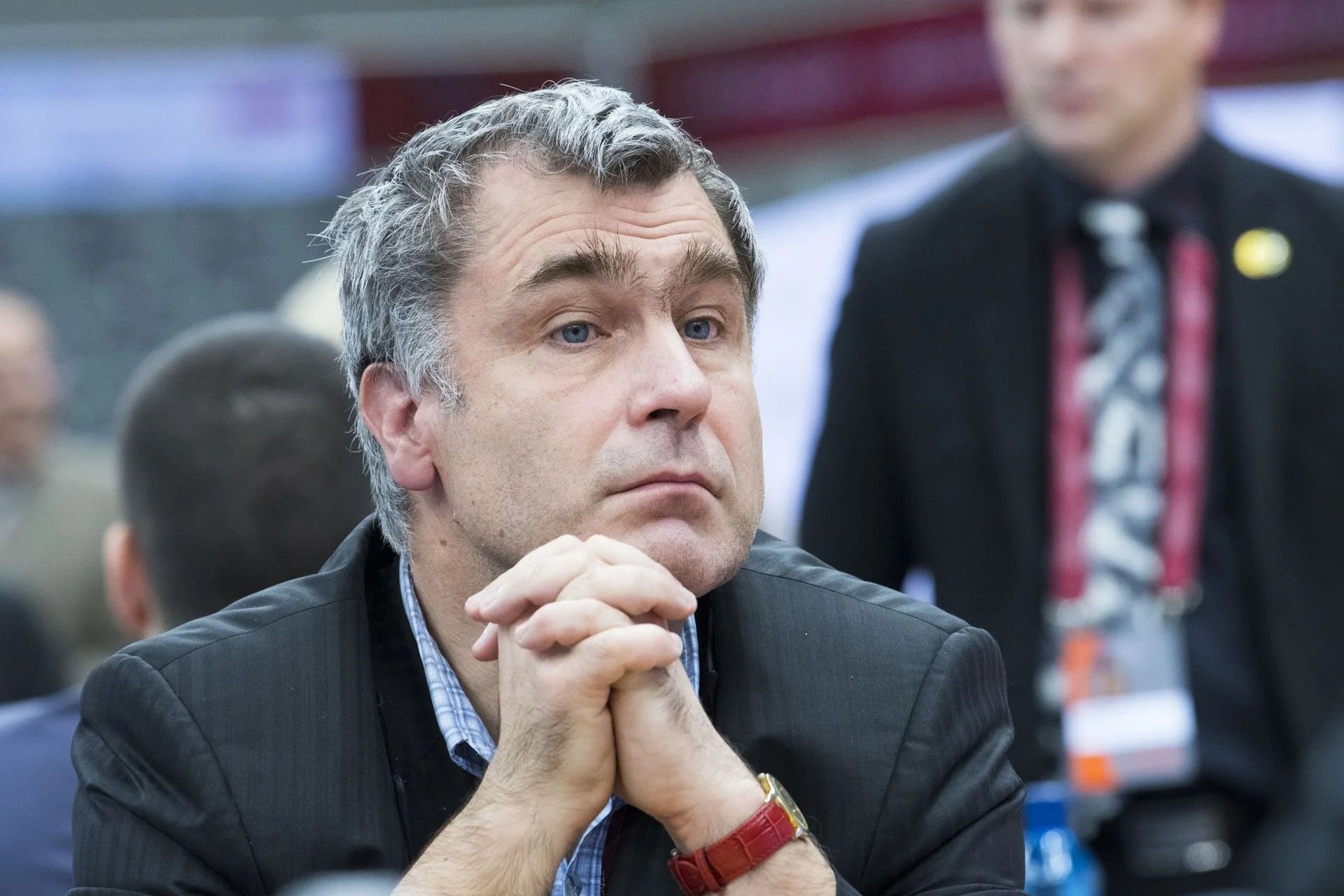
One of the most remarkable aspects of Ivanchuk’s career is its late-life abundance. In the 2023 World Cup, FIDE noted that the 54-year-old Ivanchuk eliminated the 30-years-younger Wei Yi by 1.5-0.5. ChessBase then documented a 2025 spring resurgence in which he gained 40 rating points, re-entered the top 100, and won the Menorca Open with 8/9. In January 2026 he finished second at Tata Steel Challengers with 9.5/13, and by March 2026 his official FIDE standard rating stood at 2624. A March 2026 ChessBase report also described him sweeping a 31-board simultaneous exhibition in Salzgitter-Bad. For most grandmasters, the later chapters are footnotes. For Ivanchuk, they still produce new primary material.
Stylistically, Ivanchuk is best understood as a universal player with a pronounced appetite for imbalance. ChessBase’s 2025 profile describes him as one of the most creative and unpredictable players of recent chess history, notes his mastery of virtually all aspects of the game, and highlights both his surprising sacrifices and his fondness for uneven material balances. That combination is what made him so difficult to prepare for. Many elite players have a dominant dialect, endgame squeeze, tactical assault, prophylactic squeeze, or opening specialization. Ivanchuk could speak nearly all of them.
This is why his contribution to chess theory is slightly unusual and very important. He is not remembered mainly as the proprietor of one “Ivanchuk variation” in the way some players are attached to a narrow technical brand. He is remembered instead as a repeated widener of the map, a player who took established openings and pushed them into new imaginative territory. The emblematic case is his legendary Qg7!! against Alexei Shirov in Wijk aan Zee 1996, which ChessBase describes as a pre-engine shock to the chess world and a symbol of bold calculation and creative freedom. From an academic perspective, Ivanchuk’s theoretical legacy lies not in a single named patent but in a pattern of making elite players rethink what complicated positions were truly playable.
Longevity and caliber are also visible in a statistic that has the feel of folklore but is documented plainly by ChessBase: Ivanchuk has defeated every classical and FIDE world champion since Bobby Fischer, from Karpov to Carlsen. That requires more than a long career. It requires repeated relevance across wholly different chess generations, opening fashions, and competitive climates.
If individual chess displayed his imagination, team chess displayed his weight. FIDE’s 2023 support letter identifies him as a four-time Olympiad gold-winner, with the Soviet Union in 1988 and 1990, and with Ukraine in 2004 and 2010. In Calvià 2004 he led Ukraine on board one with 9.5/13, undefeated, for a 2819 performance rating. In Khanty-Mansiysk 2010 he took the individual gold on first board with a 2890 performance. That is not simply participation in successful teams. It is structural importance to them.
The same pattern appears beyond Olympiads. At the 1989 World Team Championship he had the best first-reserve result with 6½/7, and in 1997 he had the best result on first board with 6/8. So when Ivanchuk is described as mercurial, that is only half true. In team competitions, where federations needed points rather than myth, he very often delivered both.
His importance to Ukrainian chess is also historical and civic, not merely competitive. In July 2023 FIDE reported that Ivanchuk, then living in Lviv, had received a World Cup wildcard but was denied permission to leave Ukraine under wartime rules for men under 60. The reaction was extraordinary: Carlsen, Anand, Nakamura, Caruana, Wesley So and Boris Gelfand were among the elite players who signed an open letter in support of him. A 2025 ICC profile adds that the war affected him deeply and that he had begun taking steps toward relocating to Spain. Even in late career, Ivanchuk’s biography runs directly through the political realities of contemporary Ukraine.
And he has continued to matter over the board for Ukraine. ChessBase reported that at the 2024 Olympiad in Budapest, Ukraine’s upset of the top-seeded United States was clinched by Ivanchuk’s win over Wesley So. It is a perfect late-career image: the veteran, still capable of tipping a match against the biggest names on the largest team stage.
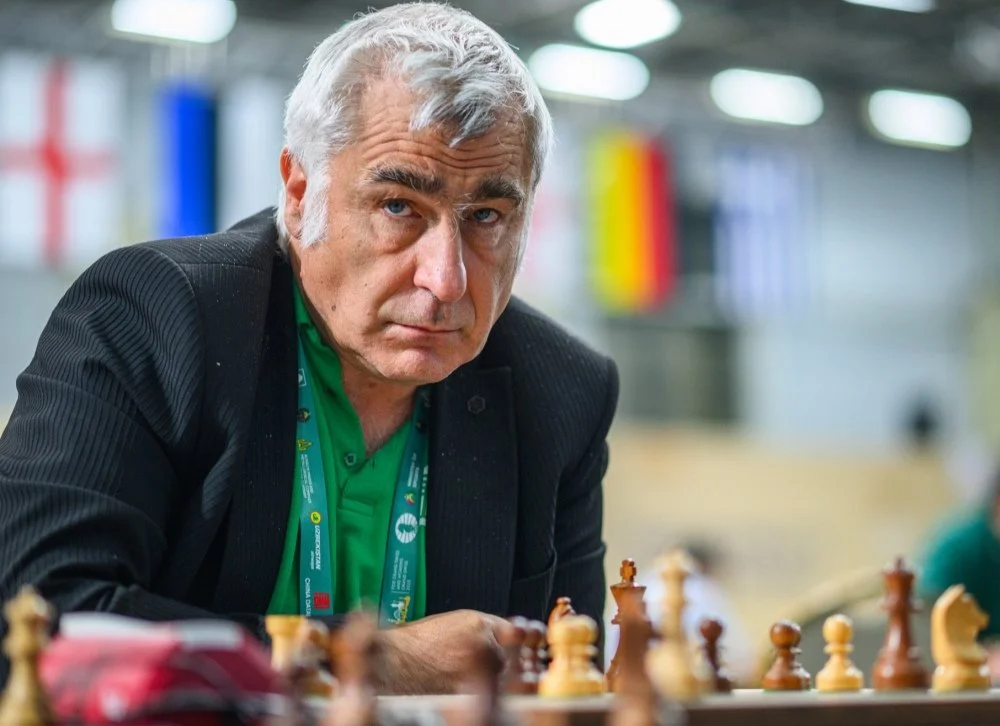
The public legend of Ivanchuk is inseparable from temperament. ICC’s 2025 portrait describes tears at the board after painful defeats, relentless post-mortem analysis with almost anyone available, and a startling capacity for learning that reportedly allowed him to pick up Spanish very quickly and Turkish in much the same way. The same profile notes his affection for detective novels and history books, his singing of Ukrainian folk songs, and Anand’s joke that he lives on “Planet Ivanchuk.” These details matter because they help explain why so many peers speak of him not just as strong, but as singular. He gives the impression of a mind that does not visit chess as an occupation so much as inhabit it as weather.
Late in career he also became more openly pedagogical. ChessBase reported in 2022 that he had started streaming on YouTube, showing and explaining current games. That may look like a small footnote beside world titles and supertournament wins, but it is a meaningful contribution: a player with one of the game’s deepest internal libraries choosing to externalize part of that knowledge for a wider public.
His volatility has sometimes spilled into headlines. After losing to Wesley So at the 2009 World Cup, he declared in anguish that chess would become merely a hobby, then retracted the statement within days. After the 2008 Dresden Olympiad, a missing-drug-test controversy threatened severe consequences, but FIDE later concluded that there had been no valid refusal and imposed no penalty. These episodes are worth noting not as gossip, but because they reveal how unusually exposed Ivanchuk’s competitive life has always been to emotion. His triumphs and collapses alike have tended to arrive without insulation.
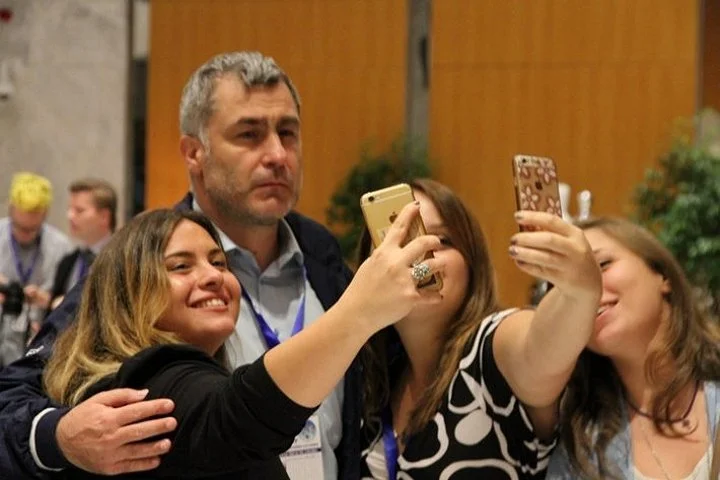
Why, then, did such a player never become undisputed or classical world champion? The simplest answer, and probably the least complete, is nerves. ChessBase notes that speculation about his mental resilience has long followed him, and ICC reports that many peers believed his emotional volatility may have cost him the championship. But that answer is only partial. Another part is that world titles are won in very specific formats, on very specific weeks, while Ivanchuk’s greatness was distributed across decades, across classical and rapid and blitz, across team events, across multiple political eras, and across several generations of opponents. My own judgment is that his career exposes the limits of title-centric history. World-championship conversion is one test of greatness. It is not the whole exam paper.
So the most defensible historical verdict is this: Vasyl Ivanchuk belongs among the great figures of modern chess not in spite of his irregularity but partly because of it. He joined late Soviet and independent Ukrainian chess culture in a single life, beat every kind of opponent, helped carry national teams to gold, left opening culture richer than he found it, won world titles in fast chess, and continued producing elite-level results well into his fifties. He is one of the strongest players never to hold the undisputed world title, but even that description feels too cramped. Ivanchuk is better understood as one of the most original grandmasters the game has produced, a player for whom chess was never just a sport or a profession, but a kind of total medium.
Sources
1. FIDE Profile: Ivanchuk, Vasyl
https://ratings.fide.com/profile/14100010
2. FIDE. Top players sign an open letter in support of GM Ivanchuk
https://www.fide.com/top-players-sign-an-open-letter-in-support-of-gm-ivanchuk/
3. OlimpBase. World Men's Team Chess Championship :: Vasyl Ivanchuk
https://www.olimpbase.org/playerst/oeo8eigf.html
4. Tata Steel Chess 2026, Challengers standings
https://tatasteelchess.com/en/archive/tournament/2026/Challengers/10/standings
5. ChessBase. Understanding before Moving 221: Vasyl Ivanchuk
https://en.chessbase.com/post/understanding-before-moving-221-vasyl-ivanchuk
