Lev Psakhis
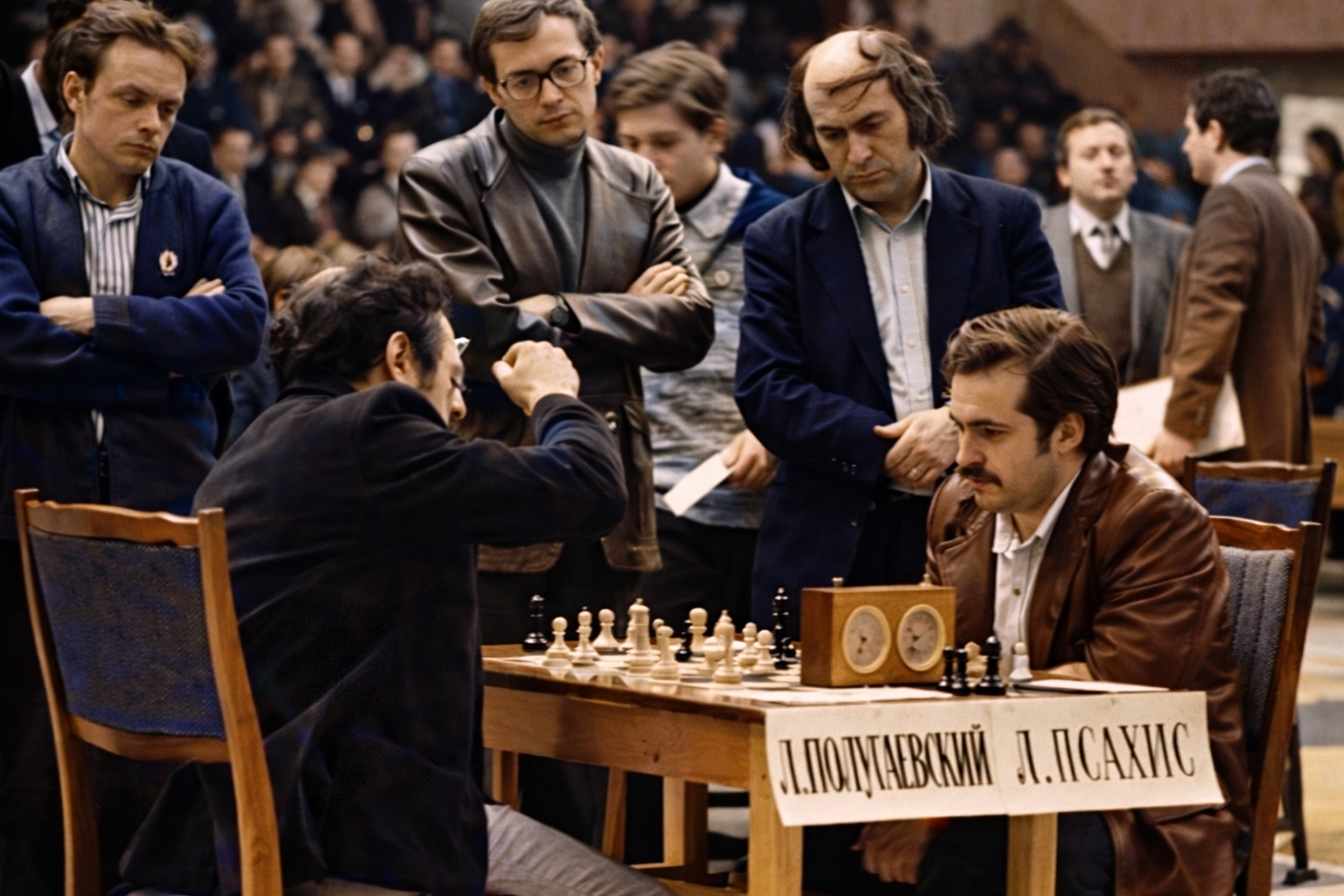
Lev Psakhis is one of those grandmasters who sits just outside the loudest spotlight, yet the closer you look, the more he seems to be threaded through several major histories at once: late Soviet elite chess, Israeli team chess, opening literature in English, and modern high-level coaching. He was born in 1958, later represented Israel, won the Soviet Championship twice, received the GM title in 1982, and would go on to earn the FIDE Senior Trainer title. As of March 2026, his FIDE profile still lists him with inactive ratings of 2438 in standard and 2517 in rapid.
The first reason Psakhis matters is straightforward: he was genuinely world-class. Modern historical rating databases record a peak FIDE rank of no. 9 in July 1982, while ChessBase’s player archive lists a best Elo of 2625. That puts him not in the category of “strong grandmaster” in the generic sense, but in the much narrower class of players who briefly stood among the strongest few on earth. The second reason he matters is less obvious and, in some ways, more important: his influence did not end with his own tournament results. He became a transmitter of chess knowledge across generations and countries, from the Soviet school to Israel, to the Polgár orbit, to Indian team preparation, and to later students such as Daniel Naroditsky.
Origins, early formation, and the Botvinnik anecdote
Psakhis was born in Tver and grew up in Krasnoyarsk after his family moved there during his school years. That geography matters. He was not formed in the most mythologized Soviet chess capitals, yet he emerged from the Soviet system anyway, which says something about both his talent and his self-propulsion. As a young player he studied at Botvinnik’s school, but the relationship quickly acquired a legendary anecdote: after an early knight sacrifice on f7 in the Petroff, Botvinnik reportedly dismissed it as “chess hooliganism,” and Psakhis was expelled. He also enrolled at university in Krasnoyarsk but did not graduate, because chess became his profession.
That story is more than colorful folklore. It is a miniature portrait of the young Psakhis: daring, combative, impatient with sterile orthodoxy, and willing to test doctrine by force. Botvinnik’s objection was not merely to a move, but to a style of engagement with chess. Psakhis’s later career would show that this was no adolescent whim. He remained a player whose chess had teeth, and whose best work often began where clean systems ended and live complications began.
Breakthrough in Soviet chess
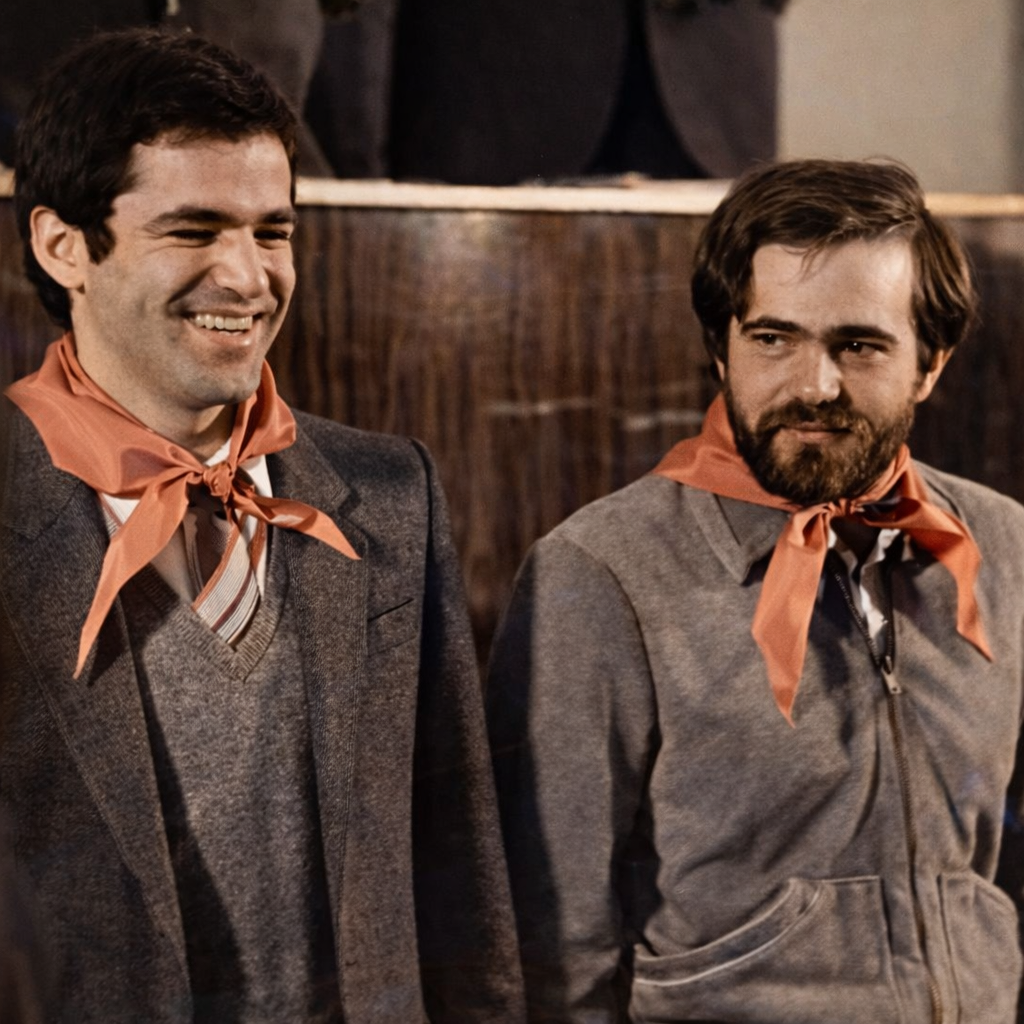
His rise was rapid. In 1979 he won the RSFSR championship and also the Union tournament of young masters. Then came the achievements that permanently fixed his name in Soviet chess history: he shared first in the 1980/81 USSR Championship at Vilnius with Alexander Beliavsky, and then shared first again in the 1981 championship with Garry Kasparov. Official championship summaries confirm both titles, and the Russian Chess Federation notes that winning the national title in consecutive years was a feat achieved by very few Soviet players.
The 1981 title is especially revealing. Psakhis did not merely tie Kasparov at the top. The crosstable of the 49th USSR Championship shows that he actually defeated Kasparov in their individual encounter while both finished on 12½/17. That matters because it illustrates the real competitive meaning of Psakhis at his peak: he was not just present in the same era as the future world champion, he could beat him in direct, high-stakes elite play.
By 1982 he had secured the grandmaster title, and the raw trajectory of his ascent was unmistakable. In a very short span he had moved from promising Soviet talent to national champion to recognized world-class grandmaster. If one wanted to identify the sharpest upward arc of his career, it runs from the 1979 RSFSR title through the 1982 GM title and world top-10 standing.
The world-championship cycle and his place in the world hierarchy
Psakhis also came close to translating Soviet success into a deeper run in the world championship cycle. Contemporary records show that he finished runner-up behind Artur Yusupov at the 1982 Yerevan Zonal, which qualified him for the Las Palmas Interzonal later that year. There he scored 6/13, a respectable but insufficient result, and did not reach the Candidates. The Russian Chess Federation’s retrospective summary puts it simply: he did not break into the top eight.
This near-miss is important for historical placement. Psakhis belongs to that formidable Soviet cohort who were strong enough for the top layer of world chess, but whose path to the very summit was blocked by the density of the era itself. A player can be a two-time Soviet champion, a world top-10 performer, and still never become a regular world-title-cycle protagonist. In Psakhis’s case, that says as much about the ferocity of early-1980s Soviet chess as it does about any limitation of his own.
Tournament career beyond the Soviet titles
The Soviet titles were not isolated spikes. The Russian Chess Federation’s profile of Psakhis describes the 1980s as his best years and lists a substantial set of international successes, including victories in Sarajevo, Cienfuegos, Yerevan, Szirak, and Troon, along with other strong prize finishes. It also notes that he won a major Soviet rapid or “tempo” event in 1987, held for the 70th anniversary of the October Revolution. These are not decorative add-ons. They show a player who could follow national glory with repeated international confirmation.
His later tournament career also had real substance. Near-contemporary reports show him tying for first at the 1999 Mind Sports Olympiad main event on 7/9 alongside Alexander Baburin and Jon Speelman, and winning the 2000 Andorra Open outright with 7.5/9, half a point clear of Mihail Marin and Hicham Hamdouchi. In Israel, event records and winners’ lists support his 1996 national title after the tournament ended in a three-way tie at 6.5/9. These later results matter because they show durability: Psakhis was not merely an early-1980s phenomenon living on reputation. He kept producing serious results well after the Soviet phase of his career had ended.
Move to Israel and the Israeli chapter
In 1989 Psakhis moved to Israel. That relocation is not a biographical footnote. It marks the second major act of his chess life. The Soviet grandmaster of the early 1980s became, in the 1990s and early 2000s, one of the experienced pillars of Israeli chess, helping stabilize a national team culture that increasingly included elite names such as Boris Gelfand, Ilya Smirin, Emil Sutovsky, Alexander Huzman, and Boris Avrukh.
His Israeli career was not ceremonial. At the 1990 Olympiad in Novi Sad he played board one for Israel and scored 8/13. In 1996, now on board four, he scored 6.5/10 for Israel at Yerevan. In 1998 he added 5/8 on board four at Elista. At the 2000 Olympiad in Istanbul he scored 4.5/8 on board four, and OlimpBase’s event summary notes that Israel finished fifth with only four game losses, one of the better team performances in the country’s Olympiad history. In 2002 Israel finished ninth at Bled, with Psakhis still part of the lineup.
Team chess and why it matters for his legacy
Team chess is one of the most useful keys to understanding Psakhis. The Russian Chess Federation notes that, as a member of the Soviet juniors’ team, he became world champion twice, in 1981 and 1983, and that he also became European team champion with the Soviet men in 1983. The official OlimpBase page for Plovdiv 1983 fills in the harder edges of that result: the USSR won team gold, and Psakhis, playing board seven, scored 5/7 without a loss and took individual gold on his board.
He reproduced that kind of team value for Israel. At the 1999 European Team Championship in Batumi, Psakhis scored 5.5/7 on board four, again undefeated, with a 2743 performance rating, winning individual gold on that board. This is one of the most important but least remembered facts about him. It shows that even after his Soviet peak, he remained a highly efficient team competitor, exactly the sort of player national squads treasure because he converts experience into points.
Style: what kind of player was he?
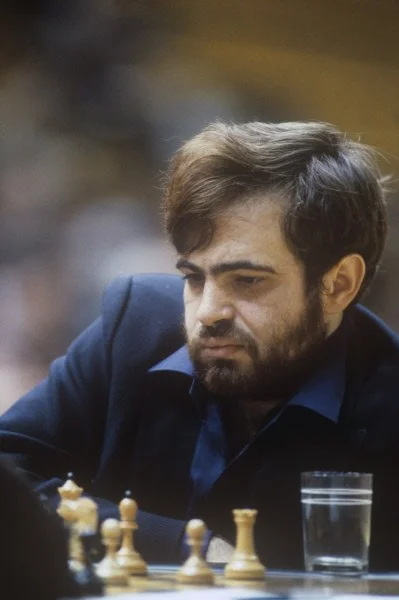
The Russian Chess Federation characterizes Psakhis’s style as “inventive and attacking,” and notes that his games regularly drew spectators and were often counted among the best of the events in which they were played. That description matches the Botvinnik anecdote, the tactical reputation encoded in Advanced Chess Tactics, and the general shape of his best-known games. Psakhis was not a dry accumulator. At his best he played chess that had narrative velocity. Positions did not merely get solved; they got stressed, stretched, and made to answer uncomfortable questions.
But to stop there would be misleading. One of the more interesting arc-lines in his career is the shift from attacking player to deeply practical teacher. Secondary biographical summaries describe his younger self as drawn to sharp, complex positions, whereas later testimony from students and fellow trainers highlights his knowledge of endings, structure, and practical play. That evolution is not a contradiction. It is the maturation of a fighting player into a complete chess educator.
Psakhis as author and opening theoretician
Psakhis’s writing career is substantial enough that he would deserve historical notice even if his tournament résumé were smaller. His early English-language opening books include The Complete French, originally published by Batsford in 1992 and in a 1993 New York edition, and The Complete Benoni in 1995. Those are not casual side projects. They are full-scale repertoire works, and they helped place him among the major practical opening authors of his generation.
He later produced a full French Defence cycle in the early 2000s: French Defence 3Nd2 (2003), Advance and Other Anti-French Variations (2003), French Defence 3Nc3 Bb4 (2003), and French Defence: Steinitz, Classical and Other Systems (2004). Taken together, these works amount to a large cartographic project: not a pamphlet on one sideline, but a sustained attempt to map the French Defence as a living repertoire universe.
His broader pedagogical identity is also visible in Advanced Chess Tactics, whose later edition runs to 416 pages. Product descriptions and publisher excerpts stress that the book is built around attacking play, recurring structures, and explanatory depth rather than mere puzzle consumption. That suits Psakhis perfectly. His best writing tends to sit at the seam where concrete analysis meets human guidance: not only what works, but what a player ought to notice, feel, and fear in the position.
An especially interesting paradox lies here. Psakhis became famous as an opening author, especially around the French, yet later testimony about his coaching philosophy suggests he did not especially enjoy coaching openings. In other words, he wrote major opening books, but as a trainer he seems to have believed that many players were under-investing in the rest of chess. That tension is not accidental. It reveals a serious practical thinker, someone who understood that publishing theory and improving human beings are related but not identical tasks.
Trainer, second, and teacher
Psakhis’s FIDE profile lists him not only as a grandmaster but as a FIDE Senior Trainer, with the title dating from 2004. That formal credential matters less than the underlying reality: for many years he functioned as a high-level coach whose influence extended well beyond his own games. The Russian Chess Federation says he began working with the Polgár sisters in 1992, later worked with Emil Sutovsky, and trained the Indian national team.
There is direct corroboration for parts of that coaching map. Judit Polgár later referred to Psakhis as her “old trainer,” which is a compact but meaningful confirmation of his role in her development. A contemporary TWIC report from late 1995 noted that Psakhis and Judit would both assist Susan Polgar in her 1996 world championship match. These are not marginal connections. They place Psakhis inside one of the most historically important training ecosystems in modern chess.
His later students and collaborators further broaden the picture. Daniel Naroditsky said in a 2010 interview that Psakhis was coaching him then and called him “a huge endgame specialist,” adding that he had learned many endgame ideas from him. Meanwhile, Dvoretsky, quoting Psakhis about his work with the Indian team, reproduced a coaching philosophy built around human contact, selectivity, and endgame seriousness rather than opening obsession. Psakhis reportedly argued that not every talented student can be transformed equally, that the trainer-student relationship matters enormously, and that modern players often neglect the ending at their peril.
That coaching stance may be the single most revealing thing about him. The opening author turned out, in pedagogical practice, to be something closer to a whole-game realist. He seems to have valued technical phases, practical conversion, and the psychological chemistry between trainer and student. This helps explain why his influence appears in such varied places. He was not selling a narrow system. He was teaching how to think, how to feel a position, and how to survive the long grind after the opening fireworks have gone out.
Later years and continuing presence
Even late in life, Psakhis did not disappear into archival sepia. Secondary biographical accounts report that he underwent a liver transplant in 2011 and later recovered sufficiently to return to chess activity. More concretely, game databases record him still appearing in Israeli team competitions into 2023, and the March 2026 FIDE list continues to show him as an inactive but rated grandmaster. So the story is not one of a vanished Soviet relic. It is a story of long endurance, including a difficult personal chapter followed by continued public presence in chess.
What people often forget about Lev Psakhis
What usually gets omitted in quick sketches of Psakhis is the shape of his total contribution.
First, he was not merely a “French Defence author.” He was a genuine world-class player who won the Soviet Championship twice and reached top-10 standing. That alone puts him in rare company.
Second, he was not only a Soviet-era figure. The Israeli chapter was not an epilogue but a second career, rich in Olympiads, team events, national competition, and board-medal performances.
Third, his legacy is at least as pedagogical as it is competitive. The FIDE Senior Trainer title, the Polgár connection, work with Sutovsky, Naroditsky’s testimony, and his role with India all point to a man whose afterlife in chess history runs through other people’s improvement as much as through his own tournament tables.
Fourth, he is a useful corrective to a distorted way of telling chess history. Too many narratives orbit only world champions and Candidates finalists. Psakhis reminds us that chess culture is also built by players who were elite enough to beat future world champions, deep enough to write lasting books, and generous enough to pass their knowledge forward. In that sense, his career is not a side corridor. It is one of the hidden load-bearing beams.
Bottom line
Lev Psakhis should be remembered as far more than “the other co-winner” of Soviet championships with Beliavsky and Kasparov. He was a top-tier Soviet grandmaster, a world top-10 caliber player, a durable Israeli team mainstay, a major opening author, a tactician with an attacking imagination, and a coach whose influence touched some of the most important chess cultures of the last few decades. His career is best understood as a bridge: from Soviet rigor to international practice, from elite competition to pedagogy, and from individual brilliance to transmitted understanding.
