Mark Taimanov
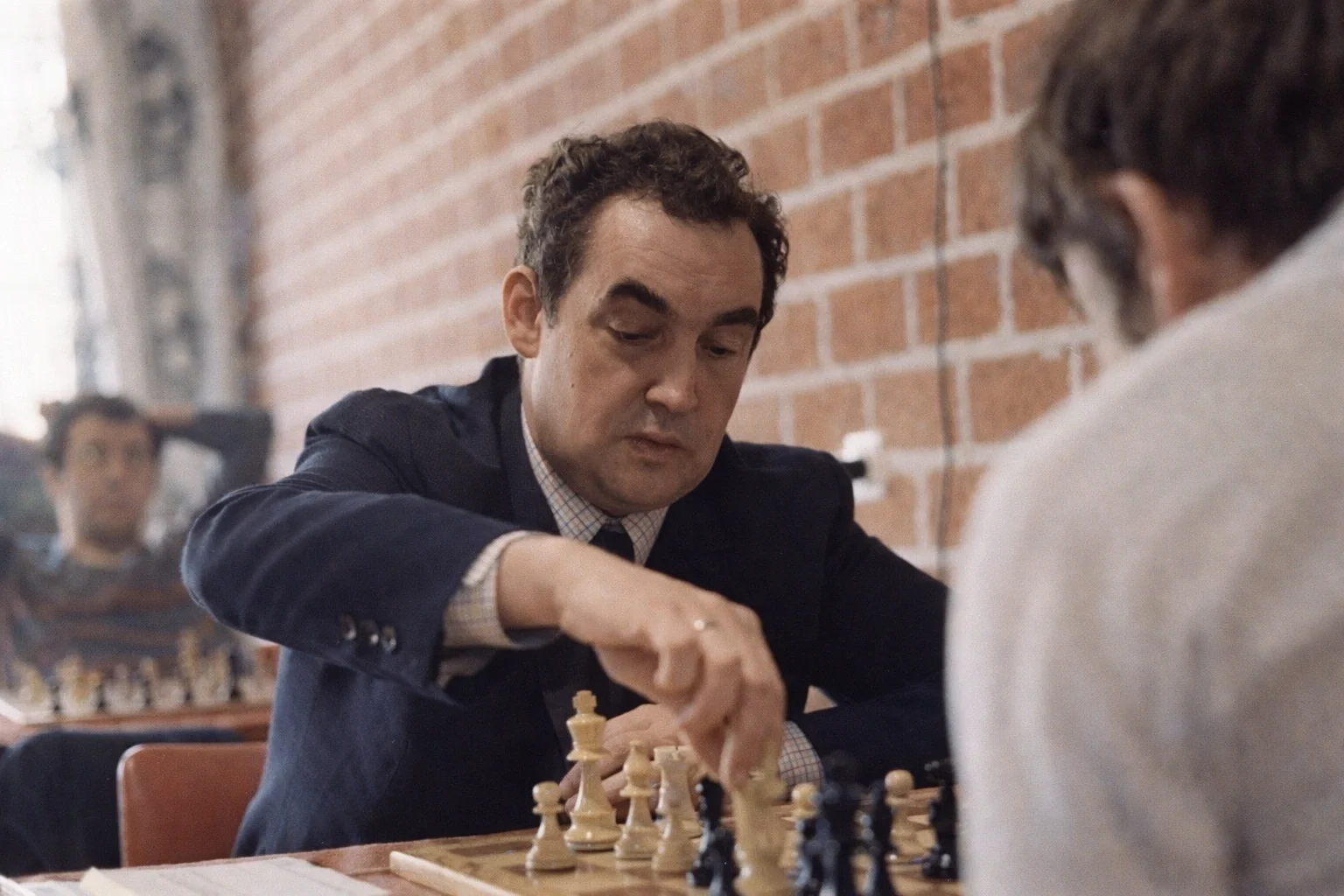
Mark Taimanov, Beverwijk, 1970
Mark Taimanov belonged to the very small class of twentieth-century figures who reached genuine international distinction in two demanding fields at once. In chess he was a Soviet champion, two-time World Championship candidate, a mainstay of elite Soviet competition from the late 1940s into the 1970s, a major opening theoretician, and a prolific writer. In music he was a conservatory-trained concert pianist whose duo with his first wife, Lyubov Bruk, was important enough to be singled out decades later by the official Saint Petersburg Rimsky-Korsakov Conservatory as the only piano duo from the second half of the twentieth century included in the Philips anthology Great Pianists of the 20th Century. Contemporary and official records place him at the center of both Soviet chess and Soviet concert life, a dual identity that was not ornamental but constitutive of his public persona.
The broad outline of his career is clear. Born in Kharkiv in 1926 while his parents were studying there, he moved as an infant to Leningrad, received elite musical training, entered the chess circle at the Pioneer Palace under the influence of Mikhail Botvinnik, rose through Soviet competition, became International Master in 1950 and Grandmaster in 1952, won the 1956 USSR Championship, qualified for the 1953 and 1971 candidates cycles, remained an active and dangerous grandmaster deep into old age, won the World Senior title twice, founded a chess school in his name, and died in Saint Petersburg in 2016 at ninety. Retrospective ratings place his peak as high as world number five in January 1957, while official early FIDE lists still had him tied for world number ten in January 1971 and number fifteen in July 1971.
The usual shorthand for Taimanov is the 0-6 defeat to Bobby Fischer in Vancouver in 1971. That match was undeniably decisive, yet it has also distorted his historical image. Taimanov himself described it as sending his life "into hell," and his account of salary loss, travel bans, censorship, and social ostracism is corroborated in broad outline by later Russian scholarship on Soviet sport and the Cold War, which reports that the defeat was treated by party authorities as "scandalous and unprecedented" and that his return through Soviet customs, with undeclared currency and a banned book by Alexander Solzhenitsyn, intensified the punishment. The right historical judgment is that Vancouver was the hinge of his public biography, not the measure of his chess strength.
The most persuasive sources on Taimanov are not generic summaries. They are his own interviews and memoirs, official Russian institutional notices, digitized contemporary tournament material, and results databases such as OlimpBase and 365Chess. These sources show a cultured, witty, formidably well-prepared, stylistically self-aware master who thought of chess as art, preferred openings that balanced structure with elasticity, and left a larger body of instructive writing than is often recognized outside Russian-speaking chess culture. His legacy survives not only in the Sicilian line that bears his name, but in the idea that chess understanding can be simultaneously technical, literary, and musical.
Life and Formation
Official Russian and St. Petersburg institutional sources agree on the foundations of Taimanov's early life. He was born on 7 February 1926 in Kharkiv, where his father was studying engineering and his mother had musical training. The family moved to Leningrad when he was about six months old. There he entered a musical school in 1934, later studied at the specialized ten-year music school attached to the conservatory, and then graduated from the conservatory itself. A childhood film role in Beethoven's Concert made him briefly known as a young actor, and by his own later recollection the chain "music, film, then chess" is exactly how he arrived at the game. He began serious chess study at the Leningrad Pioneer Palace at age eleven, where Botvinnik directed the school and selected the strongest pupils for the famous Botvinnik group.
His musical formation was not a side story. The official centenary page of the St. Petersburg Philharmonia is especially valuable here because it is based on concert-institution history rather than chess memoir. It records that Taimanov was a pupil of Samariy Savshinsky, that he gave a solo appearance at the Philharmonia in 1937 as a prodigy, that the evacuated conservatory in Tashkent brought him together in 1943 with Bruk for their first public concert, and that Savshinsky was the teacher who first placed the two at twin pianos. That page also stresses a point later obscured by chess mythology: for almost thirty years the Bruk-Taimanov duo was a sustained concert institution, with domestic and foreign performances, recordings, and premieres of works written for them.
Personal life is documented unevenly, but several core facts are secure. Taimanov married four times and had seven children. His first marriage, to Bruk, was also the defining artistic partnership of his pianistic life and lasted until the early 1970s, when both the marriage and the public duo came to an end. Later sources identify his fourth wife as Nadezhda and note that he became the father of twins, Masha and Dima, at age seventy-eight. Official conservatory sources identify his sister, Irina Taimanova, as a professor of musical-theatre direction, and later conservatory material identifies his son, Igor Taimanov, as a professor who remained active in piano-duo commemorative work. Widely repeated anecdotes about Taimanov's romantic life are abundant in memoiristic literature, but the secure archival core is simpler: the family network remained deeply embedded in St. Petersburg's musical institutions across generations.
He died on 28 November 2016 in Saint Petersburg. TASS gives the date and place, while a near-contemporary ChessBase obituary adds testimony from his widow that he had been seriously ill for about a year and a half. Public sources I reviewed do not consistently specify a medical cause of death, and that gap is typical of the way his final years were covered: the fact of his passing is well documented, the exact medical details are not.
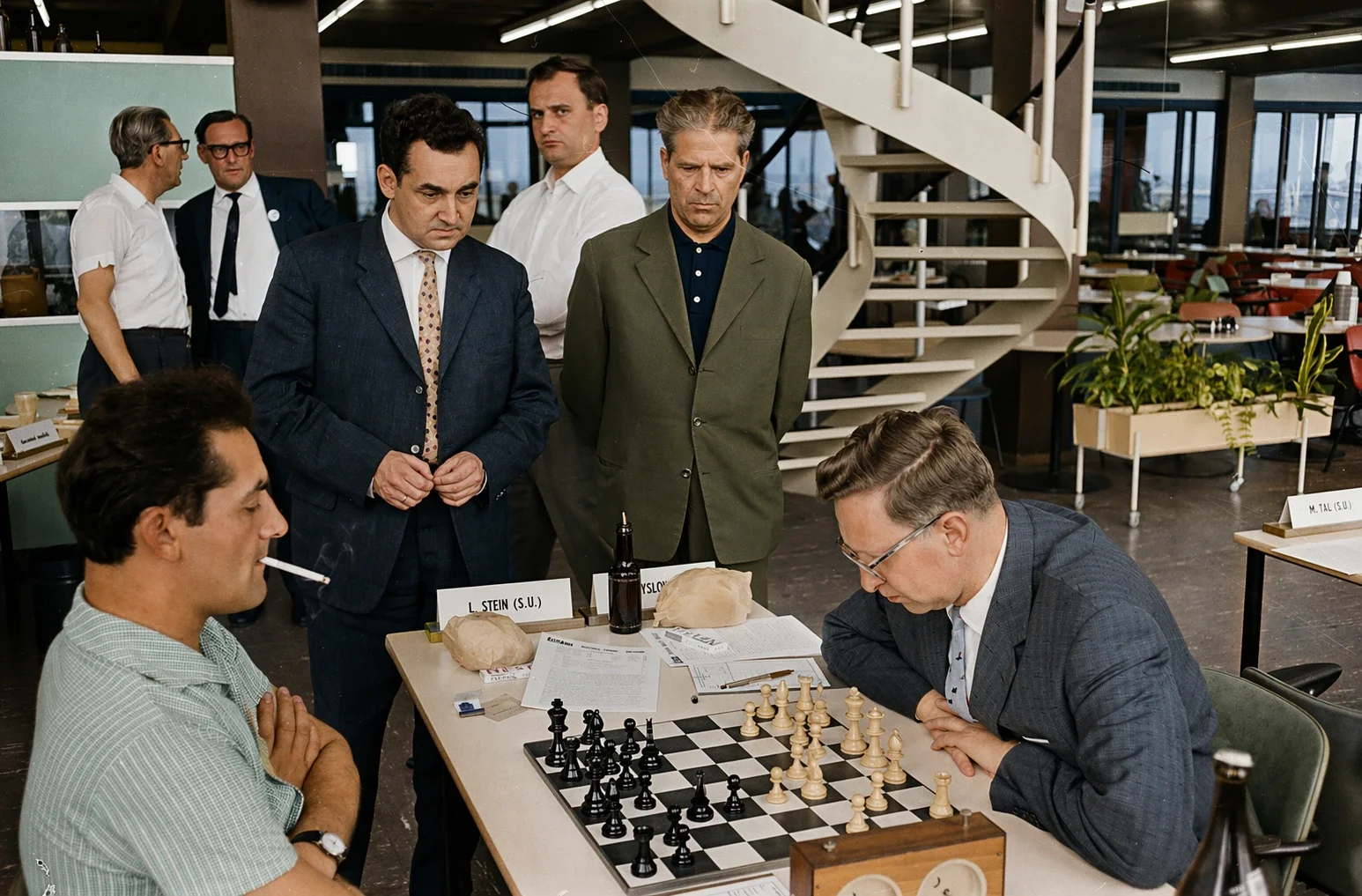
Left to rifght: Stein, Taimanov, Ivkov, Lilienthal, Smyslov
Chess Career
Taimanov's chess career is best understood as an unusually long sequence of ascent, consolidation, setback, and renewal. He won the Leningrad championship in 1948 and again in 1950 and 1952, then made his first major Soviet breakthroughs in the national championship itself. OlimpBase records a rough opening at the 1948 USSR final, followed by a sharp rise to shared third-fourth in 1949, shared first-second in 1952, shared second-third in 1954, and then clear first after the 1956 playoff. Those placements alone would mark an elite Soviet player. In his case, they came inside the deepest national championship system in the world.
The international climb came just as fast. Taimanov recalled 1950 as the year he became International Master, and contemporary records place him among the qualifiers from the 1952 Saltsjöbaden Interzonal. A digitized Chess Review summary shows him tying for second-third there with Tigran Petrosian on 13.5 points, behind only Kotov and ahead of a field that included much of the non-Soviet elite. In the same general period he shared first at the 1952 Liverpool student event with Bronstein, and then tied for first-second in the 1952 USSR Championship before losing the playoff match to Botvinnik by 2.5-3.5. Taimanov later remembered the subsequent Zürich Candidates of 1953 less for his final standing than for the event's artistic and competitive grandeur, already canonized by Bronstein's famous tournament book.
The middle of the 1950s established his permanent stature. TASS and the Russian Chess Federation describe him as Soviet champion in 1956, a member of the USSR team that won a Chess Olympiad, and a four-time European team champion. OlimpBase confirms the 1956 title through the Leningrad playoff ahead of Yuri Averbakh and Boris Spassky. It also records his immense overall Soviet Championship presence: twenty-three finals between 1948 and 1976, with one gold, three silvers, and four bronzes in aggregate medal terms. That number says as much about endurance as it does about quality. Even to qualify so often meant surviving repeated national bottlenecks.
The 1960s are the most underrated part of his career. He did not turn his 1950s rise into a title match, yet he remained a constant factor in top Soviet and international events. OlimpBase records shared second-third in the 1962 USSR Championship, third in 1965, shared third-fifth in 1966, fourth in the 1967 Soviet final stage, and shared third-fifth again in 1969. He also won or shared leading places in a substantial range of international tournaments, with TASS summarizing him as a winner or prizewinner in more than forty major events. The all-time tournament index at OlimpBase records him as the outright winner at Wijk aan Zee in 1970, an achievement that keeps him clearly inside the top-tier conversation of the period.
His second great run toward the world title came late. Palma de Mallorca 1970 brought him shared fifth-sixth place with 14/23 and a seat in the Candidates. Just before that, in the USSR vs. Rest of the World match at Belgrade, he beat Wolfgang Uhlmann in both games on board seven, a reminder that he entered the Fischer match in excellent practical form rather than as a ceremonial Soviet veteran. The official world-championship record at OlimpBase then gives the brutal statistic that dominated subsequent memory: Vancouver, May 1971, lost to Fischer 0-6. Yet Taimanov's career did not end there. He later returned to interzonal play in 1973 after FIDE qualified him and Soviet authorities lifted the ban, won the European Club Cup in 1976 with Burevestnik, stayed on the rating list into the 2000s, and was still turning up in senior and commemorative tournaments into 2012. He won the World Senior Championship in 1993 and 1994.
Retrospective and official rating systems together give a fairer picture than the Fischer shorthand. Chessmetrics ranks him as high as world number five in January 1957, while official FIDE-era lists show him tied for number ten, unofficially, in January 1971 at 2620 and tied for number fifteen in July 1971 at 2600. Those numbers describe a durable world-class player who spent decades in or near the first rank, not a one-cycle curiosity.
Style, Repertoire, and Representative Games
Taimanov's own self-description is unusually helpful because it matches what fellow grandmasters later saw in his games. In a long interview with Joel Lautier, he said that music shaped his chess style and that he conceived chess "first and foremost as an art." His favorite players were Alexander Alekhine, Mikhail Tal, and Garry Kasparov, which is revealing because his own practical style was more controlled than Tal's, but never purely bureaucratic or mechanical. Artur Jussupow, speaking on his death, emphasized his good positional style, his ease when a position was under control, and a certain absence of ruthless killer instinct. That joint evidence suggests a player who was aesthetically ambitious, strategically lucid, and theoretically serious, though sometimes a touch less brutal than the very greatest match specialists.
Database evidence aligns with the verbal sources. 365Chess gives his most-played White openings as English and fianchetto King's Indian structures, and his most-played Black opening by far as the Sicilian Taimanov. In an interview he named the Nimzo-Indian and the Sicilian as his favored Black defenses and pointed to his books on those systems as central parts of his intellectual work. TASS confirms his published output on the Sicilian, the Nimzowitsch Defense, and other opening topics, while later English-language bibliographic records show Winning with the Sicilian and Taimanov's Selected Games continuing that pedagogical line. The right summary is that he was not simply the source of one fashionable variation. He was a systems-builder and expositor whose practice and writing fed one another.
The seven games below are chosen to illustrate that broader profile. In keeping with your instruction, I am not going into heavy tactical trees. The emphasis is on strategic narrative, career significance, and what each game shows about Taimanov's way of thinking. The existence of these games, their dates, and their publication trail are documented in Soviet-press translation work by Douglas Griffin and in the major historical databases.
Taimanov vs Herman Steiner, Saltsjöbaden Interzonal 1952. This belongs to the event that brought him into the World Championship conversation. The instructive point is not a single tactical trick but the way the young Taimanov handled an international-pressure game with notable calm. It shows early traits that stayed with him: measured development, pressure without haste, and a preference for positions where understanding could accumulate over time. In contextual terms, the game also belongs to the breakthrough tournament that qualified him for Zürich.
Taimanov vs Miguel Najdorf, Alekhine Memorial 1956. Griffin includes this among the Soviet-press annotations, and it fits perfectly inside Taimanov's championship year. The game is useful because it shows him against a great fighter from outside the Soviet school, not in sterile maneuvering but in a position where opening preparation, central control, and attacking timing all had to coexist. This is the Taimanov who could be classical in shape while still very dangerous in execution.
Milan Matulovic vs Taimanov, Leningrad-Belgrade 1964. By the mid-1960s Taimanov was one of the best "professional" players in the finest sense of the word: seasoned, deeply booked-up, and able to turn theoretical understanding into practical wins with Black. This game is representative of his mature craft. It shows why later colleagues described him as a player who became increasingly comfortable once the position was under control. The effect is cumulative rather than spectacular.
Anatoly Lutikov vs Taimanov, USSR Championship 1969. This game has unusual historical force because it fed directly into the Palma qualification story. Russian retrospective coverage makes plain that Taimanov's last-round win over Lutikov was a decisive part of his route into the interzonal. As an instructive example, it shows resourcefulness under selection pressure. This is less about romantic artistry and more about the hard logic of Soviet championship survival.
Taimanov vs Henrique Mecking, Palma de Mallorca Interzonal 1970. This is the most revealing game if one wants to connect Taimanov the competitor with Taimanov the theoretician. A contemporary Spanish-language source preserves analysis by Smyslov, and the game sits inside the interzonal that put Taimanov back into the Candidates eighteen years after his first run. It is an excellent example of how he handled the transition from opening scheme to middlegame plan, which is precisely where his best practical and pedagogical work tends to live.
Fischer vs Taimanov, Vancouver 1971, game three. If one game has to stand for the whole match, this is the one. Taimanov later said that the third game was the turning point, because he believed he had achieved a winning position and then could not force a breakthrough. His recollection is valuable because it shifts explanation away from myth and toward psychology. The match did not become a catastrophe because Taimanov forgot how to play. It became one because Fischer's error-resistance and Taimanov's frustration fed each other until confidence collapsed. For historians, this game is the hinge between his peak reputation and the long shadow that followed.
Taimanov vs Honfi, Bucharest 1973. This later game is worth including because it resists the lazy narrative that Vancouver ended his effective chess life. Griffin's list includes it because it was good enough for Soviet-press attention, and that in itself is significant. The broader point is that after sanctions began to lift, Taimanov did not merely survive. He could still produce clear, cultured, high-level chess of the kind that made him important in the first place.
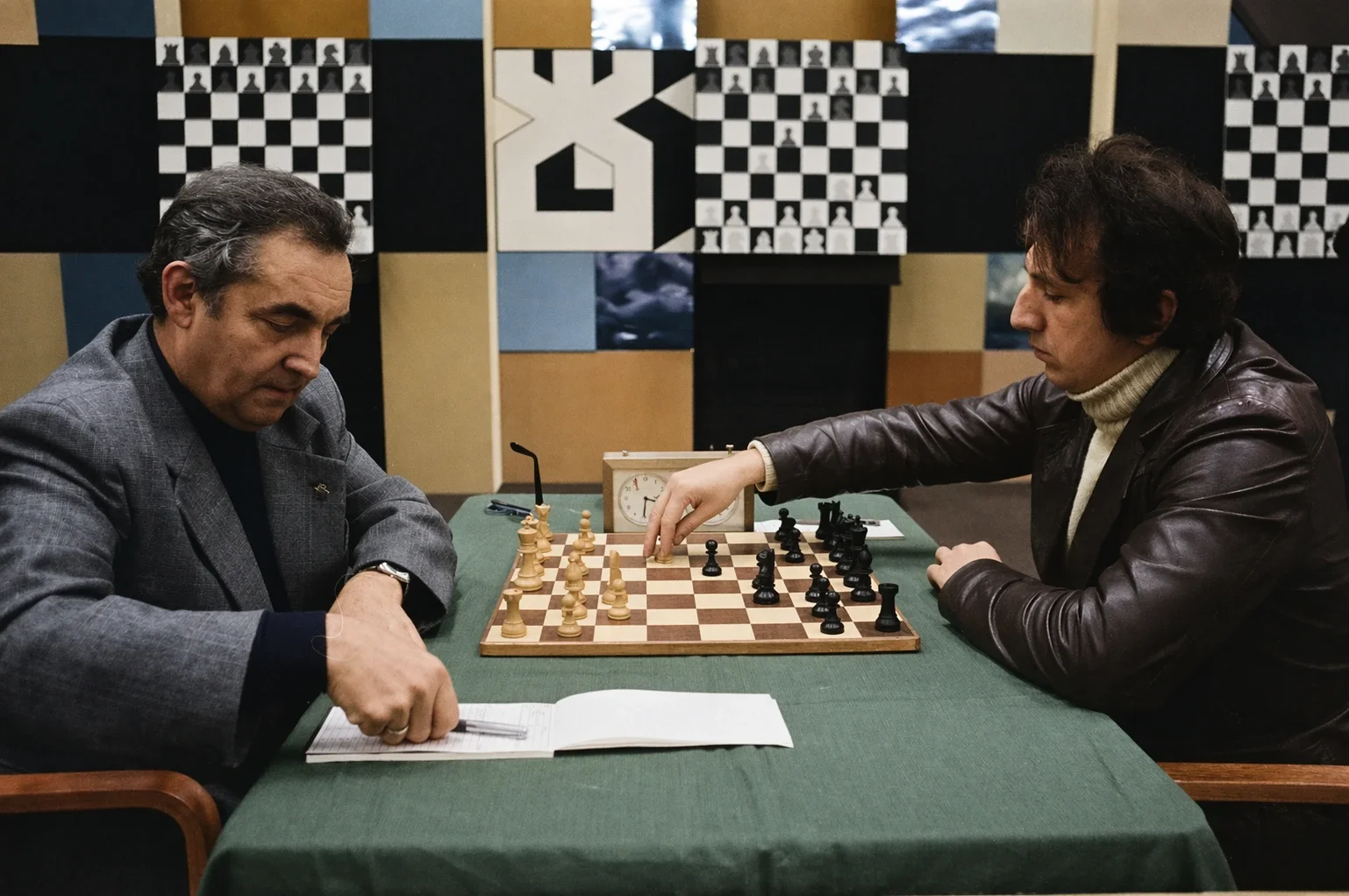
Taimanov and Sveshnikov, Wijk aan Zee, 1981
Music, Writing, and Teaching
The musical career was real enough that it must be treated as coequal to the chess career, not as a biographical ornament. Official St. Petersburg music institutions provide the strongest evidence. The Philharmonia's centenary page traces the Bruk-Taimanov duo from wartime Tashkent through nearly thirty years of concerts, recordings, and a repertory mission that included unfamiliar works for two pianos and pieces written specifically for them. It records thirteen small-hall Philharmonia concerts between 1950 and 1971, performances with orchestra in Saint-Saëns, Mozart, and Vladislav Uspensky, and a return appearance by Taimanov in 2002, after a thirty-year break, playing with his son. The conservatory's 2026 centenary program goes even further by describing Bruk and Taimanov as the only piano duo of the second half of the twentieth century included in Philips' Great Pianists of the 20th Century anthology.
Taimanov's own testimony fills out the artistic self-conception behind those facts. He told Lautier that he and Bruk were the first to perform music by Francis Poulenc in the Soviet Union, that he preferred romantic and Russian music, and that when he played chess he thought like an artist. This is not just attractive rhetoric. It explains why his chess prose, too, has a literary and tonal quality that distinguishes it from the driest technical Soviet annotation. He was neither an "artist" in the empty sense nor a narrow technician. The ordinary boundary between the two disciplines never really held for him.
As writer, commentator, and teacher, Taimanov also had unusual range. TASS notes that from 1983 he served as a chess commentator for the magazine Ogonyok and identifies him as the author of major books on the Nimzowitsch Defense, travel and tournament writing, memoir, and later world-championship commentary. In the Lautier interview he stressed that writing and journalism had always been important to him, and added that when he taught he urged pupils to study Nimzowitsch and Tarrasch closely for their principled clarity. Douglas Griffin's work on translating Taimanov's Soviet-press annotations confirms how much first-rate teaching material remains scattered through periodicals rather than anthologies. The posthumous reputation of Taimanov the annotator still lags behind the quality of the surviving primary material.
That pedagogical vocation continued into old age. The Russian Chess Federation reported in 2014 that his Saint Petersburg school would offer in-person and remote instruction, lectures, simultaneous exhibitions, and evenings of classical music. ChessBase reported that around his ninetieth year he was still speaking of about eighty students at the school. That institutional afterlife is fitting. Taimanov had always been more than a performer. He was a transmitter of culture, and he wanted the chess school to share the room with music rather than shut the door on it.
Politics and the 1971 Aftermath
The Fischer match must be read inside the symbolic politics of late Cold War chess. Scholarly work by Souvik Naha situates precisely this period in the wider contest between Soviet chess authority and Western celebrity culture, while FIDE's own historical pages still present Fischer's 1970 to 1972 path as a sequence of devastating victories over Taimanov, Larsen, Petrosian, and finally Spassky. Within that narrative, Taimanov's loss became more than a sporting result. It became a political embarrassment within a system that had invested heavily in chess as proof of cultural and intellectual leadership.
Taimanov's own retrospective account remains the indispensable primary source. He insisted that the 6-0 score did not reflect the "true balance of strength," described Fischer as an almost machine-like opponent whose resistance to positional concession broke his confidence, and identified the third game as the decisive emotional turning point. He then described the consequences in stark institutional terms: loss of salary, travel prohibition, press censorship, slander, accusations connected with Solzhenitsyn, and two years of social isolation. He also linked that time to the breakup of his first marriage and the temporary collapse of his pianistic career. Even allowing for retrospective dramatization, the testimony is too detailed and too consistent with other sources to be dismissed.
Later Russian scholarship strengthens the case that this was not merely wounded personal memory. The Russian-language volume Sport i kholodnaia voina reports that the Central Committee treated the 0-6 defeat as "scandalous and unprecedented," that Soviet customs found undeclared currency and Solzhenitsyn's The First Circle in his luggage, that the Sports Committee removed him from the USSR chess team and stripped him of the title Honored Master of Sport, and that this title was restored only in 1991. This source is one step removed from the original party-sport documentation, so it is not identical to archival minutes themselves. Even so, it is much stronger evidence than the simplified Anglophone anecdote that he was merely "punished by embarrassed bureaucrats."
There are still source problems. The details of his pre-match preparation, for example, have been remembered inconsistently. A Russian Chess Federation retrospective by Dmitry Kryakvin, using later testimony from Evgeny Vasiukov and Yuri Balashov, reports that Taimanov's camp analyzed some 500 Fischer games under Botvinnik's guidance. It also notes a long-running discrepancy about the score of secret training games, eventually narrowed by Balashov's files to +2-0=6 for the consulting team, and includes Vasiukov's claim that poor nutrition during the match left Taimanov physically depleted because he tried to conserve hard currency. These are important, vivid details, but they belong to the category of retrospective testimony rather than fully settled documentary fact. They are useful because they reveal preparation culture and memory politics at once.
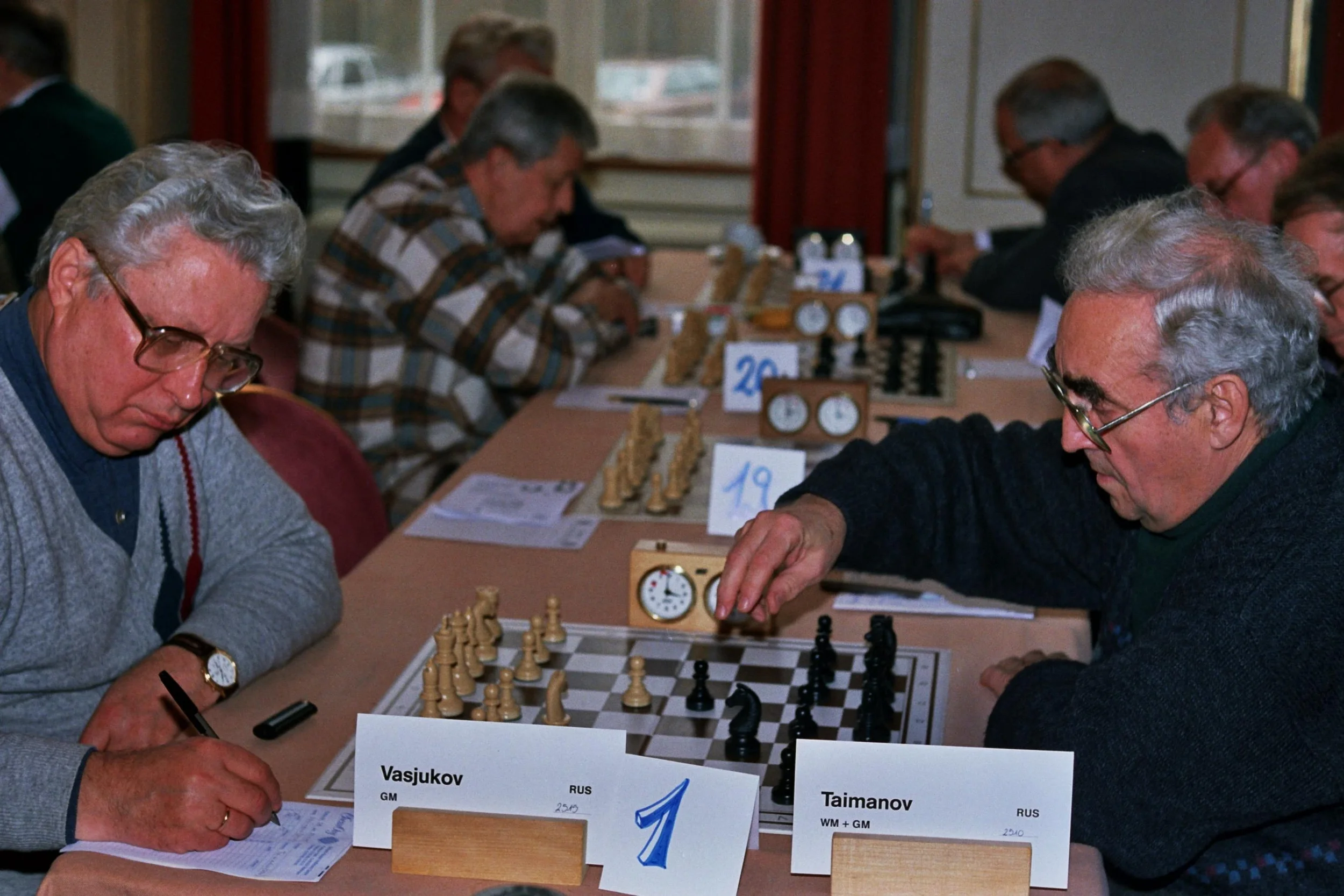
Evgeni Vasiukov and Mark Taimanov, Senior Chess World Championship, 1995 at Bad Liebenzell
Legacy, Historiography, and Research Gaps
Taimanov's legacy is larger than the one variation and the one match with which he is usually tagged. His name survives in opening nomenclature, in the continued use of the Sicilian Taimanov, in Russian chess teaching, in the St. Petersburg school founded under his name, and in a still-underappreciated body of annotated games and books. Modern database summaries also note that he was one of the relatively few players to defeat multiple world champions across eras. The music institutions of Saint Petersburg, meanwhile, continue to remember him not as a crossover curiosity but as part of their own performance history. The dual memorial culture is itself part of his significance.
The historiography is unusually uneven. English-language treatments often telescope his life into a dramatic arc that culminates in Fischer. That is understandable, because Vancouver was globally legible and narratively irresistible. Yet the strongest primary materials complicate that picture. His own interviews foreground art, teaching, books, and parallel musical life. Official Russian sources foreground championship depth, institutional honors, and long service to Soviet chess. Music institutions foreground pedagogy, duo performance, and repertoire-building. Later chess historians such as Douglas Griffin have been especially useful because they restore Soviet-press annotations and period texture that broad biographical sketches usually flatten. No single source tradition is enough on its own.
A few uncertainties remain, and they are worth stating plainly. Official biographical notices provide reliable dates and institutional affiliations, but they are less detailed on family ancestry and inner life. Memoirs and interviews are indispensable on personality and the 1971 aftermath, yet they are shaped by later self-understanding. The exact scope of the post-Vancouver sanctions is described with varying emphasis across sources. The score of the secret pre-Fischer training games was disputed for decades. Public sources do not clearly specify the medical cause of his death. These are not fatal problems for scholarship, but they do mark the places where a future researcher would need direct archival work rather than repetition of later summaries.
The best avenues for further research are concrete. A serious monograph should inspect the party-sport documentation cited in Russian Cold War scholarship, Soviet customs and Sports Committee files relating to Taimanov's return from Canada, the Philharmonia and conservatory concert archives for programs and correspondence, and the family and institutional papers behind the St. Petersburg memorial materials. On the chess side, a modern critical edition of Taimanov's annotations from Ogonyok, 64, Shakhmaty v SSSR, and related periodicals would do more than almost any new biographical essay to restore his stature as a teacher and prose stylist.
