Results of the 16th USSR Championship
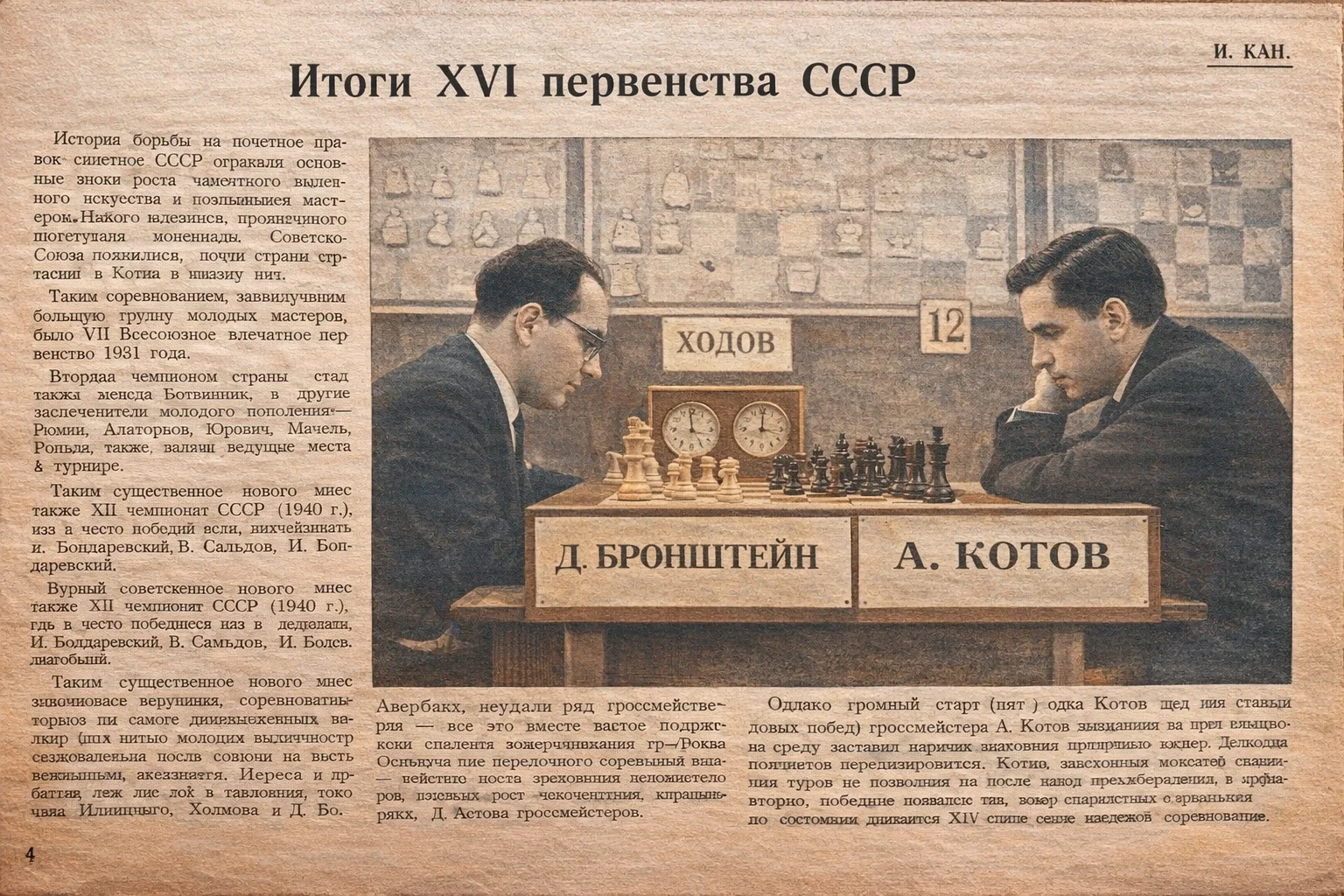
The 16th USSR Championship was presented in the Soviet chess press as something larger than a tournament. In the report by I. Kan, the event appears as a measure of the strength, depth, and future direction of Soviet chess itself. The article places the championship within a longer institutional story. Earlier Soviet championships are described as turning points in national chess life, moments when new generations emerged and the center of gravity shifted. The 1931 championship is recalled as the event in which Mikhail Botvinnik first became champion, while the 1940 championship is remembered for bringing Bondarevsky, Smyslov, and Boleslavsky to the forefront. By the time the author reaches the 16th championship, the argument is already clear. This was another event in which the field itself revealed the onward movement of Soviet chess.
At the center of the article stands David Bronstein. The report calls the 24-year-old the brightest representative of the postwar generation and treats his performance as one of the clearest signs of the new creative energy in Soviet chess. Bronstein is described as a player of exceptional natural talent, capable of calculating fast, deep, and dazzling combinations. The author notes that ten draws may seem high for such a gifted attacking player, yet rejects any criticism of excessive peacefulness. In the writer’s view, Bronstein was playing for wins in the overwhelming majority of his games, and his overall record in the championship and at Stockholm showed extraordinary resilience. He lost only once, to Paul Keres. His late charge at the finish, in which he erased Kotov’s lead and reached a tie for first, becomes one of the central dramas of the report.
Alexander Kotov is presented in a different light. If Bronstein embodies postwar brilliance and imagination, Kotov is cast as the hardened fighter whose persistence and discipline brought him to the summit. The report recalls that Kotov’s early years as a grandmaster had been uneven. Successes and failures alternated, and his results lacked stability. Yet in recent seasons, the author says, a decisive change had taken place. Kotov’s steady tournament achievements, strong theoretical preparation, self-command, willpower, and ability to defend as well as attack had elevated him into the front rank of Soviet and world chess. His five-game winning start forced many pre-tournament predictions to be reconsidered, since many had expected Keres and Bronstein to be the principal contenders for first. Although Kotov later lost some ground, he remained in front until the final stretch and ultimately shared first place with Bronstein. The report treats this outcome as earned through labor, discipline, and fighting spirit.
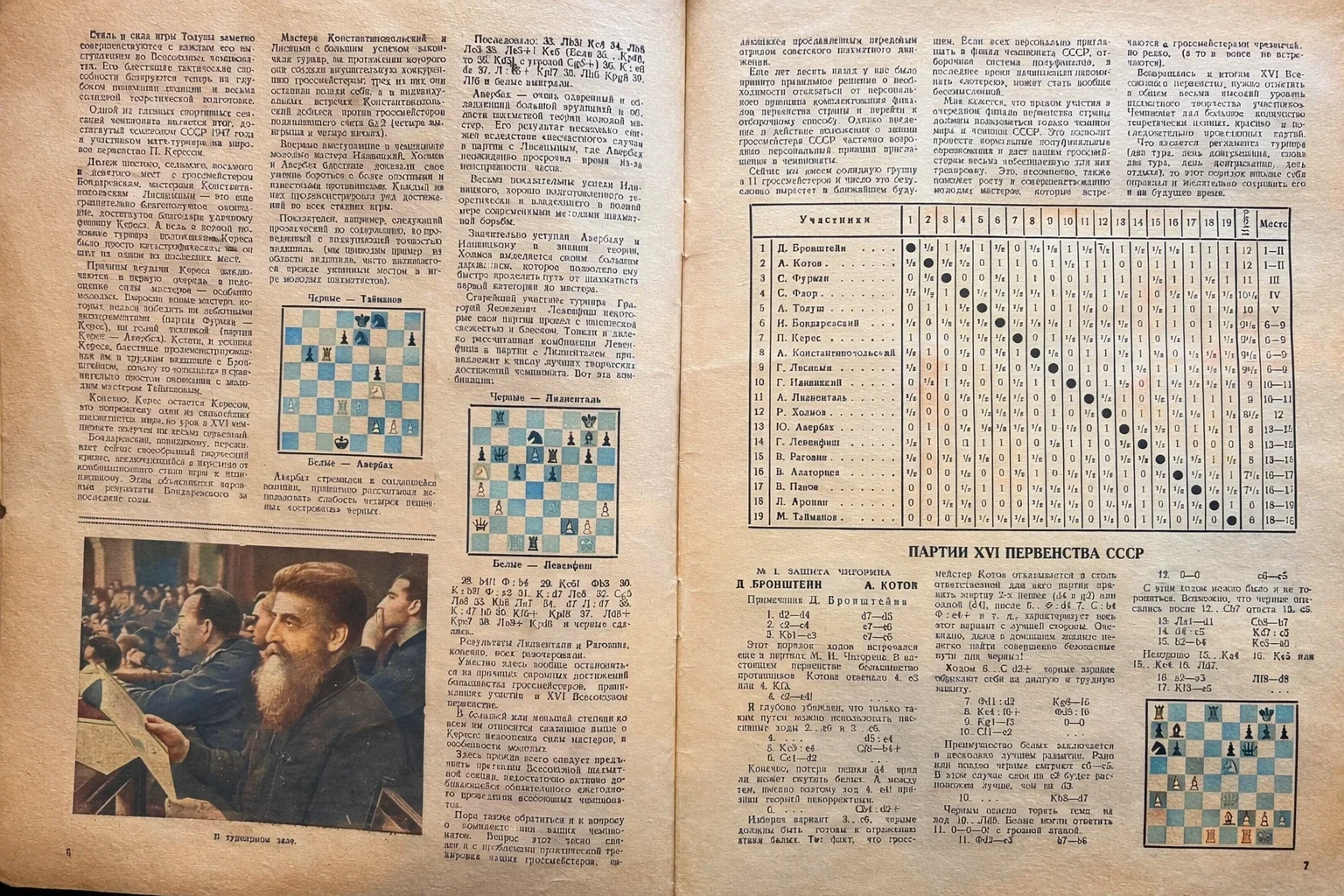
Semyon Furman emerges as one of the great positive revelations of the championship. The article insists that his success was no accident. Playing in the national championship for the first time, the young Leningrader is said to have displayed excellent preparation, deep positional understanding, and bold attacking play full of combinational ideas. The report links his development to serious creative study and even hints at the influence of Levenfish. Furman’s third place is taken as proof that a new master had fully arrived. In the language of the article, one of the chief results of the championship was the creative growth of young masters ready to reinforce the ranks of Soviet grandmasters, and Furman stands at the front of that group.
Salo Flohr receives a more mixed but still respectful assessment. His fourth place is called a good result and evidence of progress compared with some of his more modest recent performances. At the same time, the report gently criticizes him for excessive caution and for too many draws. Flohr, the writer suggests, might have joined the fight for first had he shown greater decisiveness. Even so, the criticism remains measured. His endgame technique is praised as being of a very high order, and he is treated throughout as a player of real class whose technical strength remained intact.
Tolush is one of the quiet success stories of the championship. The report remarks that his play had been steadily improving with each appearance in the USSR Championship. What is especially striking is the character of the praise. Tolush’s brilliant tactical gift is acknowledged, yet the author stresses that it now rested on deeper positional understanding and much stronger theoretical preparation. This is serious praise in Soviet chess language, because it suggests the movement from gifted tactician to mature master. His fifth-place finish is said to show that he had come right up to the grandmaster group. The article adds that serious illness accompanied him during the second half of the event, which makes the result appear even more impressive.
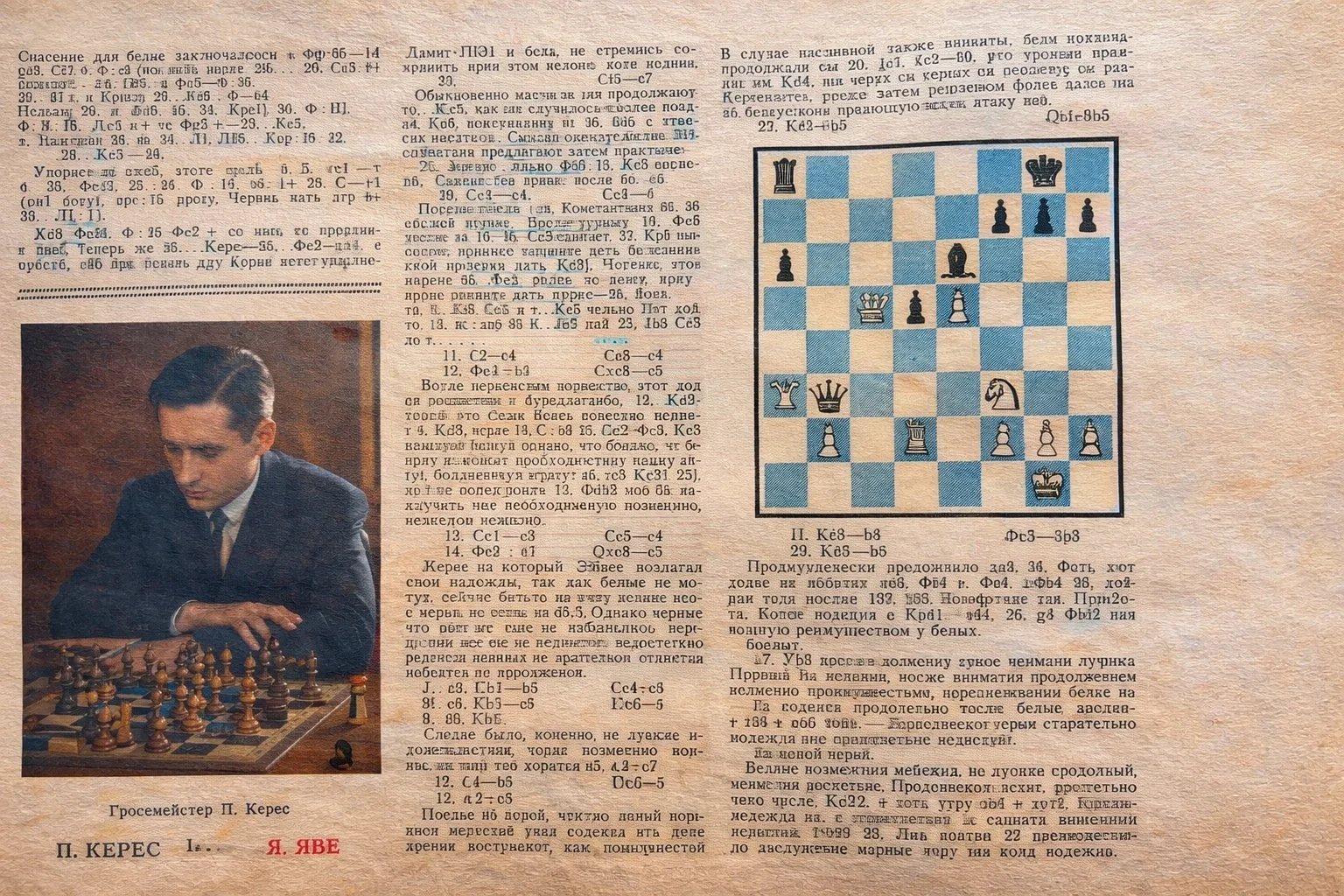
If Bronstein, Kotov, Furman, Flohr, and Tolush form the leading human narrative of the report, Paul Keres becomes its most striking disappointment. The article describes his result as one of the great sporting surprises of the championship. Finishing in a tie for sixth through ninth is treated as a fortunate recovery after a poor first half of the event, during which his position had been close to catastrophic. The explanation the author offers is revealing. Keres, he says, underestimated the young masters, especially the rising generation. New players had appeared whom it was no longer possible to defeat through opening experiments or routine technical pressure. The warning is sharp, though not dismissive. Keres remains, in the writer’s words, one of the strongest players in the world. Still, the championship had given him a serious lesson.
Bondarevsky is judged critically as well, though the tone is different. The report suggests that he was living through a kind of creative crisis, a transition from a combinational style toward a positional one. That transition, the author argues, helps explain the unevenness of his recent results. Even this is typical of Soviet chess writing. Players are judged not only by scores, but by where they stand in their chess development.
The article is generous toward the broader second rank of the field. Konstantinopolsky and Lisitsyn are praised for creating real internal competition for the grandmasters. Ilivitsky is singled out as especially convincing, theoretically prepared, and fully at home in modern chess methods. Kholmov is described as a player of great natural gift who had risen quickly. Averbakh is treated as another important young master. The oldest participant, Grigory Levenfish, is admired for games played with youthful freshness and brilliance. By this point the report’s larger conclusion is unmistakable. Soviet chess had become so deep that reputation alone no longer guaranteed superiority.
That conclusion leads the author into one of the most important parts of the report, his criticism of the championship system itself. He argues that too much reliance on personal invitations had weakened the logic of qualification. Years earlier, Soviet organizers had moved away from the older invitation principle in favor of a qualifying system, but the regulations surrounding the title of USSR Grandmaster had partially restored privileged access to the final. The result, the author warns, is that the semifinals risk becoming almost meaningless. His proposed remedy is simple. Only the world champion and the USSR champion should have an automatic right to the next final. Everyone else should qualify. This, he argues, would sharpen competition, give grandmasters valuable practical experience, and provide younger masters with more frequent chances to meet elite players at the board.
The final crosstable supports the article’s entire argument. Bronstein and Kotov share first on 12 points. Furman finishes third on 11. Flohr takes fourth with 10.5. Tolush is fifth with 10. Keres, Bondarevsky, Konstantinopolsky, and Lisitsyn tie for sixth through ninth on 9.5. Ilivitsky and Lilienthal follow on 9. Kholmov scores 8.5, and Averbakh, Levenfish, and Ragozin each finish on 8. These standings show a field in which the margin between established greatness and ambitious ascent had narrowed considerably.
Taken together, pages 4 through 7 of this Soviet report offer a compact portrait of late 1940s Soviet chess at a moment of internal change. Bronstein is the gifted new star. Kotov is the disciplined fighter who turned effort into first place. Furman is the breakthrough talent. Flohr is the refined technician. Tolush is the rising near-grandmaster. Keres is the great player warned by a changing field. Around them stands a wider group of masters ready to challenge hierarchy and force a reconsideration of how the national championship should function.
That is what gives the article its lasting value. It preserves a Soviet view of chess strength in motion. The championship is treated as a competitive test, a cultural institution, and a mechanism of renewal. In that respect, the report tells us a great deal about the tournament. It also tells us how Soviet chess wanted to understand itself.
