Rashid Nezhmetdinov (Рашид Незметдинов)
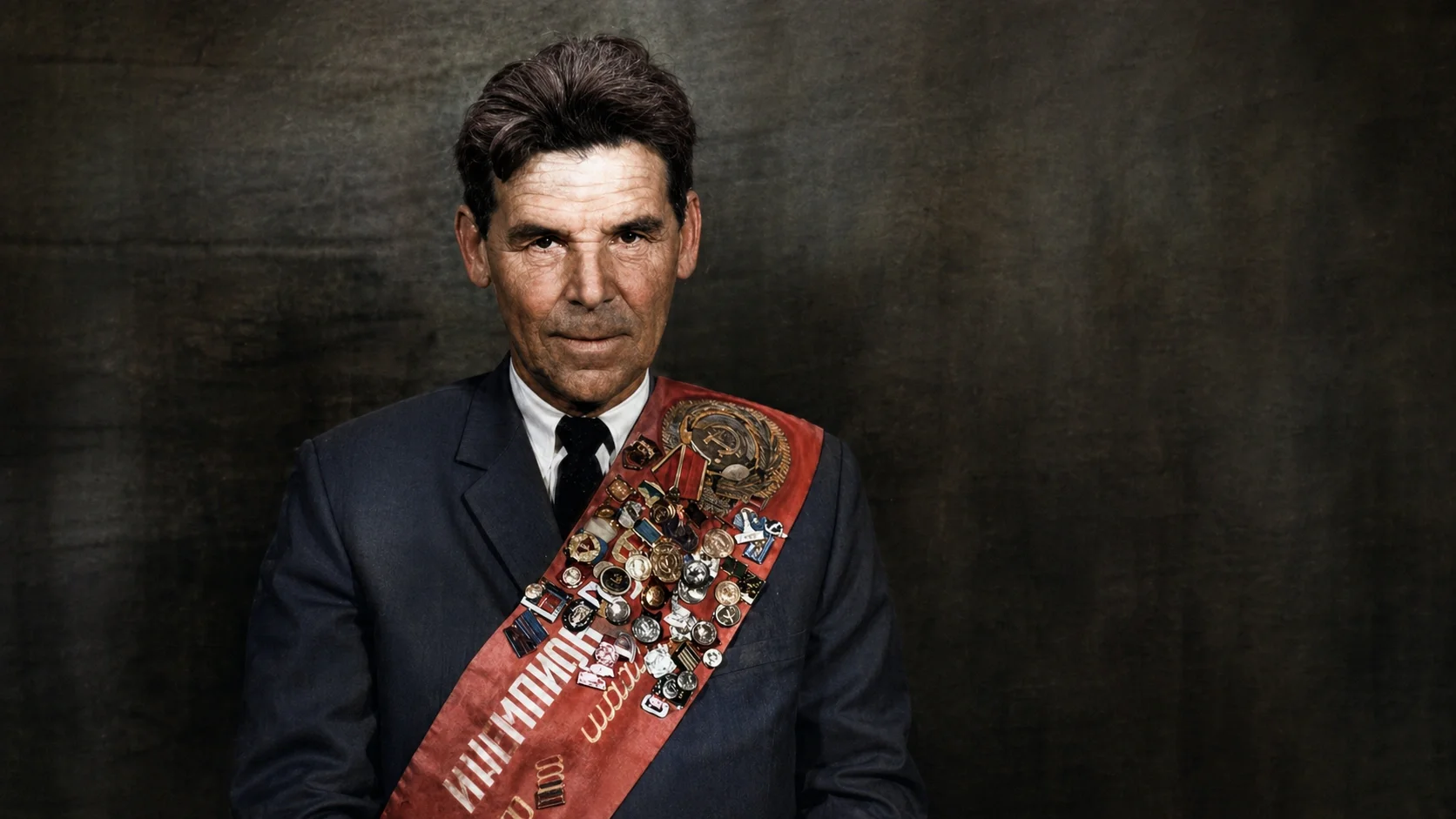
Rashid Gibyatovich Nezhmetdinov, 15 December 1912 to 3 June 1974, is one of the clearest cases in chess history where title and historical importance do not line up neatly. Officially, he remained an International Master rather than a grandmaster. Historically, he stands as a five-time champion of the RSFSR, a five-time participant in USSR Championship finals, the first Soviet Master of Sport in both chess and checkers, and, in Russian chess memory, the first great Tatar chess player and a defining symbol of the Kazan school. That mix of formal underrecognition and lasting aura is exactly why he still fascinates serious readers of chess history.
What people often forget about Nezhmetdinov is that the famous sacrificial games are only the bright front edge of a much larger life. His story is also about orphanhood and famine, wartime interruption, social ascent through Soviet institutions, elite-level achievement in checkers, work as a coach and organizer, and a real cultural role in Tatar chess education and publishing. If you remember only the queen sacrifices, you remember the fireworks but not the power plant.
Life and formation
Nezhmetdinov was born in Aktiubinsk, now Aktobe in Kazakhstan, into a poor peasant family. According to the Russian Chess Federation’s official retrospective, he lost both parents by the age of five, was raised for a time by distant relatives, entered an orphanage during the famine year of 1921, and was brought to Kazan in 1922 by his older brother Kavi, who later became a notable Tatar writer and effectively filled the role of father. This beginning matters. Nezhmetdinov was not a polished metropolitan prodigy backed from childhood by stable institutions. He first had to survive.
His early adult life was equally uneven. He entered the Kazan Chemical-Technological Institute but did not complete his studies, in part because he had to work while studying. After his brother’s arrest, he spent time in Odessa, then returned to Kazan, enrolled in the physics and mathematics faculty of the Kazan State Pedagogical Institute in 1937, graduated in 1940, and was then drafted into the Red Army. He finished the Second World War in Berlin. In developmental terms, the years when many future grandmasters were assembling opening knowledge and international résumés were, for Nezhmetdinov, years of displacement and military service.
His entry into chess later acquired an almost folktale glow. Later biographical retellings preserve the image of the orphan boy finding a torn page with strange squares and notation, then recognizing the same pattern when he saw adults playing in a club. Whether read literally or as a memory polished by time, the anecdote captures something true about his formation: he was largely self-made, learning first by watching, imitating, and analyzing obsessively. What is securely documented is that he became Kazan school champion in 1927, champion of Kazan among adults in 1930, and a Candidate Master in 1939. That is a remarkably steep climb.
Chess and checkers, not chess alone
One of the easiest ways to misunderstand Nezhmetdinov is to treat checkers as a decorative footnote. It was not. Official federation history credits him with a unique record: he was the first Soviet Master of Sport in both chess and checkers. Later biographical reconstructions add that by 1933 he had become champion of Odessa in both games, and that in 1949, after a long absence from serious checkers competition, he returned as a substitute in a major event, won the semifinal, and then finished near the top at the republican level. Even if one treats some of the later biographical detail with the caution proper to retrospective writing, the main conclusion is solid: Nezhmetdinov belonged to an older board-game culture in which imagination moved freely across disciplines.
This dual mastery also helps explain his chess. Nezhmetdinov often looks, on the board, like a player who is less interested in static bookkeeping than in the live geometry of movement, tempo, and forced transformation. Checkers does not “cause” that style, of course, but it is not absurd to suspect that cross-training in a second combinational game sharpened his feel for piece activity and tactical patterning. At a minimum, it reminds us that he was not a narrow specialist who merely happened to produce a few famous attacks. He was a broad board-game talent.
Competitive career
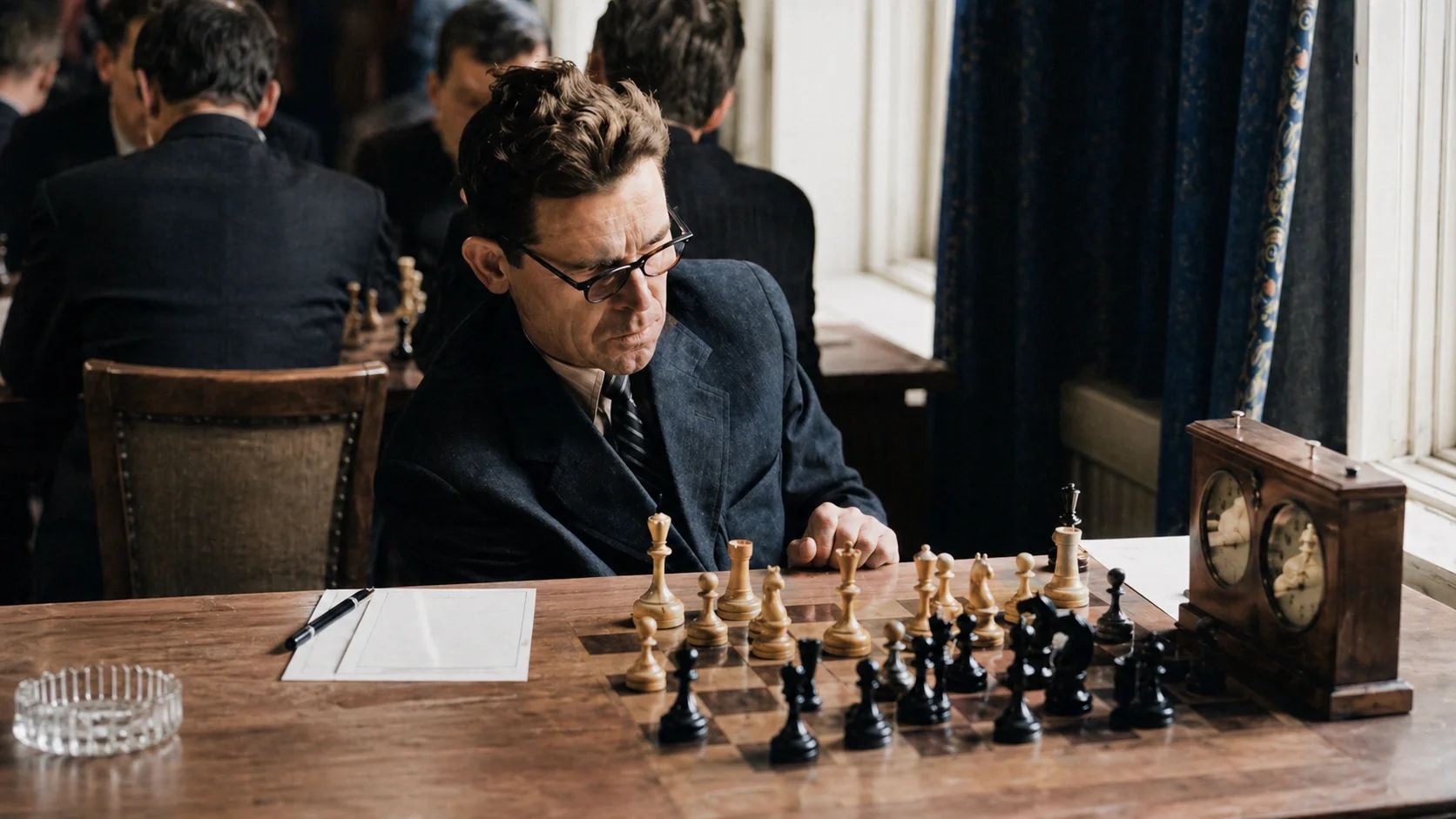
Nezhmetdinov’s peak came late, and that fact distorts the surface record if you read it too quickly. He fulfilled the requirements for the Master of Sport title in 1950 by winning the 10th RSFSR Championship final. He then won the RSFSR title four more times, in 1951, 1953, 1957, and 1958, for a total of five. He also reached five finals of the USSR Championship. That distinction is important: he was not champion of the USSR itself, but of the Russian republic within it. Even so, repeated success in the RSFSR was no provincial trifle. In the ecology of Soviet chess, he was marked as one of the most dangerous masters of his era.
The most decisive international confirmation of his strength came at Bucharest in 1954. Tournament records show him finishing second on 12.5 points, just behind Viktor Korchnoi on 13.0. Biographical sources identify this as the performance that secured him the International Master title, and it appears to have been the defining foreign opportunity of his career. There is something almost tragic in the timing: by 1954, he was already in his forties, only then receiving the sort of international exposure many future elite players had much earlier.
Nor was his record made only of isolated lightning strikes. Later biographical sources credit him with USSR team championship victories in 1954 with Spartak and in 1955 with the RSFSR. Khasanov’s reconstruction of his 1958 season is even more revealing: it highlights his RSFSR title, first-board success in the Spartak team event, victory in the USSR semifinal at Rostov-on-Don, and a strong first-board showing at Vilnius against a field that included Korchnoi, Geller, Keres, Bronstein, and Boleslavsky. That résumé looks far less like a cult hero’s scrapbook and much more like the dossier of a player brushing the edge of the world elite.
Official Russian federation retrospectives are unusually direct in their assessment, saying that “by today’s standards,” Nezhmetdinov played at grandmaster strength, and not weak grandmaster strength either. The same official profile notes his large collection of beauty prizes, his role as a second for Mikhail Tal in Tal’s 1960 world championship match against Botvinnik, and his 4 to 1 plus score against Tal in tournament games. Retrospective ratings point the same way: Chessmetrics places him as high as world no. 21 in September 1954. None of this retroactively awards him a grandmaster title, but it does make the central paradox impossible to miss: title and actual playing force were not perfectly aligned in his case.
Style, or the logic of beautiful violence
Russian Federation history calls Nezhmetdinov the “true symbol of the Kazan chess school,” and that is not just ceremonial language. He was a player of brilliant combinational style who could defeat the best Soviet opposition with startling imaginative force. But it is worth being precise about the nature of that force. Nezhmetdinov was not just a tactician in the narrow sense, not merely a calculator who spotted combinations after they appeared. He had a rare instinct for positions in which material, time, king safety, and geometry stopped behaving like separate accounting columns and fused into one attacking current. In his hands, initiative became almost physical.
That same style, however, had a shadow. FIDE’s centenary piece on Yuri Averbakh notes that Nezhmetdinov managed only one draw in nine games against him. This is not a trivial stat. It reveals a structural truth about Nezhmetdinov’s chess. Great defenders and strategic consolidators could sometimes deprive him of the oxygen his games needed. He was one of the purest artists of initiative the game has seen, but not always one of its most universal technicians. That tension, dazzling force against incomplete universality, is part of what makes him historically interesting rather than merely beloved.
The immortal games
Three games sit at the core of his afterlife.
The first is his win with Black over Lev Polugaevsky at Sochi in 1958. Nezhmetdinov reportedly called it the most beautiful game he ever played. Polugaevsky’s famous response is almost as memorable as the game itself: “I must have beaten him a dozen times, but I would trade them all for this one game.” That sentence captures something essential. Nezhmetdinov could lose the statistical war and still leave behind the single battle everyone remembered, the one that permanently altered the aesthetic memory of the tournament hall.
The second is the 1961 Baku victory over Mikhail Tal in the USSR Championship. Tal later said that the happiest day of his life was the day he lost to Nezhmetdinov. That remark is strange enough to be revealing. Tal, perhaps more than any other world champion, understood beauty as a competitive fact. Their Baku game was not a tidy brilliancy engineered for an anthology. It was a collision of two imaginations that both trusted the initiative to an extraordinary degree, and Nezhmetdinov won inside Tal’s own climate system.
The third is the 1962 game against Oleg Chernikov, famous for its positional queen sacrifice. Modern commentary has made an important historiographical point here: for many years, engines cast doubt on the sacrifice, but newer neural-network analysis has been more sympathetic and indicates that the combination is fully sound. That matters because Nezhmetdinov is often romanticized as a glorious intuitive gambler. In games like Chernikov, however, the intuition is not simply theatrical. It is deeply and disturbingly correct. His afterlife even extends beyond specialist chess culture: his 1955 game against Genrikh Kasparian was later echoed in The Queen’s Gambit.
Why he never became a grandmaster
The best answer is not a single answer.
First came structure. In Marat Khasanov’s account of Nezhmetdinov’s career, Nezhmetdinov’s own exasperated reply to the grandmaster's question is quoted in three words: “There were no tournaments!” Khasanov’s supporting argument is concrete. Between 1954 and 1959, Soviet opportunities to earn the title were scarce; he notes that the 1956 Alekhine Memorial was the only grandmaster event in the USSR during Nezhmetdinov’s peak years, and masters were not invited. The same source stresses how rarely Soviet players were allowed abroad, and quotes Korchnoi recalling that Nezhmetdinov was very seldom permitted to travel. For a player whose prime arrived late, that bureaucratic bottleneck was brutal.
Second came development. In the same Khasanov excerpt, Nezhmetdinov is quoted as saying that when players like Botvinnik, Smyslov, Tal, and Spassky were already armed with a solid theoretical foundation, he was only just beginning to study chess properly. He described a “20-year gap” in formation. That explanation fits the broader record. He matured late, lost critical years to war and circumstances, and remained less complete than the most universal of the Soviet elite. The Averbakh score is one sign of that. Nezhmetdinov could create volcanic middlegames, but he was more vulnerable when a position demanded long prophylaxis, exact defense, or dry endgame technique without attacking fuel. In that sense, his career was constrained both by the Soviet system and by the exact shape of his genius.
Coach, author, builder
Stopping at the grandmaster question would still miss one of the most important parts of his significance. Nezhmetdinov was not only a performer. He was also a builder. Official federation history describes him as an excellent coach who trained leading players of Tatarstan and headed the RSFSR youth teams; a related federation summary broadens that image by describing him as a long-time curator of both youth and adult RSFSR teams. Among the students associated with him are Yakov Damsky, William Voloshin, Yury Smirnov, and Nail Mukhamedzyanov. By 1962, he held the title Honored Coach of the USSR. He did not merely produce games. He helped produce chess culture.
His role as a writer is even more interesting because it lets us watch official memory and scholarship correcting each other. Official commemorative texts often refer to him as the author of the first chess textbook in Tatar. A 2021 scholarly article on early Tatar chess manuals refines that claim. Earlier Tatar-language instructional books had already appeared in 1929 and 1936. What Nezhmetdinov produced in 1953 was, more precisely, the first original, professionally authored, full-scale Tatar chess manual, written at a deeper level and suitable even for players with ambitions to rank. That is a serious cultural contribution. He was not simply carrying chess into a new language; he was helping give that language a durable technical vocabulary for chess instruction. Later scholarship on chess in Tatarstan also emphasizes his role as player, honored coach, organizer, and popularizer, and notes multiple editions of his selected games.
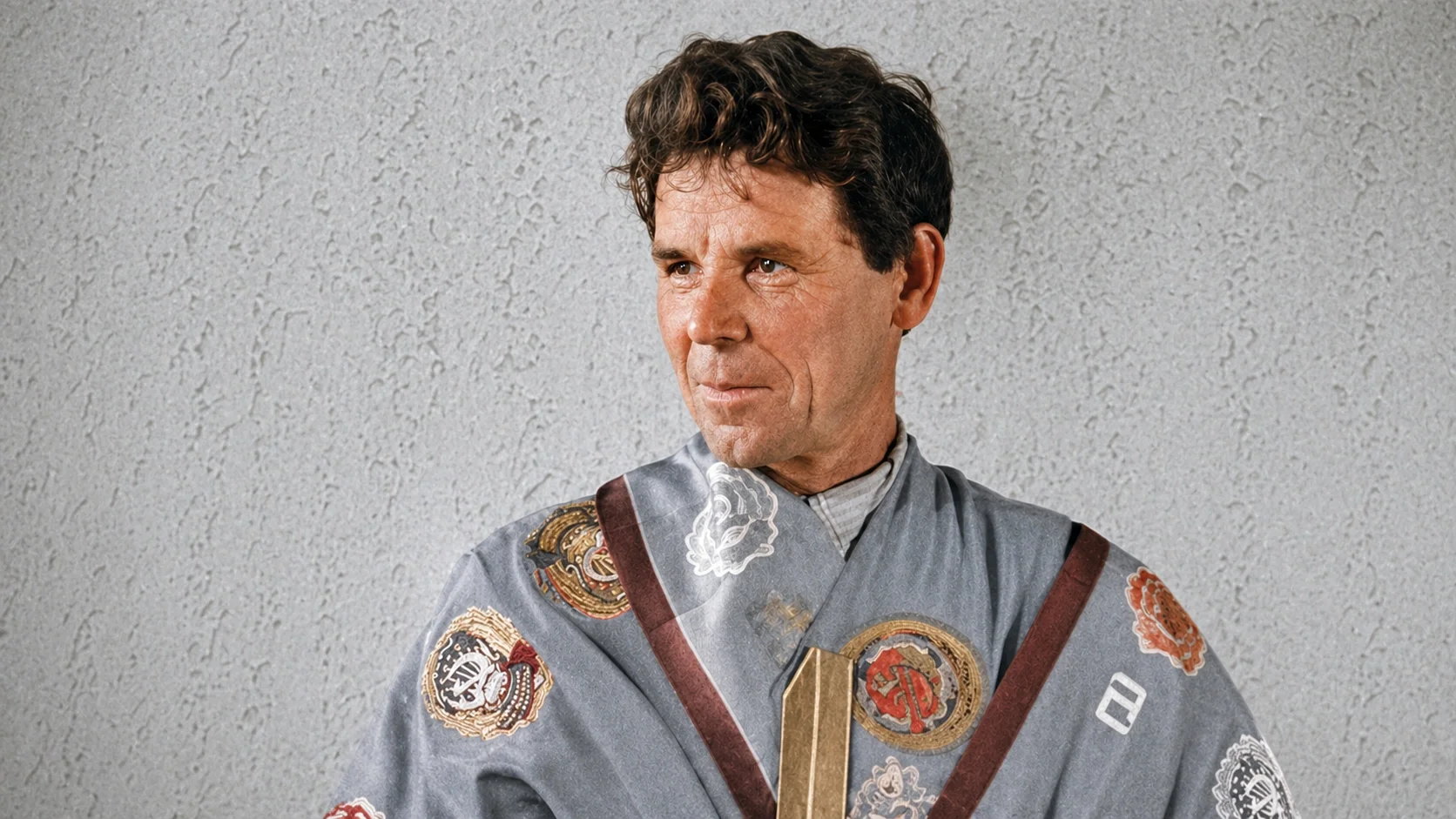
Nezhmetdinov’s legacy in Kazan and Tatarstan is therefore not merely memorial but structural. The Kazan chess school bears his name, and the house where he lived at 76 Bauman Street received a memorial plaque in 1988. The commemorative tournament in his honor has endured for decades: the Russian Chess Federation reported the 39th Nezhmetdinov Memorial in 2017, and by June 2025, the event had reached its 47th edition. At his centenary in 2012, Tatarstan officials publicly described him as the founder of the republic’s chess school. Ceremonial language always exaggerates a little, but not from nothing. Nezhmetdinov is remembered there not as an isolated artist but as an origin point, a civic ancestor of regional chess culture.
The most accurate way to place him historically is to avoid two opposite mistakes. One is to shrink him into a cult figure of beautiful attacks and little else. The other is to inflate him into an uncrowned world champion. He was neither. He was an elite Soviet master of demonstrable grandmaster-level force at his best, a five-time RSFSR champion, a dual master in chess and checkers, an honored coach, a Tatar-language chess author of real cultural consequence, and one of the purest artists of the initiative the game has produced. His title undersells him, but myth can oversell him, too. The truth is stronger than either distortion: Nezhmetdinov matters because he showed that chess can be at once local and universal, institutional and untamed, pedagogical and ecstatic. In his games, calculation catches fire. In his life, culture and survival do the same.
