Vsevolod Rauzer
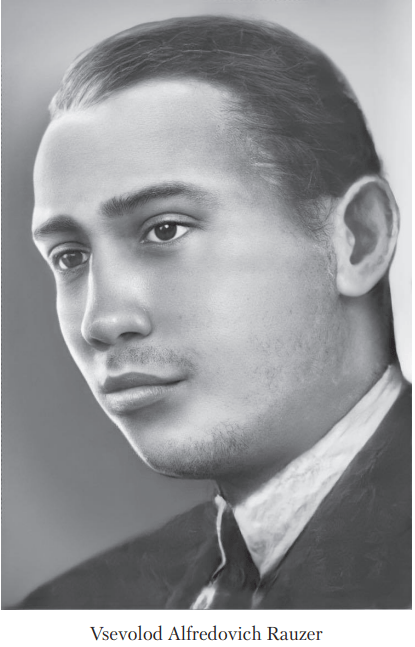
This profile prioritizes Russian-language materials and Soviet-era reference traditions, above all the Russian Chess Federation biographical note on Rauzer, the posthumously published Aleksandr Konstantinopolsky biography Obsession: A Chess Biography of Vsevolod Rauzer, and Soviet reference works that recorded his career while memories were still relatively fresh. Taken together, they present Rauzer not merely as the man whose name survived in one Sicilian variation, but as a formative analytical mind in early Soviet chess, a player whose practical career was cut short before his historical stature could fully stabilize in public memory.
Vsevolod Alfredovich Rauzer was born in 1908, and the best current Russian archival reconstruction makes Kyiv, then Kiev, the likeliest birthplace. Older recollections were less certain. Konstantinopolsky remembered Rauzer as having come to Kiev in 1924 after periods in Rostov-on-Don and Kislovodsk, and even admitted that he never thought to ask where Rauzer had been born. Later research cited by the editors of Obsession and by the Russian Chess Federation points to housing records showing that both Rauzer and his mother were born in Kiev, while his mother is described as a native of the city. His father remains uncertain in the record, though Rauzer himself reportedly listed his nationality as German.
The most striking thing about Rauzer’s early formation is how self-directed it was. According to Konstantinopolsky’s memoir, Rauzer said that he had first been introduced to chess in 1920 and, sixteen years later, still regarded himself as essentially self-taught. He studied from an almost unreadable Dufresne handbook and copied chess columns from the magazine Niva by hand. His first published compositions appeared while he was still a teenager, and a Soviet column editor, N. Grigoriev, publicized both one of his early problems and his first notable practical success, a 7 out of 7 sweep in a Rostov-on-Don city competition in 1924. This matters because it shows that Rauzer’s later theoretical originality did not arise from formal institutional training alone. It began in the intensely improvised, partly amateur, partly self-educational chess culture of the 1920s.
By the later 1920s Rauzer had become one of the most respected young players in the Kiev chess scene. Konstantinopolsky, himself no minor witness, recalled that from 1926 to 1930 he regarded Rauzer as a teacher and the most talented, knowledgeable, and authoritative of the young Kiev players. Rauzer’s apartment became a gathering place for long analytical sessions, often lasting late into the night, with his mother finally telling the assembled analysts that it was time to stop. That image is important because it anticipates the later Soviet model of collective analysis, opening laboratories, and chess study as organized intellectual labor. Rauzer was not just participating in that culture. He was helping create its atmosphere.
His competitive rise was real, even if later generations sometimes remember the theory more than the results. A Soviet chess dictionary from 1929 already lists him as a Kiev first-category player whose chief success had been second place in the 1927 Ukrainian championship, which nevertheless conferred the title of champion because Aleksei Seleznev was effectively outside the competition. The same reference notes that Rauzer had already published endgame analysis, specifically on bishop endings with rook pawns. The Russian Chess Federation summary adds that he became champion of Kiev, won the Ukrainian championship twice, earned the Soviet Master of Sport title in 1929, played in six USSR Championships, won the 1930 masters tournament of Transcaucasia, Ukraine, and Uzbekistan, placed second in the Leningrad championship, shared second and third in the 1935 masters event of the Union republics with Hans Kmoch present, and shared first and second in a young masters event in Leningrad in 1936.
Even so, Rauzer’s historical importance does not rest mainly on a tournament crosstable. It rests on the specific kind of theoretical work he did. Konstantinopolsky and the Yudovich-Fogelevich material in Obsession present him as a thinker who did not merely find pretty tactical ideas. He built coherent systems. One passage states flatly that the leading position in modern theoretical development belonged to Rauzer, and explains that his great advantage was not isolated novelties but the ability to discover whole developmental schemes in modern openings. That distinction is crucial. Rauzer helped shift Soviet opening work away from scattered tricks and toward connected plans, where opening choices were justified by middlegame structure, piece placement, pawn breaks, and strategic continuity.
His own statements about style make him especially interesting. He said that, in his early years, he liked positional play and that Tarrasch had impressed him with logic and the clarity of his positions. This is revealing because Rauzer is often remembered as a highly aggressive opening analyst. Yet the memoir evidence suggests that beneath the attacking reputation was a strongly classical cast of mind, one that wanted logical development and positions that could be explained as well as played. That helps explain why his analyses mattered so much. He was not merely seeking chaos. He was seeking systems that made attacking play intellectually defensible.
The clearest examples of his contribution come from the French, Caro-Kann, and Sicilian. The Yudovich-Fogelevich essay reproduced in Obsession credits Rauzer’s game against Alatortsev in the 1933 USSR Championship with establishing 7.Nf3 as a classical French Defense line. It also credits his game against I. Rabinovich in the same event with a positional refutation of the Caro-Kann line 1.e4 c6 2.d4 d5 3.Nc3 dxe4 4.Nxe4 Nf6 5.Nxf6+ exf6, emphasizing Rauzer’s plan of kingside castling, g3, and a queenside pawn advance. Most importantly, the same source identifies his Sicilian system after 1.e4 c5 2.Nf3 Nc6 or 2...d6 3.d4 cxd4 4.Nxd4 Nf6 5.Nc3 followed by 6.Bg5 as a development that started what it explicitly calls a “real revolution” in Sicilian theory. That is a very strong claim, but in historical context it is justified. Rauzer did not merely lend his name to a line. He helped establish the idea that White could answer the Classical Sicilian with a principled, deeply prepared attacking system whose value lay in long-term plans, not just in move order fashion.
That is why the later Richter-Rauzer name, while famous, is actually a slightly narrowing label for a broader legacy. Modern opening nomenclature still preserves the Richter-Rauzer Variation as a recognized branch of the Classical Sicilian, beginning with 6.Bg5, which shows how durable his analytical stamp remains. But the deeper point is that Rauzer’s work prefigured the Soviet habit of treating the opening as a scientific problem that had to be connected to middlegame plans and strategic objectives. Botvinnik later wrote that Rauzer’s opening studies, and not only his opening studies but also his endgame analyses, linked to middlegame plans in ways that justify placing him among the founding masters of the Soviet school. Coming from Botvinnik, who was not lavish with praise, that is a major historical verdict.
Memoir evidence also gives Rauzer an almost tragic intensity. The Russian Chess Federation summarizes the testimony of contemporaries by saying he worked on chess up to sixteen hours a day and tried, analytically, to prove the maxim “White begins with 1.e4 and wins.” This was connected to an attacking style that spectators reportedly found fresh and compelling. Yet the same source also stresses how precarious his material life was. He lived with his mother, depended on modest means, served as a low-paid Spartak instructor, and suffered from undernourishment and nervous problems. Konstantinopolsky’s memoir similarly depicts a gifted but maladjusted man, capable of honesty, directness, and pride, but poorly equipped for ordinary life and forced to work as a courier in the city's financial department. These details matter because they keep Rauzer from being romanticized into a pure “theory genius.” His brilliance existed alongside poverty and fragility.
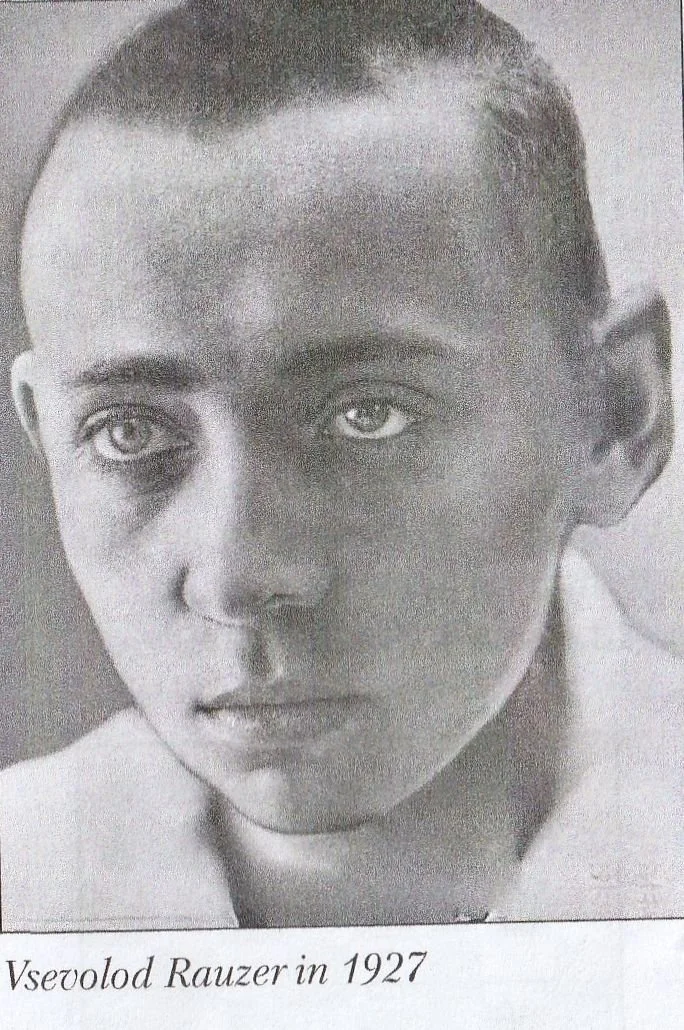
The collapse of his playing career came early. The Russian Chess Federation states that after losses to Sergei Belavenets in the 1937 Leningrad versus Moscow match, Rauzer withdrew from the Leningrad championship because of illness and then stayed away from serious tournament play for roughly three years while undergoing psychiatric treatment. ChessBase’s historical note likewise says that his psychological problems intensified with age, that he played his last tournament in the 1940 Soviet Championship semifinal in Kyiv, and that by the end of 1940, he had been sent to a psychiatric hospital. Ruchess also adds a final, significant detail: in the last prewar years, he trained the future women’s world champion Lyudmila Rudenko. Even at the edge of his own collapse, he was still transmitting knowledge forward.
The final chapter of Rauzer’s life is one of the places where a careful historian has to slow down and distinguish established fact from repeated tradition. Many English-language and older secondary sources gave 29 December 1941 as his date of death in besieged Leningrad. Yet the more recent Russian archival reconstruction cited in Obsession and on the Russian Chess Federation site indicates that 1942, probably May 1942, is more likely, with the month and precise date not fully certain. The same records indicate that his mother died later, on 29 July 1942. For that reason, the most responsible formulation is that Rauzer died during the Siege of Leningrad, very likely in May 1942, after prolonged illness and deprivation, while the exact day remains unsettled in the surviving record.
So how should Rauzer be placed in chess history? Not as a world-title contender who narrowly missed immortality. That would be the wrong frame. He should be understood instead as one of the decisive early system-builders of Soviet chess thought, an analyst whose work helped define how Soviet masters approached opening preparation. His practical record was strong enough to prove he was far more than a laboratory figure, but his real historical distinction lies in the union of analysis, structure, and attacking logic. He belonged to that first Soviet generation that transformed opening study into a disciplined, collective, and future-oriented enterprise. His career was abbreviated by illness and war, but his ideas survived in theory books, in Botvinnik’s verdict, in Soviet analytical culture, and in the living vocabulary of the Sicilian itself. That is why Rauzer remains historically important. He is one of the great unfinished figures of twentieth-century chess, a master whose legacy is larger than his fame.
Source note: The most useful sources for this profile were the Russian Chess Federation biographical entry on Rauzer, the preview of Aleksandr Konstantinopolsky’s posthumously published biography Obsession: A Chess Biography of Vsevolod Rauzer, and the 1929 Soviet chess dictionary entry that already recorded Rauzer as Ukrainian champion and an endgame analyst. These were supplemented cautiously with later historical summaries only where they aligned with the Russian record.
