Nicolas Rossolimo
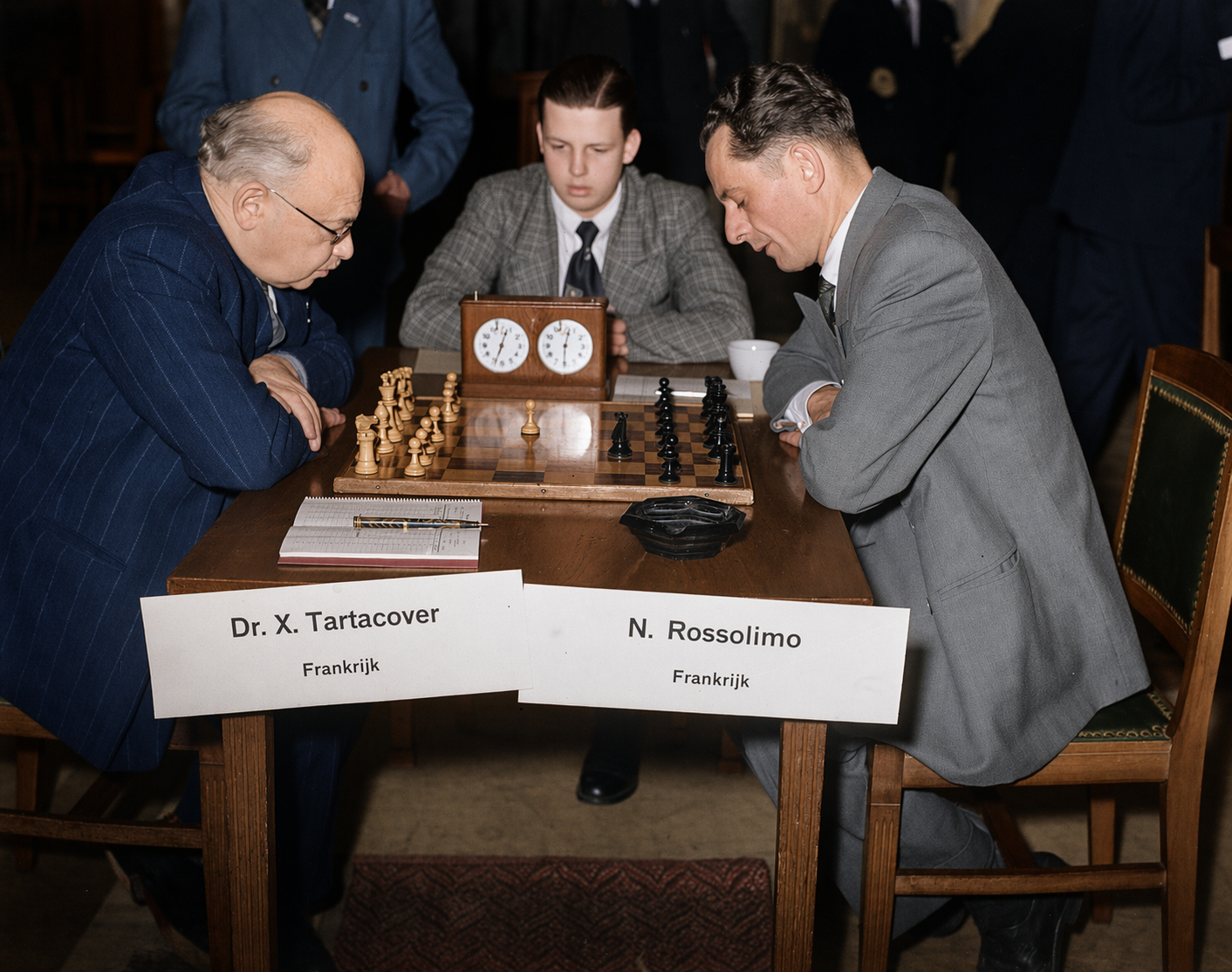
Tartakower vs. Rossolimo, Amsterdam, 1950.
Nicolas (Nikolai) Spiridonovich Rossolimo (28 February 1910 – 24 July 1975) was one of the most colourful personalities in chess history. Born in Kiev to a Greek father and a Russian mother, he grew up in Moscow, matured as a player in Paris and later became a fixture of New York’s chess scene. Throughout his life he won titles for three different nations, composed endgame studies, developed an opening system that bears his name and maintained a romantic, artistic attitude even when the hard economic realities of professional chess forced him to drive taxis and wash dishes. This profile examines his life in detail, drawing on primary sources and placing his achievements in their historical context.
Early life in the Russian Empire and escape from the Soviet Union
Family background: Rossolimo’s father Spiridon, of Greek ancestry, was an official painter for the Russian Imperial Army. His mother Xenia Nikolaevna Skugarevskaya, a multilingual aristocrat and war correspondent, met Spiridon in Manchuria during the Russo‑Japanese War. They lived in Kiev where Nicolas was born on 28 February 1910.
Move to Moscow and early chess: During the early 1920s the family relocated to Moscow. Rossolimo, a precocious child, reached first‑category strength and began composing endgame studies; his first published study appeared in the magazine Shakhmatny Listok in September 1926 when he was only 16.
Flight to the West: The post‑revolutionary Soviet climate became dangerous for the family. Xenia was imprisoned during the civil war; using her husband’s Greek citizenship she secured exit visas and left the USSR in 1929 with Nicolas and his elder brother, travelling via Czechoslovakia to Paris. Spiridon later emigrated to New York.
Paris years: Cab driver, city champion and French national
Becoming a French champion: Arriving in Paris penniless, Rossolimo supported his chess career by driving a taxi while practising relentlessly. He soon became one of the city’s strongest players, winning three Paris championships in the 1930s and placing second or third in two French championships. Just before the Second World War he had two impressive results: he finished second behind José Raúl Capablanca in the strong Paris tournament of 1938 and won the 1939 Paris event ahead of Savielly Tartakower.
French citizenship and national title: After the war he trained with Camil Seneca and obtained French nationality in 1947. The following year he won the French championship, cementing his status as France’s top player.
International recognition: Rossolimo represented France in team competitions and was awarded the International Master title in 1950 and the Grandmaster title in 1953.
The Rossolimo Variation and romantic chess
Opening innovator: Rossolimo is best remembered for the anti‑Sicilian line 1 e4 c5 2 Nf3 Nc6 3 Bb5. Although the idea had been tried earlier, it was Rossolimo who used it consistently and developed its strategic nuances. Because of his frequent successes with the system, 1 … Nc6 3 Bb5 is widely known as the Rossolimo Variation.
Late Romantic playing style: He considered himself an artist rather than a point‑gatherer. Pal Benko recalled that Rossolimo proposed awarding points according to the artistic merit of games. Vlastimil Hort described him as a “late Romantic” attacker who preferred brilliancies over pragmatic play.
Emigration to the United States and the Rossolimo Chess Studio
America and professional hardships: In 1952 Rossolimo emigrated to the United States with his wife Vera Budakovich and son Alexander, joining his parents in New York. He hoped to earn a living from chess but soon realised that the pre‑Fischer era offered little financial security. To support his family he worked as a bellboy and busboy at the Waldorf‑Astoria Hotel and drove a cab. Nevertheless, he established the Rossolimo Chess Studio in Greenwich Village, a cosy club where patrons could buy chess sets and books, take lessons, play against the master for a fee and enjoy sandwiches and coffee.
The U.S. Open triumph: Rossolimo’s greatest American success came at the 1955 U.S. Open in Long Beach. A contemporary report noted that the tournament awarded a Buick car to the “U.S. Open Champion Nicolas Rossolimo”. He scored an undefeated 10–2, conceding only draws to Donald Byrne, Samuel Reshevsky, Peter Lapiken and Anthony Saidy. Among the players he defeated were former U.S. champion Larry Evans and James T. Sherwin. Reshevsky tied him on points but lost on tiebreaks.
Polyglot Renaissance man: Rossolimo was a true polymath. According to chess historian Victor Bologan, he spoke five languages fluently, held a brown belt in judo, released a record of Russian folk songs with a cover designed by artist Marcel Duchamp and wrote two books. FiveThirtyEight’s profile (quoting the New York Times) adds that he was one of the United States’ few grandmasters, a judo master and a cab driver.
Endgame studies and literary contributions
Early compositions: Rossolimo showed a precocious talent for composing endgame studies. Most were published in Soviet journals between 1926 and 1929; he co‑authored one study with Sergei Kaminer. His early studies often featured systematic manoeuvres and were admired by contemporaries.
The 1947 booklet: After moving to Paris he collected twelve of his studies in a 28‑page booklet, Les Échecs au coin du feu (“Chess by the Fireside”). Published in 1947 with a foreword by Savielly Tartakower, the booklet showcased his best compositions.
Decline in composing: Rossolimo’s interest in composition waned during the 1930s, and his last study—dating from 1934—was published only in the 1947 booklet.
Later years, second chess studio and tragic death
Return to France and Spain: In the early 1970s Rossolimo briefly opened a second chess studio in Spain, but the venture was not successful. He represented France once more at the 1972 Olympiad despite living in America.
Continued competitive strength: Even in his sixties he remained formidable; he placed third in a major open tournament in New York in 1975, finishing ahead of many younger masters.
Accidental death: Shortly after this success, Rossolimo suffered a fatal accident. He was found unconscious after an accidental fall and died of head injuries on 24 July 1975. FiveThirtyEight notes that he fell near the Marshall Chess Club in Greenwich Village.
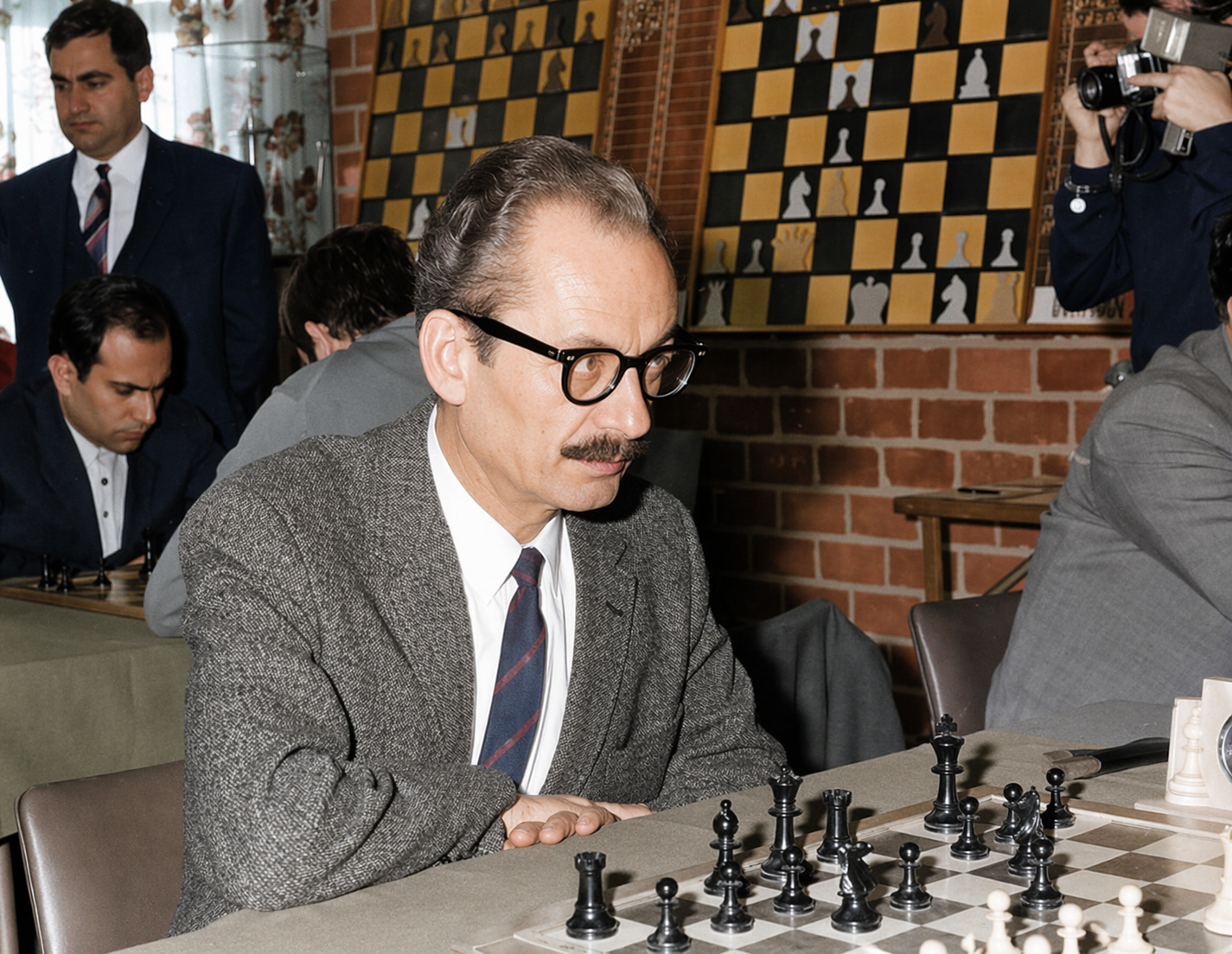
Rossolimo, Wijk-aan-Zee, 1968
Legacy and influence
A cosmopolitan identity: Rossolimo held four nationalities—Greek, Russian, French and American—and spoke multiple languages. His life epitomised the displacement of many émigré intellectuals of the twentieth century. He viewed America as “a better country for everyone but chess players”, reflecting the lack of professional opportunities at the time (as quoted by the New York Times, cited via Edward Winter’s research).
Impact on opening theory: The Rossolimo Variation remains one of the most respected anti‑Sicilian systems. Top grandmasters such as Carlsen and Caruana use it regularly, and theoretical works continue to analyse it. Its blend of positional subtlety and tactical potential reflects Rossolimo’s own playing style.
A romantic artist: Above all, Rossolimo championed chess as an art form. He refused to sacrifice beauty for results and believed that brilliancy should be rewarded more than grinding wins. His games, compositions and teaching left a legacy of imagination and creativity that continues to inspire players today.
Further reading
For readers interested in exploring Rossolimo’s life and games in greater depth, consult the following:
Alain Pallier, “Nicolas Rossolimo (28ii1910 – 24vii1975)” – detailed biographical article in EG 180 with analysis of his endgame studies.
Vlastimil Hort, “Nicolas Rossolimo” – ChessBase feature discussing Rossolimo’s cosmopolitan life and brilliancy games.
Victor Bologan, The Rossolimo for Club Players (New In Chess, 2022) – biography and theoretical guide that includes anecdotes about Rossolimo’s languages, judo and musical talents.
USCF, “Rossolimo Wins Open” (Chess Life, September 1955) – contemporary report on his U.S. Open victory.
FiveThirtyEight, “Computers Are Haunting the World Chess Championship” – short profile quoting the New York Times on Rossolimo’s life as a Renaissance man.
