The 1948 World Chess Championship: From The Hague to Moscow, the Birth of Soviet Dominance
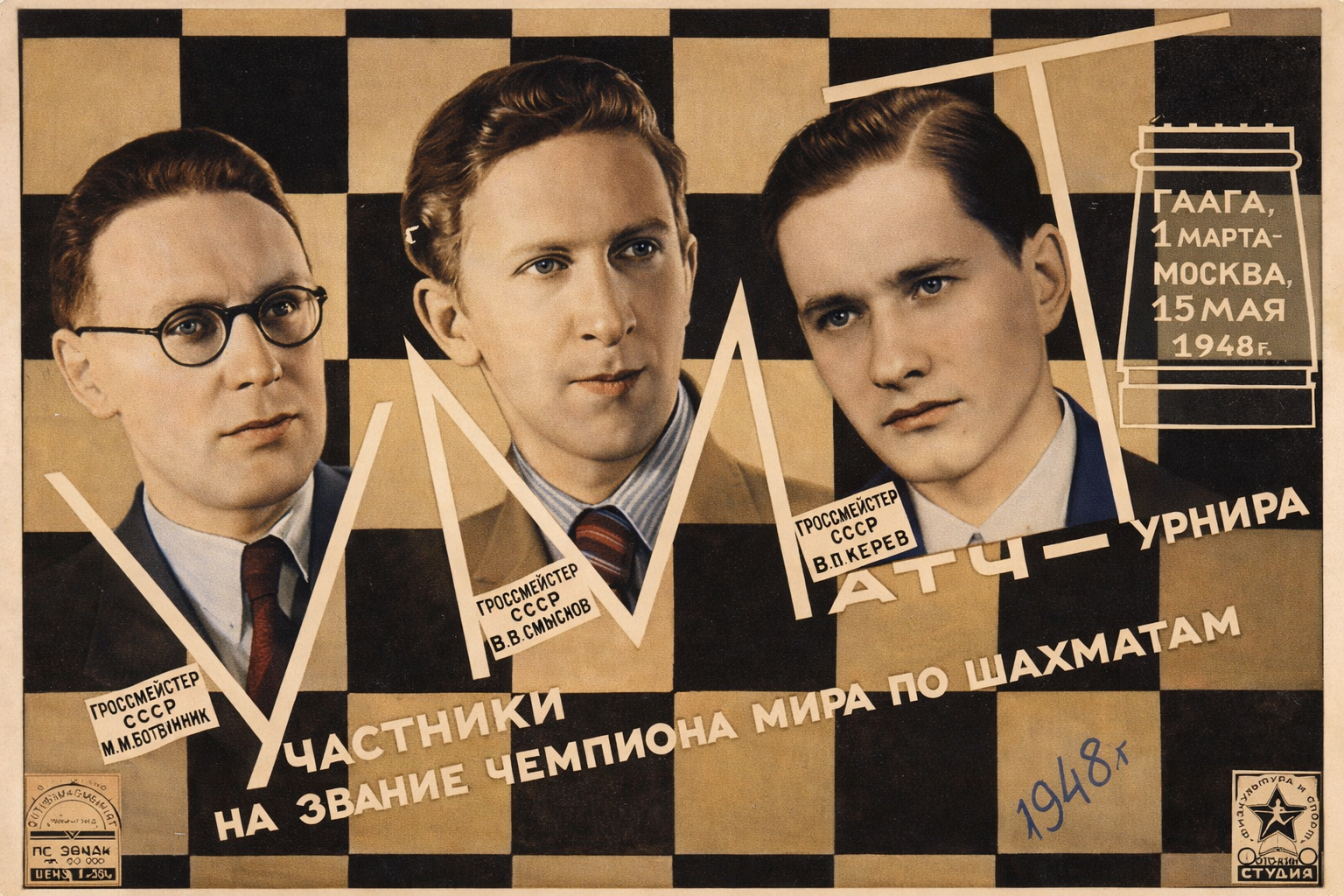
Mikhail Botvinnik, Vasily Smyslov, and Paul Keres: Participants in the match-tournament for the title of World Chess Champion.
World Chess Championship 1948: The Hague and Moscow
A useful technical note: 1948 was a world championship match-tournament, not a straight one-on-one title match. That distinction matters. After Alexander Alekhine died in 1946 while still champion, chess needed not only a winner but a new way to produce one, and the Hague-Moscow event became the bridge from the old private-match era to the modern FIDE-controlled crown.
Profile card. World Chess Championship 1948. Sites: The Hague and Moscow. Dates: 2 March to mid-May 1948. Field: Mikhail Botvinnik, Paul Keres, Samuel Reshevsky, Max Euwe, and Vasily Smyslov. Format: five-player quintuple round robin. Winner: Botvinnik with 14/20.
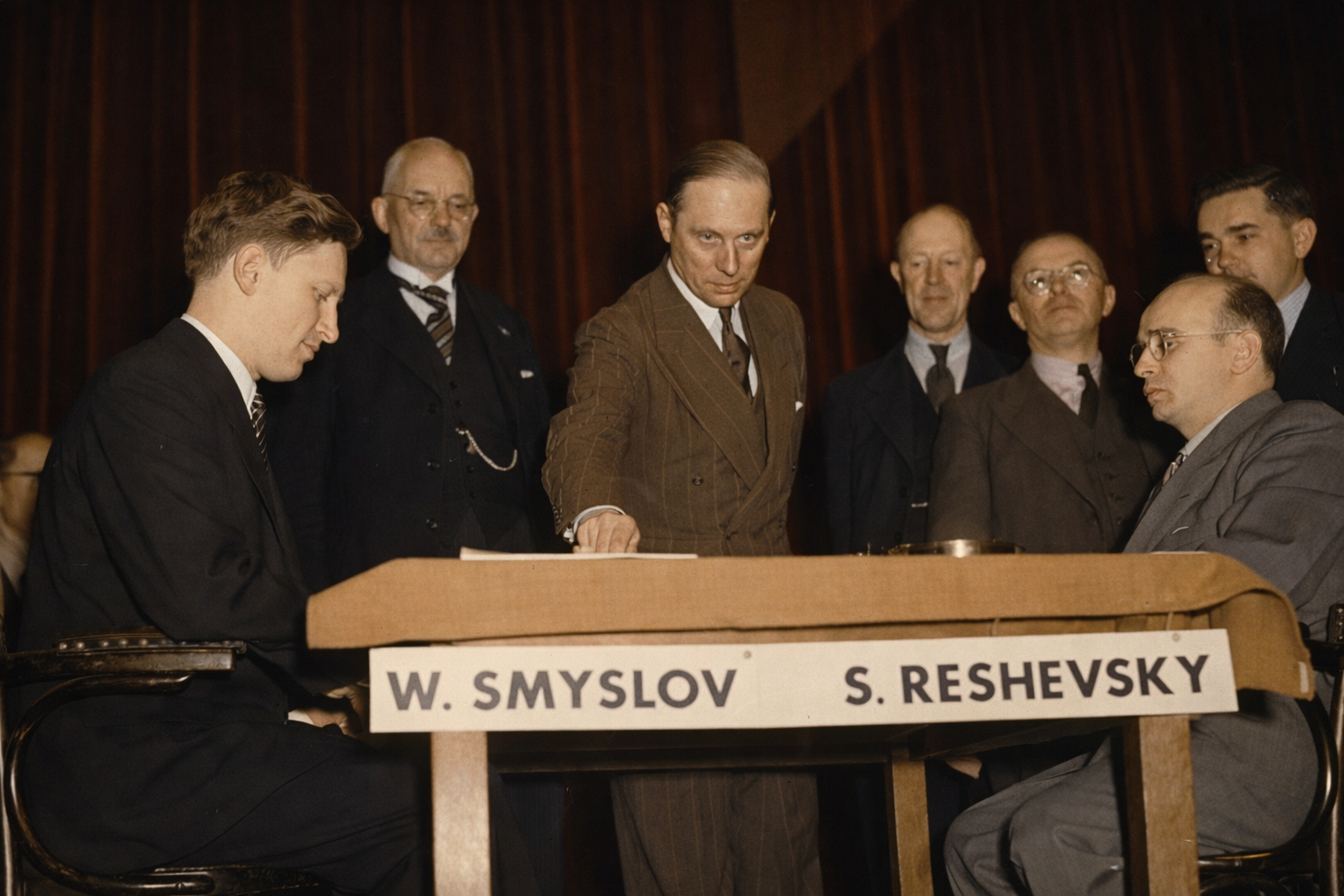
Vasily Smyslov and Samuel Reshevsky, The Hague, 1948
A Crown Without a King: The Crisis After Alekhine
Alekhine’s death created a true interregnum. The traditional route to the title had been brutally simple: beat the reigning champion in a match. But when the champion dies in office, the ladder loses its top rung. FIDE stepped into that vacuum and used the prewar AVRO 1938 supertournament as the skeleton of a solution. The original plan shifted: Salo Flohr was replaced by Smyslov, Reuben Fine declined to play, and the championship became a five-player match-tournament. Emergency improvisation slowly hardened into institution.
The Five Contenders: Power, Prestige, and Uneven Ground
The field was elite, but not balanced in circumstance. Botvinnik entered as the favorite, backed by dominant prewar form and his Groningen 1946 victory. Keres and Reshevsky were established challengers. Euwe, a former world champion, arrived in decline. Smyslov represented the future, not yet fully formed but unmistakable.
Preparation and support told another story. The Soviet players operated with structure and backing. Reshevsky arrived largely alone. The tournament, before it began, already carried the quiet tension of systems competing beneath the board.
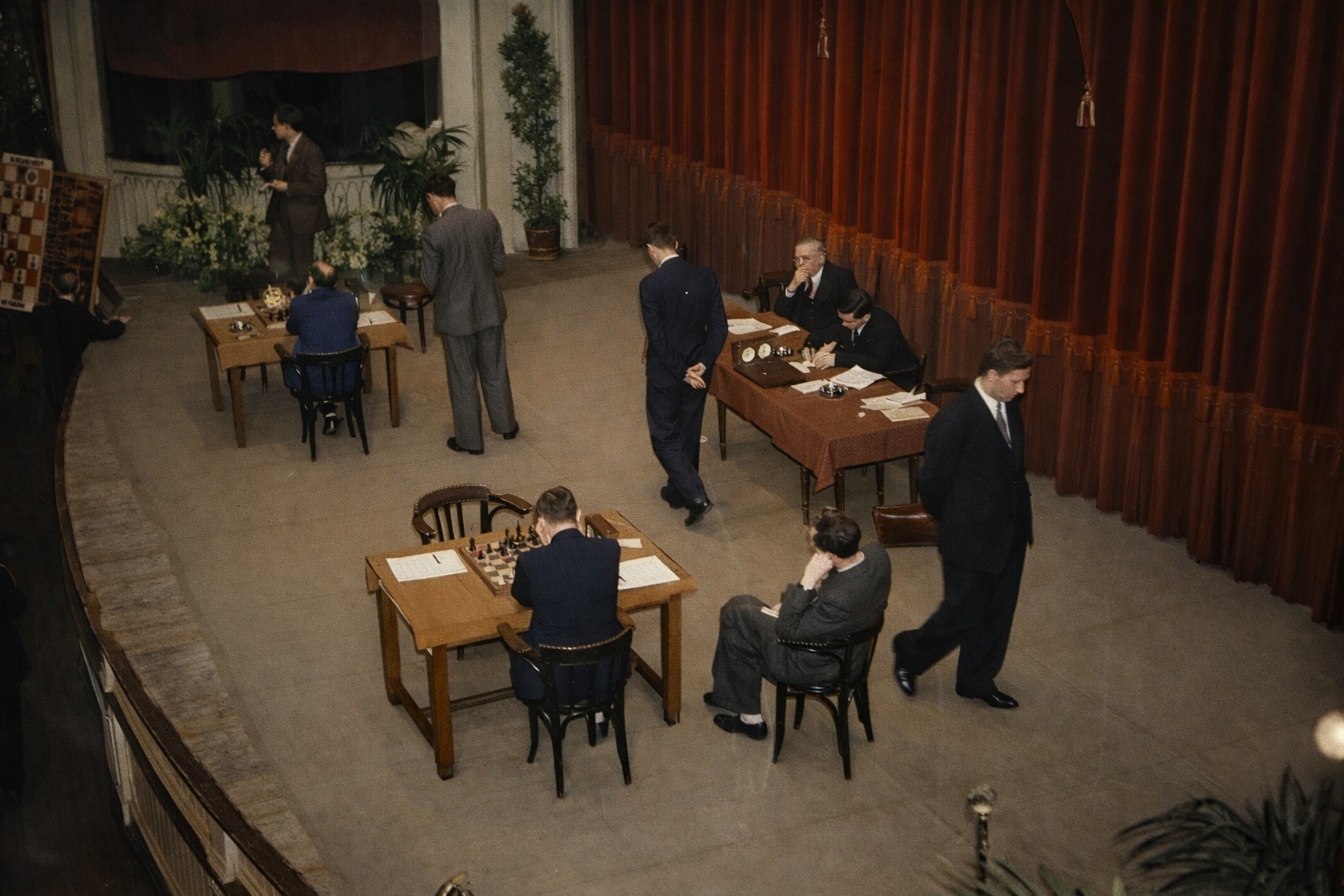
Two Cities, One Stage: From The Hague to Moscow
The championship unfolded across two distinct worlds. The Hague offered a modest, postwar setting, with games played in civic spaces and chess clubs. Moscow, by contrast, transformed the event into state theater, staged in the Pillar Hall of the House of the Unions.
The shift was not merely geographic. It was symbolic. Chess moved from reconstruction to projection, from recovery to demonstration.
The Tournament Unfolds: Botvinnik’s Relentless Ascent
Each player faced the others five times, creating a long, grinding structure where consistency mattered more than flashes of brilliance. Botvinnik seized control early and never released it. He led at every checkpoint: 3½, 6, 9, 12, and finally 14 points.
After the Hague leg, he already stood clear of the field. No late surge emerged. The championship was not decided in a final sprint but in sustained command.
The final table tells the story with clarity:
Botvinnik 14/20, Smyslov 11, Keres and Reshevsky 10½, Euwe 4.
More telling still, Botvinnik held a plus score against every opponent. This was not survival. It was domination.
The Hague to Moscow, 1948
Reshevsky - Smyslov
Chess at Full Stretch: Style, Technique, and Endurance
The games themselves reveal a wide spectrum of mastery. Botvinnik’s technical endgame wins, Smyslov’s harmonic precision, Reshevsky’s resilience, and Keres’s fighting spirit all found expression.
This was not a tournament of isolated brilliancies. It was a test of repeatable excellence. Endgames, transitions, preparation, and psychological control defined the event.
Botvinnik’s style proved ideally suited. Deep preparation, strategic clarity, and technical precision allowed him to outlast and outmaneuver the field. Over twenty games, method defeated volatility.
The Keres Question: Shadow Over the Board
No account of 1948 is complete without addressing the controversy surrounding Paul Keres. His four consecutive losses to Botvinnik have long fueled speculation about political pressure.
Officially, the tournament was declared fair. Unofficially, doubt lingered. Modern assessments tend toward a cautious middle ground: Keres faced undeniable external pressures, yet the games themselves resist simple explanations.
The ambiguity remains part of the tournament’s historical texture, a reminder that chess in this era was never played in isolation from the world around it.
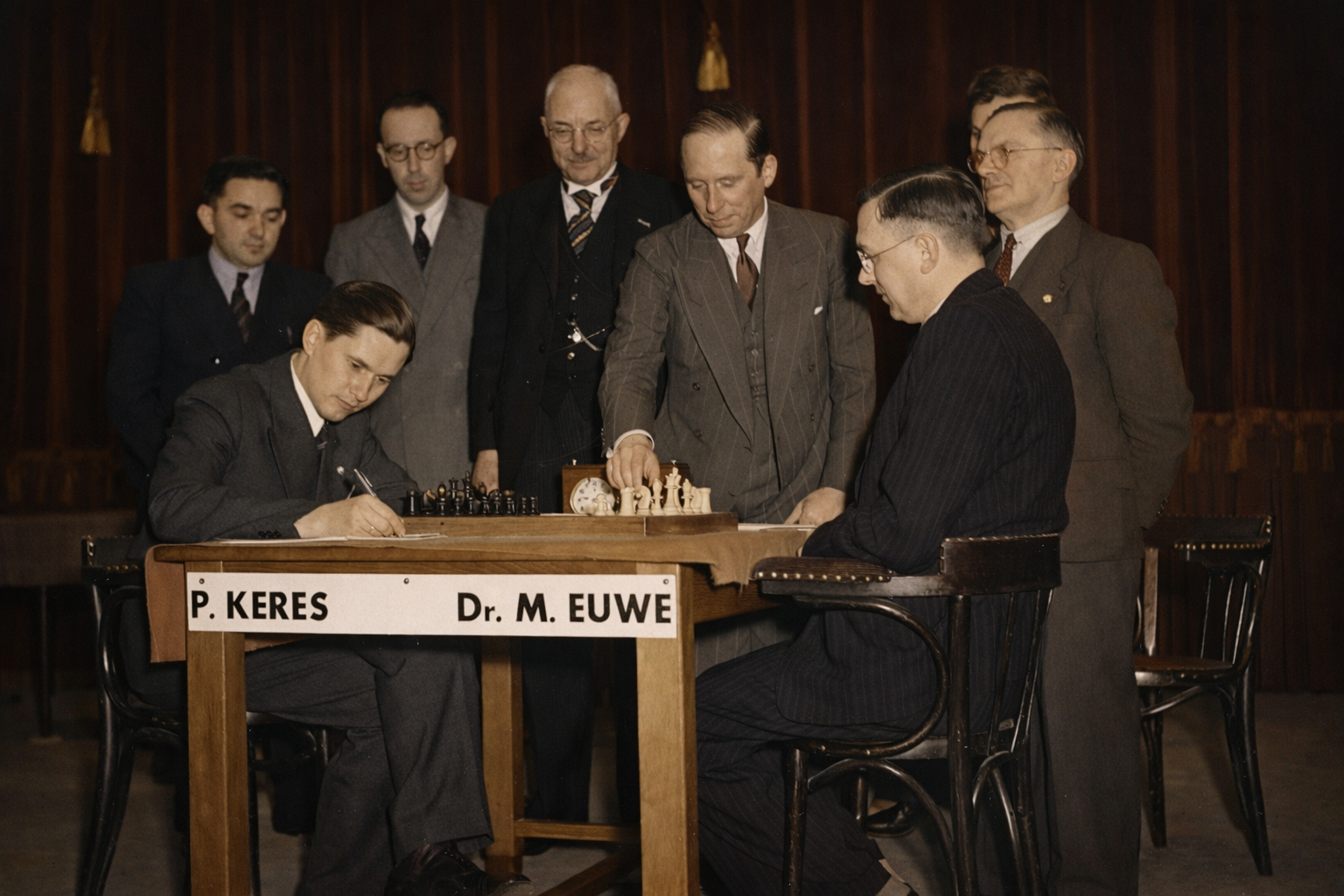
Paul Keres and Max Euwe, The Hague, 1948
Birth of the Modern Championship System
The true significance of 1948 lies beyond the final standings. This event established FIDE’s authority over the world championship and laid the foundation for the modern cycle: Zonal, Interzonal, and Candidates tournaments.
It also marked the beginning of Soviet dominance in world chess, a period defined by structure, preparation, and institutional strength.
The championship did more than crown a winner; It redesigned the architecture of elite chess.
Legacy: The Tournament That Rebuilt the Crown
The Hague-Moscow 1948 championship stands as a hinge moment in chess history. It closed one era and opened another.
Botvinnik emerged not only as world champion, but as the prototype of a new kind of champion: systematic, prepared, and supported by a broader chess culture.
From this point forward, the title was no longer a personal possession. It became an institution.
And in that transformation, modern chess was born.
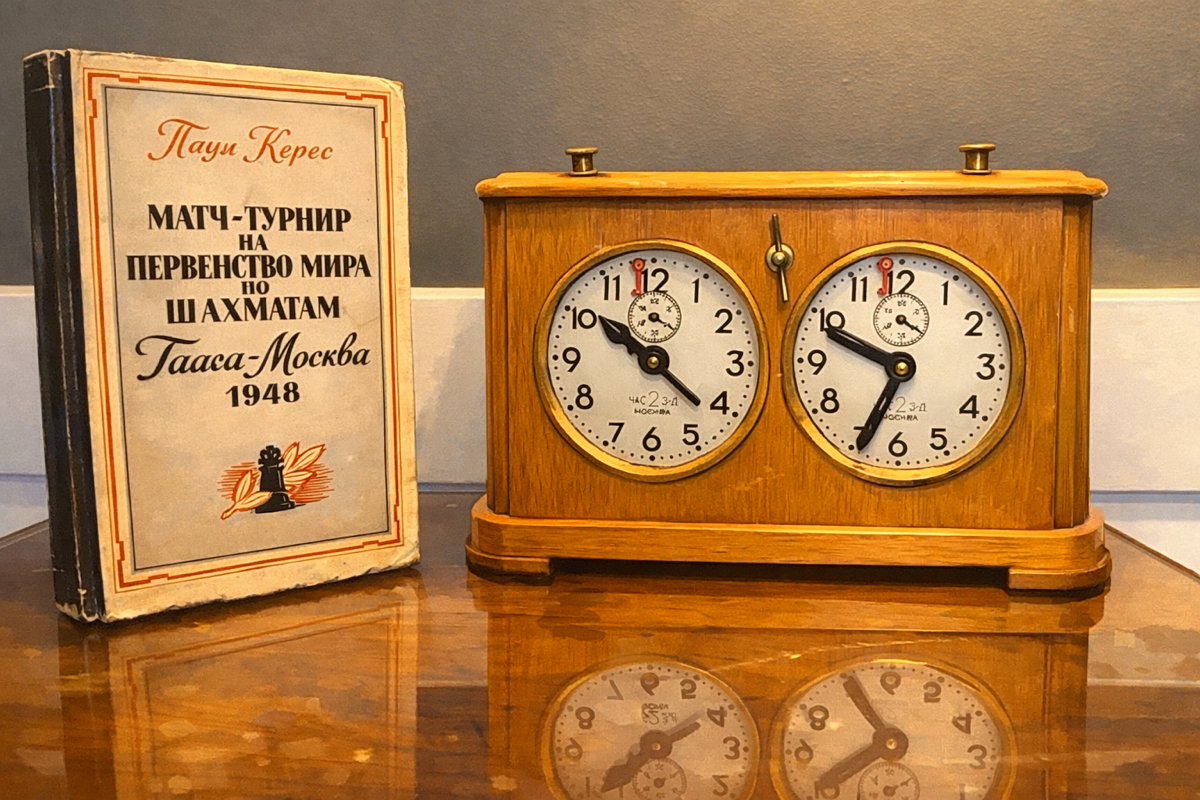
The Hague - Moscow 1948 by Paul Keres
