Viktor Korchnoi
Rob Bogaerts / Anefo, CC0, via Wikimedia Commons
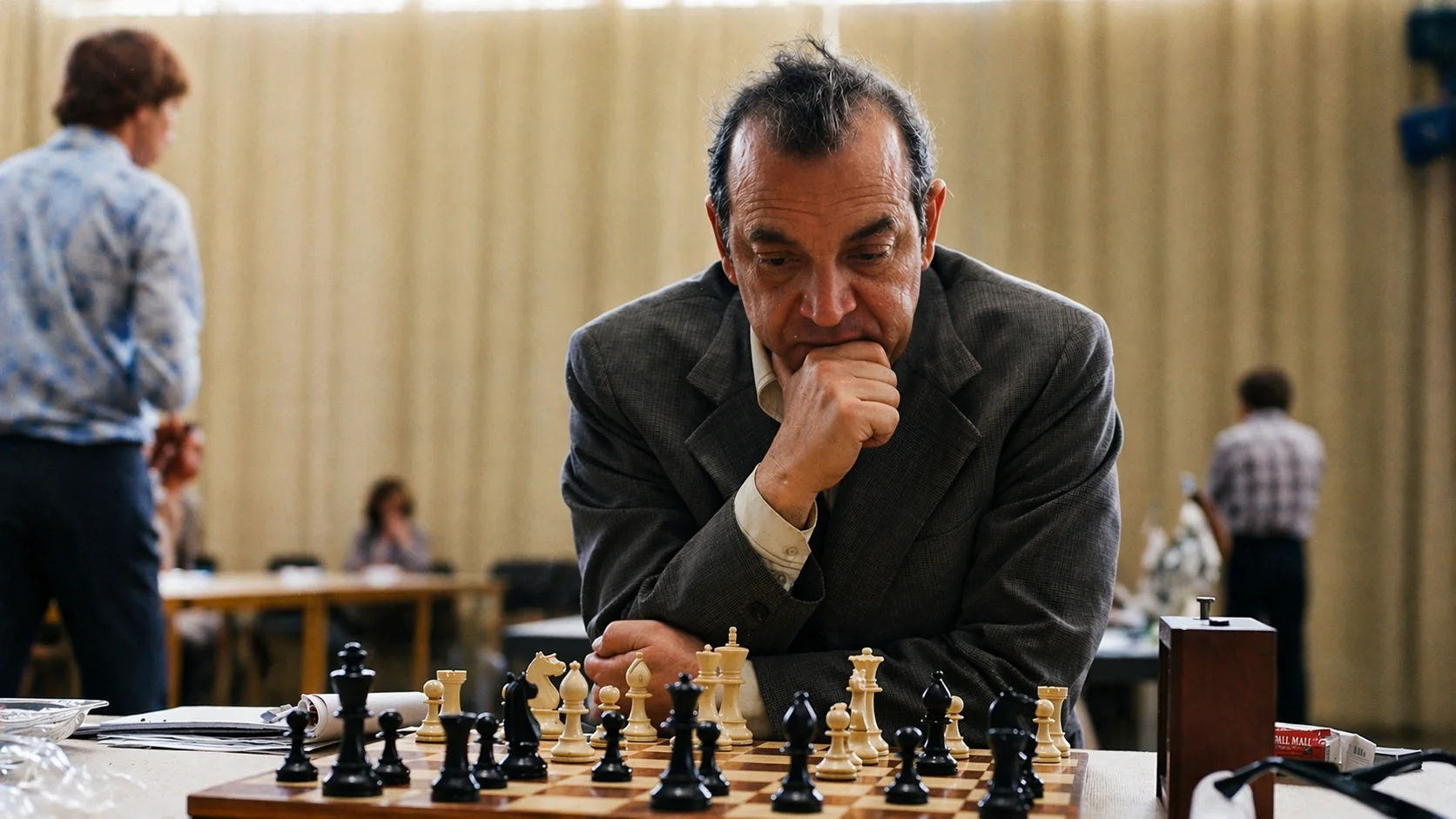
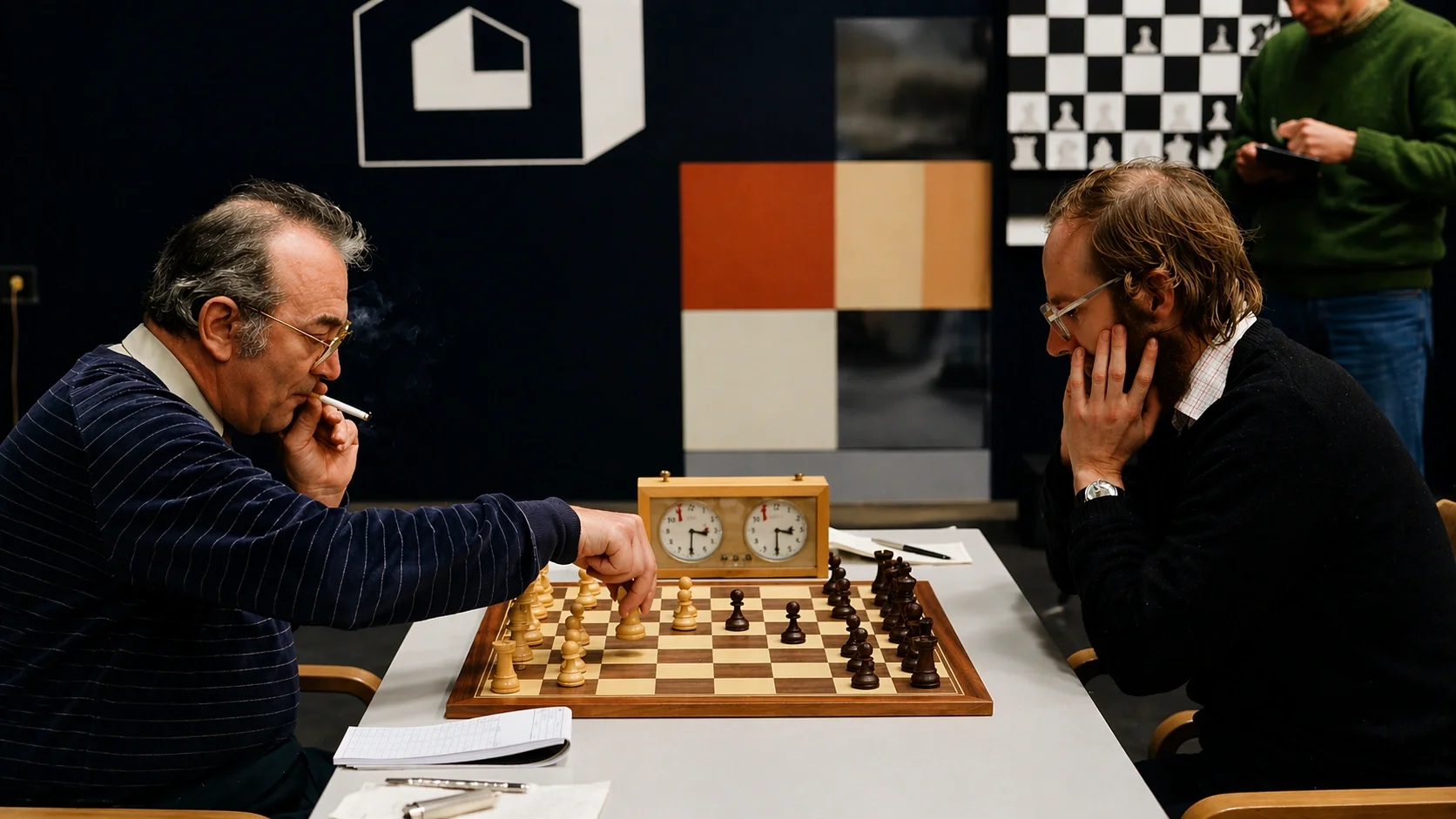
Viktor Korchnoi stands among the strongest players never to become world champion. His record is unusually weighty: four USSR titles, ten Candidates appearances across nearly three decades, victories in the 1977-78 and 1980 Candidates cycles, and two official world title matches against Anatoly Karpov after the earlier 1974 Candidates final between them. He remained a force long after most elite contemporaries had faded, winning the world senior title at seventy-five, returning to the FIDE top 100 at the same age, and continuing serious play into his eighties. These facts explain why memorial writing on him so often places him in the small company of the greatest uncrowned champions in chess history.
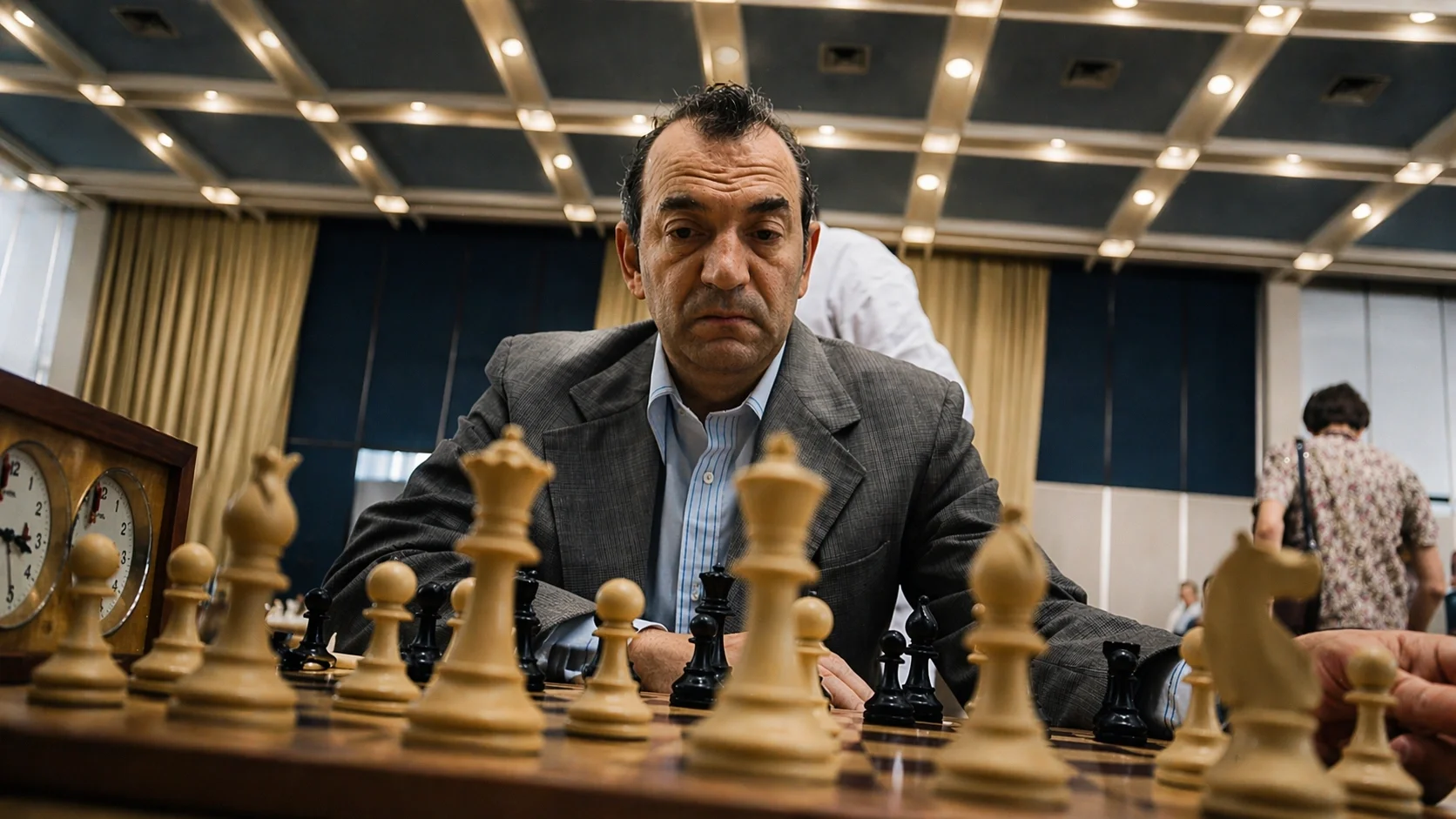
His significance extends beyond results. Korchnoi was formed by the siege experience in Leningrad, hardened by competition inside the Soviet Union, and transformed by his 1976 defection to the Netherlands before settling in Switzerland. His career, therefore, belongs to chess history and to Cold War cultural history. Over the board, he became famous for resilience, exact calculation, difficult defense, and major endgame skill. Off the board, he wrote substantial memoirs and game literature, worked intensely with younger players late in life, and generated a level of controversy that few grandmasters have matched. Because no citation style was specified, this profile uses compact author-date parentheticals with inline source links and a concise reference list. The evidentiary spine is weighted toward FIDE material, major reference works, contemporary newspaper reporting, and Korchnoi’s own published books.
Bert Verhoeff / Anefo, CC0, via Wikimedia Commons
Formation in Leningrad
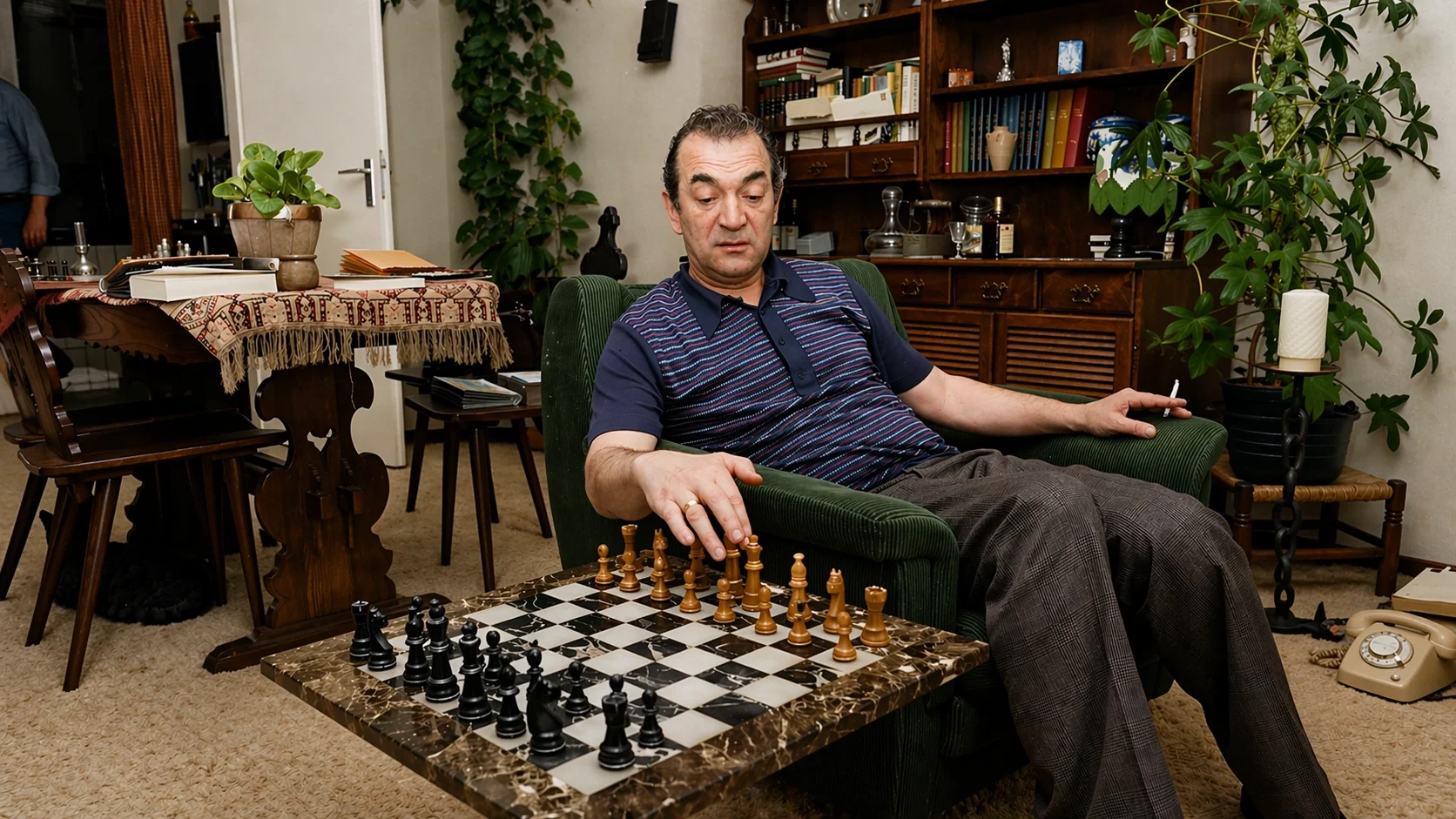
Korchnoi was born on March 23, 1931, in Leningrad. As a child he lived through the siege of the city, and later accounts consistently connect his ferocious self-reliance to that experience. Reputable obituaries and retrospective profiles agree on the broad outline: his father taught him chess when he was very young, wartime deprivation killed close family members and left him hospitalized with malnutrition, and after the war he entered the Leningrad Pioneer Palace chess school. He later graduated from Leningrad State University with a degree in history. Those biographical facts are basic to understanding his adult temperament, especially his distrust, severity, and almost ascetic devotion to competitive work.
His family background was mixed and culturally layered. Later biographical notices describe him as born to a Jewish parent and a Catholic parent, a detail that helps explain why questions of identity, belonging, and Soviet official suspicion never lay far from the surface in his life story. By 1947 he had already won the USSR junior title, a sign that the war had delayed but not broken his development. He became a Soviet master in 1951, an international master in 1954, and a grandmaster in 1956, which placed him firmly inside the elite Soviet pipeline even if he did not initially enjoy the aura attached to younger prodigies such as Boris Spassky.
Hans Peters for Anefo, CC0, via Wikimedia Commons
Soviet ascent and elite career
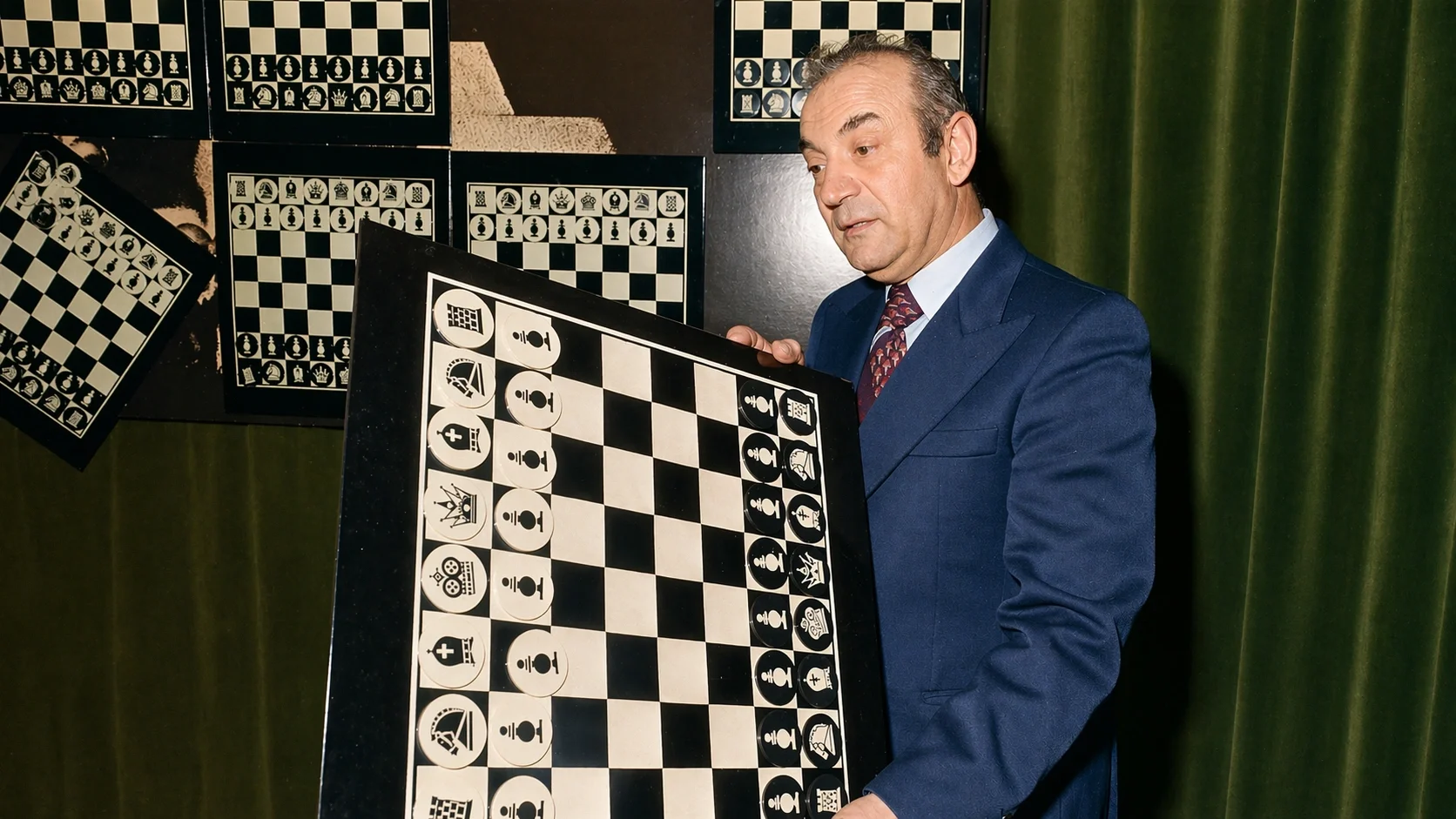
From 1960 through 1970, Korchnoi won the Soviet championship four times, in an era when that event was widely treated as the strongest national championship in the world. He also became a cornerstone of Soviet team dominance, accumulating six Chess Olympiad team golds and five European team championship golds. Archive summaries from Europe Chess and OlimpBase confirm the scale of that team record, including repeated board medals and high scoring percentages in Olympiads and European team events. In other words, before his defection he was already central to Soviet chess prestige, even if official favor later shifted elsewhere.
His world championship résumé is equally substantial. Europe Chess’s memorial summary counts ten Candidates appearances, from 1962 to 1991. He reached the 1968 Candidates final against Spassky, lost the controversial 1971 semifinal to Tigran Petrosian, and then played the 1974 Candidates final against Karpov, a match Leonard Barden correctly described as functionally a world title contest because the chances of Bobby Fischer returning to defend his title already looked remote. Karpov won that 1974 final by three wins to two, with nineteen draws.
Rankings tell the same story from another angle. Europe Chess records his official peak Elo as 2695 in January 1979. The same memorial notes that in January 2007 he stood No. 85 in the world at age seventy-five, the oldest player ever to enter the FIDE top 100. That late-career feat is especially striking because retrospective rating reconstruction from Chessmetrics places his absolute competitive crest even earlier, with a best reconstructed world rank of No. 1 during parts of 1965. Taken together, the official FIDE-era rating peak, the top-100 return in old age, and the retrospective No. 1 estimate indicate a player whose elite relevance was extraordinarily long-lived.
Hans Peters for Anefo, CC0, via Wikimedia Commons
Championships, candidates, and rivals
Korchnoi’s career can be read through rivalries. The early Soviet field was shaped by Petrosian, Mikhail Tal, and Spassky; the international horizon was altered by Fischer; the decisive long duel of his mature life was with Karpov; the final great generational transfer came when he met Garry Kasparov. In the 1977-78 Candidates, he defeated Petrosian, then Lev Polugaevsky, then Spassky to earn his first official world title match. In the 1980-81 Candidates, he again went through Petrosian and Polugaevsky, then advanced past Robert Hübner after Hübner withdrew from the final. Korchnoi was therefore not a one-cycle accident. He imposed himself twice on the strongest path available to a challenger.
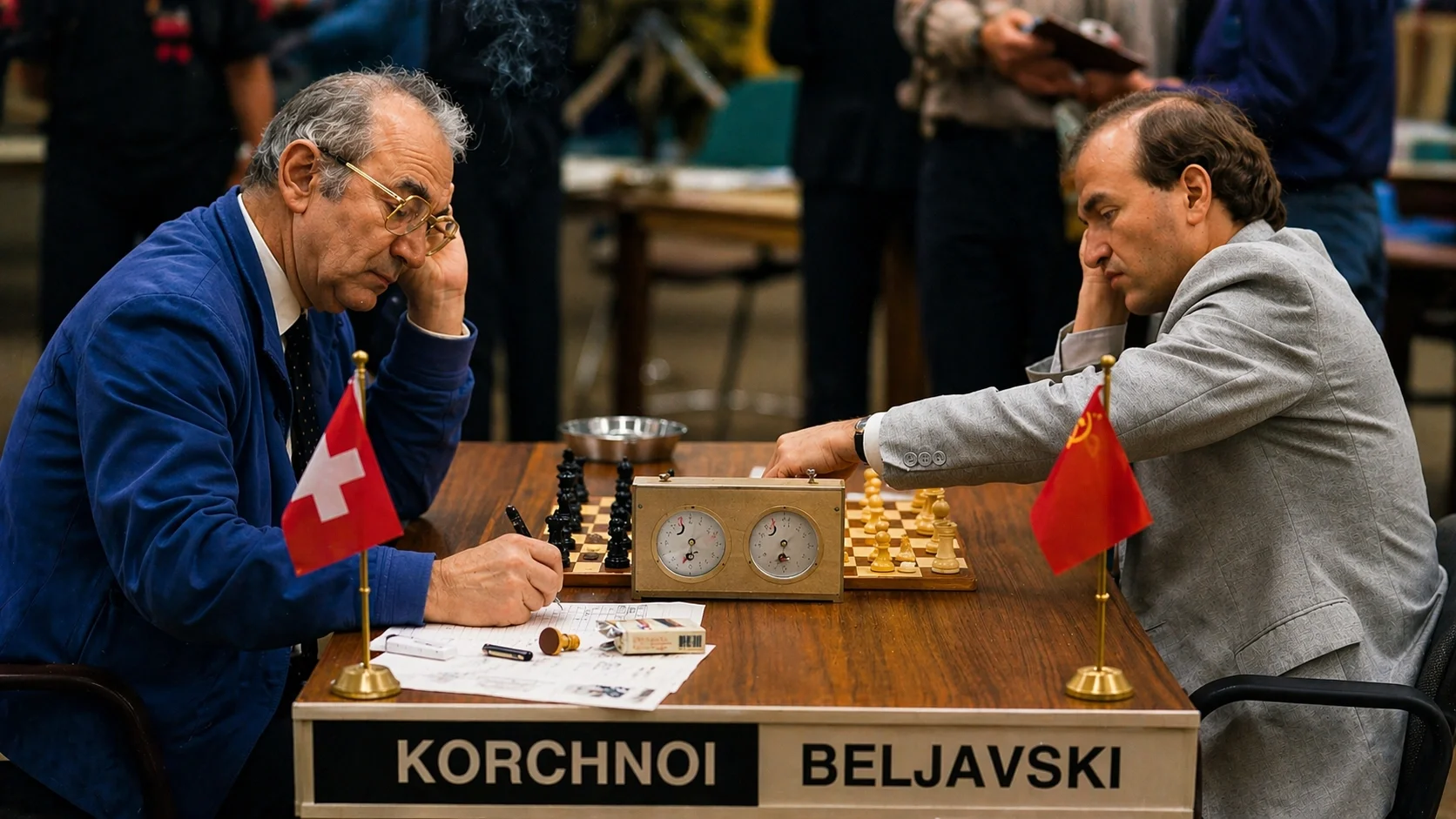
The 1978 title match in Baguio remains the best known episode of his public life. Barden’s obituary called it the most bizarre championship contest in history, and contemporary reporting in The Washington Post shows why. Karpov’s camp included a hypnotist figure in the front rows; Korchnoi wore mirror glasses and brought his own counter-psychological theater; a formal protest over a blueberry yogurt delivered at a particular moment made front-page copy. Under the first-to-six-wins format, Karpov led 5-2, Korchnoi fought back to 5-5, and Karpov then won the decisive final game. However strange the surrounding theater became, that comeback remains one of the defining demonstrations of Korchnoi’s stamina against a younger champion supported by the Soviet state.
The 1981 rematch in Merano ended far more badly for him. Official FIDE museum material gives the final score as 6-2 with 10 draws and notes how dominant Karpov was in comparison with the near-escape at Baguio. Barden likewise described the Merano series as a bridge too far for a fifty-year-old challenger facing a champion at full strength. Then came the 1983 Candidates conflict with Kasparov. The match was first scheduled for Pasadena, but Soviet authorities refused to allow Kasparov to travel, and Korchnoi was initially declared the winner by default. He then agreed to waive that result and play in London, where Kasparov won. That decision has often been read as generous, pragmatic, and historically revealing: Korchnoi remained difficult, but he was not blind to the significance of a real contest over an administrative victory.
Marcel Antonisse / Anefo, CC0, via Wikimedia Commons
Defection, exile, and institutional conflict
Korchnoi’s break with Soviet officialdom came after the 1974 cycle. Barden’s account is persuasive on the underlying logic: official support shifted toward Karpov, Korchnoi concluded that his own prospects inside the Soviet system had narrowed sharply, and after Karpov became champion by Fischer’s default he made the decision to defect. He later insisted that the move was driven less by abstract ideological conversion than by the desire to be a free chess professional. That distinction is important. Korchnoi became political because Soviet chess was political, not because his initial self-presentation resembled the career of a conventional dissident intellectual.
The response from Soviet institutions and the international chess bureaucracy was immediate. Barden records that Soviet authorities tried to exclude him from the 1977-78 title eliminators on the grounds that he was stateless. When that failed, Moscow news reports minimized him or omitted his name. The Baguio match was conducted in a climate where Soviet media spoke of him as “the challenger” or “the opponent,” and the broader press read the duel as a Cold War morality play compressed into a chessboard. In 1982, The Washington Post covered his lobbying visit to Washington, where he described his wife and son as hostages of Soviet policy and appealed for public pressure on Moscow. That public campaign became inseparable from his chess identity.
The family story gives the political cost its clearest human form. Korchnoi’s first wife, Bella, and his son, Igor Korchnoi, remained in the USSR after the defection. UPI reported Igor’s release from a Siberian prison camp in May 1982 after a sentence for draft refusal, and another UPI dispatch reported in June 1982 that the family had finally received permission to emigrate. Barden and later chess obituaries confirm that they joined him in the West in 1982, while the marriage to Bella then ended soon after. By that stage, Korchnoi had already built a life in Switzerland and entered a durable relationship with Petra Leeuwerik, another exile who later became his second wife. Swiss reporting after his death emphasized that he had lived for decades near Wohlen and remained a public figure in Swiss chess until health forced retirement.
Rob Bogaerts / Anefo, CC0, via Wikimedia Commons
Style, theory, books, and mentoring
The clearest recent official characterization of Korchnoi’s style comes from Emil Sutovsky’s 2026 FIDE essay. Sutovsky stresses fighting spirit, incessant labor, exact calculation, tough defense, and unusual ability to survive positions in which he had grabbed material and invited complications. He also describes Korchnoi as perhaps the greatest endgame specialist of his era, with especially notable strength in rook endings. Barden’s obituary arrives at much the same conclusion from a different angle, emphasizing defensive resilience, endgame subtlety, psychological pressure, and self-critical work habits. The convergence of those assessments is significant because one comes from a senior modern FIDE official and the other from the leading English-language chess columnist who watched him for decades.
His theoretical contribution was real, even if it did not always assume the form of a single universally acknowledged invention. FIDE’s 2026 piece points to his long use of the French and Pirc, his 1972 advice to Spassky to examine the Petroff and the early ...Nf6 Ruy Lopez systems against Fischer, and his long advocacy of the open variation of the Ruy Lopez before it became normal elite practice. In that account, Korchnoi appears less as a laboratory theoretician of one narrow line and more as an anticipator of modern practical opening culture: solid black systems, willingness to defend difficult positions, and an insistence on playable complexity. The fact that several openings and sub-variations carry his name in modern databases reflects that footprint, although named-line attribution in chess is often cumulative rather than singular.
His writings form an important part of his legacy. Bibliographic metadata and later memorial essays identify a substantial corpus: King’s Gambit with Vladimir Zak in 1974, Chess Is My Life in 1978, Persona Non Grata in 1981, Practical Rook Endings in the Olms editions of 1999 and 2002, and the My Best Games volumes on games with White and Black in 2001 and 2002. Those books are not decorative side projects. They show Korchnoi turning personal experience, opening preparation, and endgame expertise into durable chess literature. In coaching and mentorship, the evidence suggests something more personal than institutional. FIDE’s anniversary essay recalls younger players exhausted after training camps with the seventy-year-old Korchnoi, and ChessBase’s coverage of his eightieth birthday describes him giving a clock-handicap simultaneous exhibition to Swiss youth players. He was therefore not a “school founder” in the Botvinnik sense, but he clearly functioned as a demanding teacher, sparring partner, and model of professional rigor.
Fotoburo De Boer, CC0, via Wikimedia Commons
Later life, controversies, and historical significance
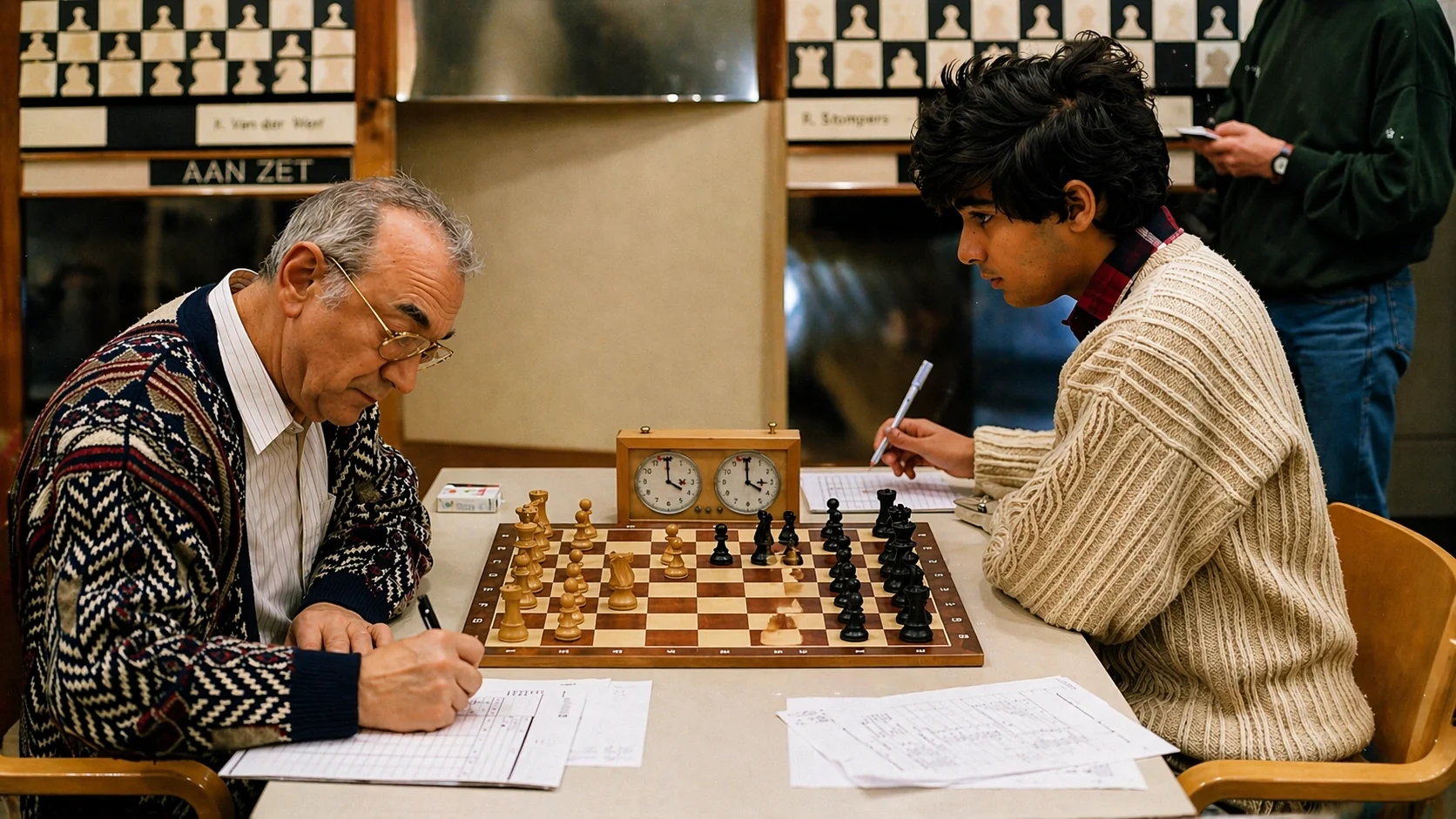
Late Korchnoi is one of the most remarkable parts of the whole story. FIDE’s 2026 memorial recalls that at seventy, he won a super-tournament in Biel ahead of top contemporaries including Gelfand, Grischuk, and Svidler. FIDE’s own archive records his 2006 World Senior Chess Championship victory in Arvier, his only appearance in that event, and his only official world title. Swiss reporting notes that he was still strong enough to win the Swiss championship in 2011 before retiring in 2012 because of health. Barden adds further detail: he beat Fabiano Caruana in 2011, suffered a severe stroke in September 2012, returned unexpectedly for late matches, drew 2-2 with Wolfgang Uhlmann in 2015, and later that year beat Mark Taimanov in what was reported as the oldest combined-age match between grandmasters. He died on June 6, 2016, near his long-time Swiss home.
Controversy followed him through almost every decade. Barden notes the long-running allegation, later repeated by some Soviet figures, that his 1971 semifinal loss to Petrosian had been arranged; Korchnoi denied it. The Baguio match became a carnival of accusations involving hypnosis, sectarian helpers, and signaling disputes over food delivery. Official Soviet media denied him the dignity of a name, while many contemporaries in the chess world found his own over-the-board conduct abrasive or inflammatory. Sutovsky’s FIDE essay is candid on that point, describing him as irritable, caustic, and frequently hard to tolerate even when admired. Yet both Barden and Sutovsky arrive at the same conclusion: colleagues forgave him much because the devotion to chess was visibly total, and because his belligerence was inseparable from the competitive energy that made him unique.
The best historical assessment is therefore double. First, Korchnoi was one of the half dozen or so strongest non-champions in chess history by any serious standard of results. Four Soviet titles, ten Candidates appearances, repeated survival of the strongest qualifying paths, and credible elite chess across seven decades are too large a body of evidence to dismiss as romantic hindsight. Second, his life altered the cultural meaning of chess during the late Cold War. He showed that a great Soviet grandmaster could reject the state that had trained him, remain elite in exile, and turn a championship cycle into a contest over freedom, legitimacy, and human endurance. His legacy in chess culture lives in literature, in opening practice, in the professional ideal of relentless fighting play, and in the enduring archetype of the uncrowned champion who still shaped the game’s history.
Reference list
Encyclopedia Britannica, “Viktor Korchnoi.”
FIDE, “In memory of Viktor Korchnoi on the 95th anniversary of his birth,” and “History of the Candidates: From Budapest (1950) to Cyprus (2026).”
Leonard Barden, “Viktor Korchnoi obituary,” The Guardian (2016).
Joseph McLellan, “Tempest in a Yogurt Cup,” The Washington Post (1978), and “Victor Korchnoi Delivers A Family Appeal,” The Washington Post (1982).
UPI archive items on Igor Korchnoi’s release and family emigration, 1982.
Europe Chess memorial, “In Memoriam Viktor Korchnoi” (2016), and selected OlimpBase team records.
Viktor Korchnoi, Chess Is My Life (1978), Persona Non Grata (1981), Practical Rook Endings (Olms, 1999/2002), and My Best Games volumes (2001-2002).
Genna Sosonko, Evil-Doer: Half a Century with Viktor Korchnoi, listed in standard Korchnoi bibliographies.
