Yuri Balashov
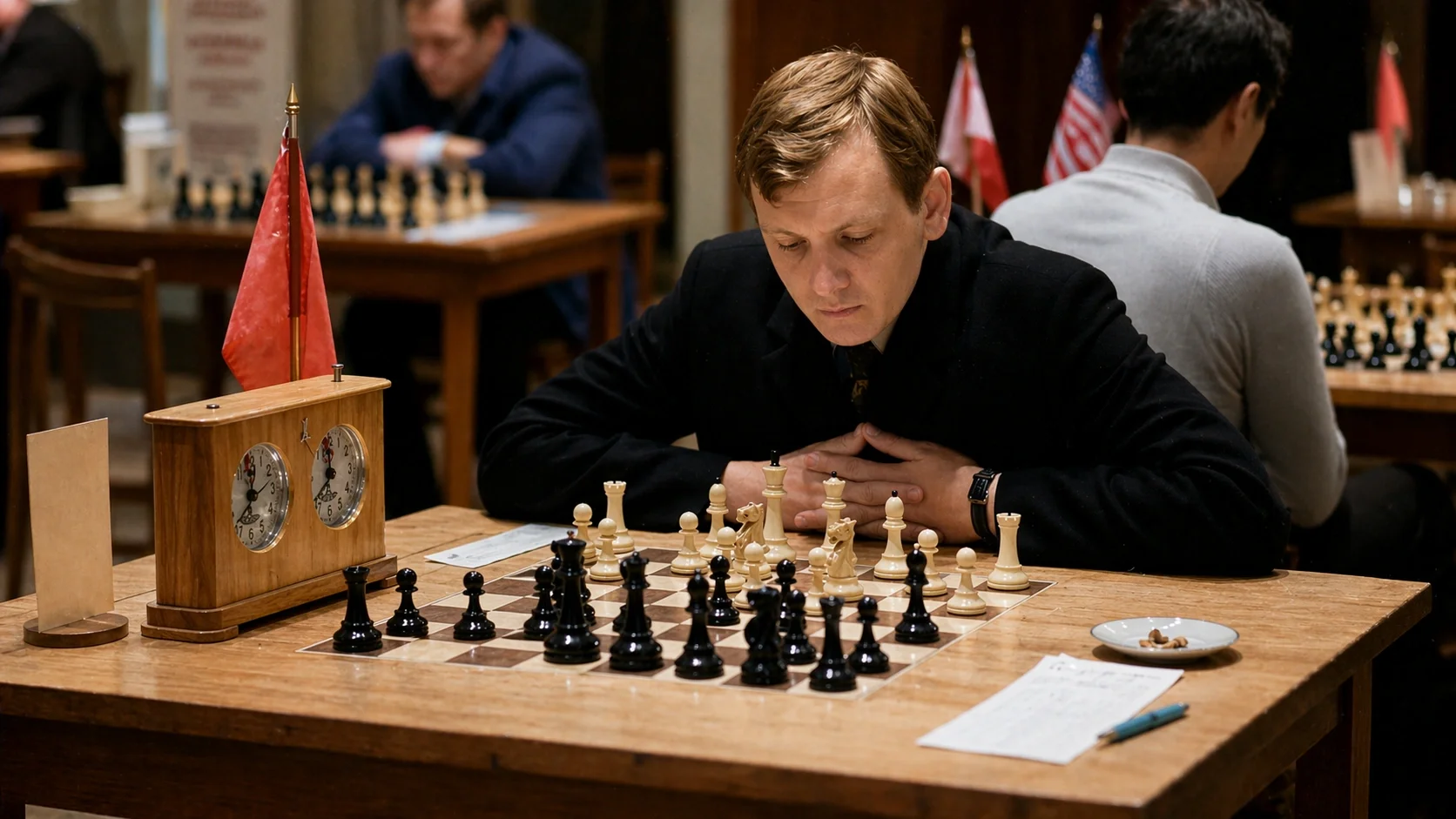
Yuri Balashov belongs in the narrow upper tier of late Soviet grandmasters whose strength was plainly world-class, yet whose route into the Candidates stage was blocked by the extraordinary depth of the Soviet system. Official profiles from FIDE and the Russian Chess Federation agree on the core outline: he became an International Master in 1970 and a Grandmaster in 1973, played in 15 USSR Championships, finished runner-up to Anatoly Karpov in the 1976 Soviet Championship, reached four Interzonals, won team gold at the 1980 Olympiad with an individual reserve-board gold, and later became one of Karpov’s principal seconds in world championship play.
His historical importance extends beyond tournament placings. Federation retrospectives, official trainer records, and Balashov’s own long interview from 2025 portray a player formed by Mikhail Botvinnik’s school, valued for encyclopedic opening knowledge, positional judgment, endgame precision, and psychological steadiness. Those traits carried him from youth prodigy to world match analyst for Karpov and later Boris Spassky, and then into a long senior career that included repeated team successes and the Russian veteran title in 2023.
The record is strong on titles, ratings, team events, and seconding work. It is thinner on full family socioeconomic detail, complete event-by-event documentation for every smaller Soviet tournament, and some institutional appointments outside team and veterans’ structures. Two uncertainties need to be stated plainly at the outset: Balashov’s detailed 2025 interview places his move to Moscow in 1966, while a 2025 federation sketch gives 1967 for entry into the institute; and although his peak published rating is recoverable from archival lists, the exact audited world ranking at that peak is not fully established in the official sources consulted here.
This report privileges Balashov’s current FIDE profile, Russian federation biographical essays and interviews, official or quasi-official tournament archives such as OlimpBase, the Tata Steel historical archive for Wijk aan Zee, and contemporary newspaper reporting, where it helps show how Balashov was perceived at the time. Because Soviet domestic archives survive online unevenly, especially for mid-level team and regional events, I use federation retrospectives and Balashov’s own interview testimony as the strongest available evidence for personal chronology, coaching work, and recollected incidents, and I flag contradictions where they appear. Dates are integrated into the narrative rather than presented in a table, in keeping with the requested format.
Balashov was born on March 12, 1949, in Shadrinsk, in Kurgan Oblast, then part of the Soviet Union. Official federation profiles describe a large working family in which chess was respected. By Balashov’s own recollection, he was the youngest, the fifth child. He learned the game from his older brother Alexander, who later became a candidate master, while his sister Tamara reached first category. In the same interview, Balashov recalled following the 1953 Candidates Tournament on the radio at age four and a half, already making a standings table by hand. He earned first category at twelve and, at fifteen, became the youngest master in the country.
His formative jump came in 1963. After winning the youth championship of the Trud sports society, he was invited into Botvinnik’s first training school cohort, a generation that also included future elite Soviet talents. Balashov later said that merely attending Botvinnik’s sessions taught him what serious self-work in chess looked like. His regional mentor, Vladimir Dyukov, also seems to have been important in his rapid growth, especially in the early 1960s, when he began to leave Kurgan-region competition and face stronger opposition.
The chronology of his move to Moscow requires caution. In his 2025 interview, Balashov stated that he moved there in 1966 and entered the Institute of Physical Culture after a Soviet education reform year, with help from Grigory Goldberg. A June 2025 federation essay states 1967. What is secure is the institutional picture: Balashov belonged to the first intake of the institute’s chess specialization, studied in a mixed sports cohort, continued to assist with Botvinnik-school sessions during his student years, and wrote a diploma thesis on the chess of Bobby Fischer. The consulted sources do not identify any long-term profession outside chess. His adult public life appears to have been spent almost entirely inside the chess world as a player, analyst, coach, lecturer, and organizer.
His family life is better documented in recent federation materials than in Soviet-era sources. The Russian Federation states that his wife, Elena Balashova, is a chess master, trainer, and author of children’s chess textbooks. The family had five children. A federation feature from 2015 identifies them and shows that their careers developed largely outside professional chess, into history, economics, music, and art, although their son Alexei also reached candidate master strength. That evidence reinforces an important point: Balashov’s household was unmistakably chess-literate, yet it was not organized as a dynastic professional playing family.
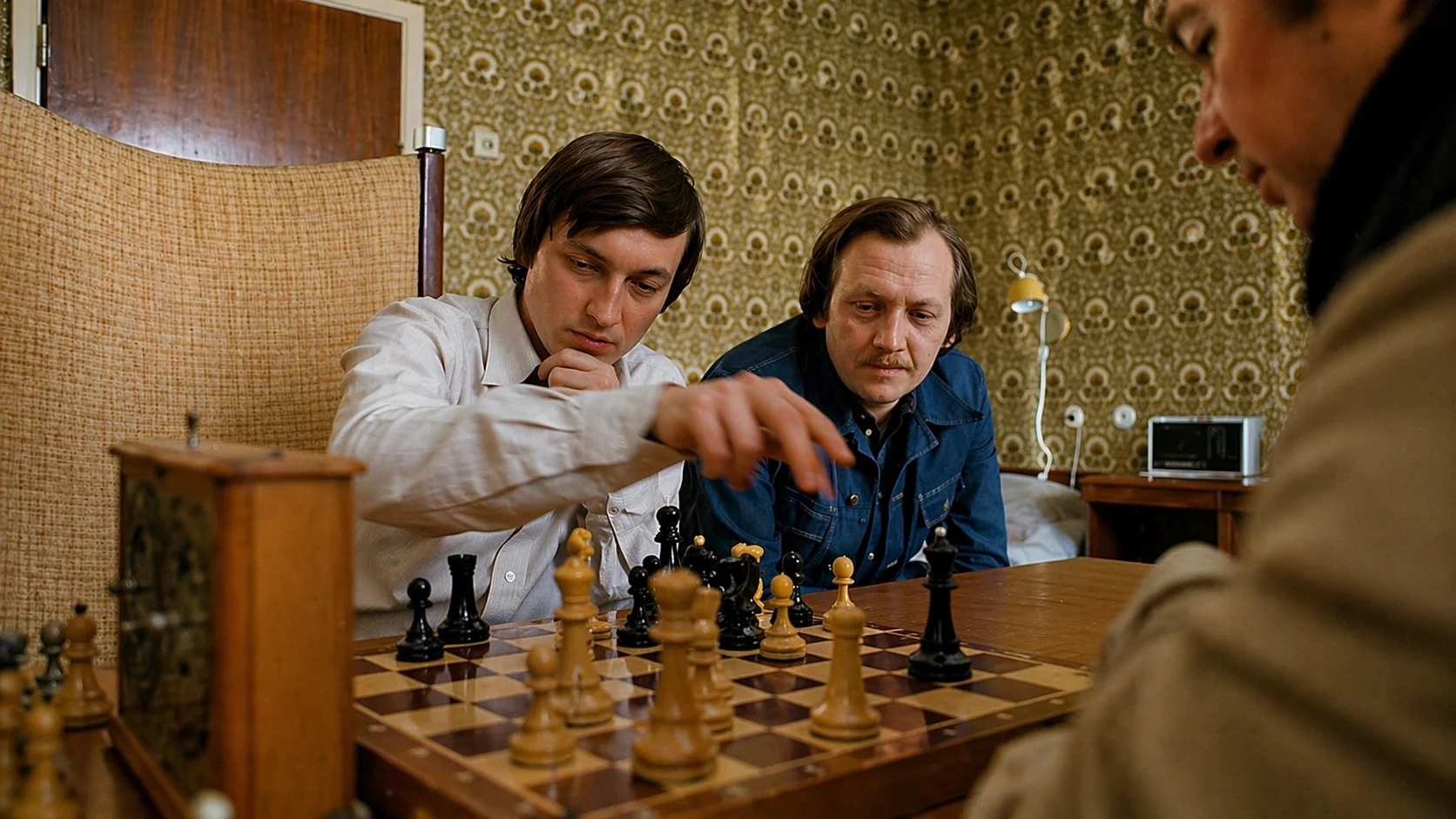
Anatoly Karpov and Yuri Balashov, World Championship preperation, 1981
Balashov’s rise from prodigy to Soviet elite came quickly. He was already traveling abroad by the mid-1960s, and by 1970 he had taken the Moscow championship while also finishing fourth in the USSR Championship. FIDE’s record gives him the IM title in 1970 and the GM title in 1973. In parallel, he became a pillar of Soviet student chess: OlimpBase’s all-time record for the Soviet student team credits him with three appearances from 1971 to 1974, three team gold medals, and one individual gold; the 1971 World Student Team Championship in Mayagüez records him scoring 6.5 out of 8 for an individual board medal as the Soviet team won by a large margin.
At the start of the 1970s, he had already become useful to older stars as an analyst. Balashov’s interview and federation essays show him assisting Mark Taimanov in the 1971 match against Fischer because of his deep study of Fischer’s games, and then beginning work with Karpov as early as the 1973 Leningrad Interzonal and the Candidates quarterfinal against Polugaevsky. This combination, strong results of his own and high trust from stronger or more famous colleagues, is one of the central patterns of his career.
His peak competitive years ran from the mid-1970s into the mid-1980s. Federation summaries credit him with 15 USSR Championship appearances. The standout domestic result was second place behind Karpov in 1976, a finish FIDE’s 2024 tribute describes as achieved with a 2773 performance. The same federation essay records further high placements in 1979, when he shared third to fourth with Garry Kasparov, in 1980, when he shared third to fifth, and in 1986, when he shared second to seventh. Internationally, the Tata Steel historical archive confirms that he finished second at Wijk aan Zee in 1973 and shared first there in 1982 with John Nunn. Contemporary newspaper reporting from 1977 shows him sharing top honors at Lone Pine with Nona Gaprindashvili, Oscar Panno, and Dragoljub Sahović. A 1978 newspaper report also identifies him as the recent winner of the Soviet zonal, which placed him firmly in the world-championship orbit.
Official sources agree that he played in four Interzonals, though the most complete city-by-city reconstruction remains better preserved in reference compilations than in currently accessible official dossiers. Archival FIDE rating lists preserved by OlimpBase show his peak published rating as 2600 on the January 1979 list, which is consistent with the picture of an established world-class grandmaster. The crucial analytical point is that Balashov’s career peak coincided with perhaps the hardest possible national environment for converting elite strength into a Candidates match berth. In most other federations, a player with his rating, consistency, and interzonal access would likely have had a more visible world-cycle profile.
His team record is outstanding and much better documented than some of his individual tournament itineraries. The Russian Federation retrospectives credit him with four European team titles for the Soviet side, and OlimpBase confirms his presence in key editions in 1970, 1973, 1977, and 1980. At the 1980 Olympiad in La Valletta, he scored 7.5 out of 10 on first reserve as the Soviet team won gold, and he shared the gold medal on that reserve board. The Soviet student team archive likewise confirms three student team golds. In other words, Balashov was not a fringe squad member filling a bench slot. He was repeatedly trusted in the deepest team structures that Soviet chess had.
The federation’s retrospective on Balashov against world champions helps clarify the quality of opposition he handled well. It credits him with a positive overall score against Vasily Smyslov, a positive overall score against Efim Geller, and a 4:3 edge over Mikhail Tal. The same retrospective highlights wins over Tigran Petrosian, Spassky, and Karpov, and it comments on his 1982 battle with the young Kasparov as an early foreshadowing of the Karpov-Kasparov era. These are retrospective claims from a federation historical essay, not a neutral database table, but they are grounded in identifiable games and they fit his broader competitive standing.
Balashov’s later career did not dissolve into mere ceremonial appearances. His own interview shows him seconding Spassky in the 1992 Fischer rematch, in the 1993 match against Judit Polgar, and in the 1999 match against Viktor Korchnoi. In senior chess, official sources are explicit: the Russian federation records repeated Russian veterans titles and a national title in 2023, while FIDE notes repeated World Team and European Team senior successes and records that in 2019 he tied for first in the World Senior Championship but took bronze on tiebreak. As of April 2026, FIDE still lists him as an active standard-rated player at 2376.
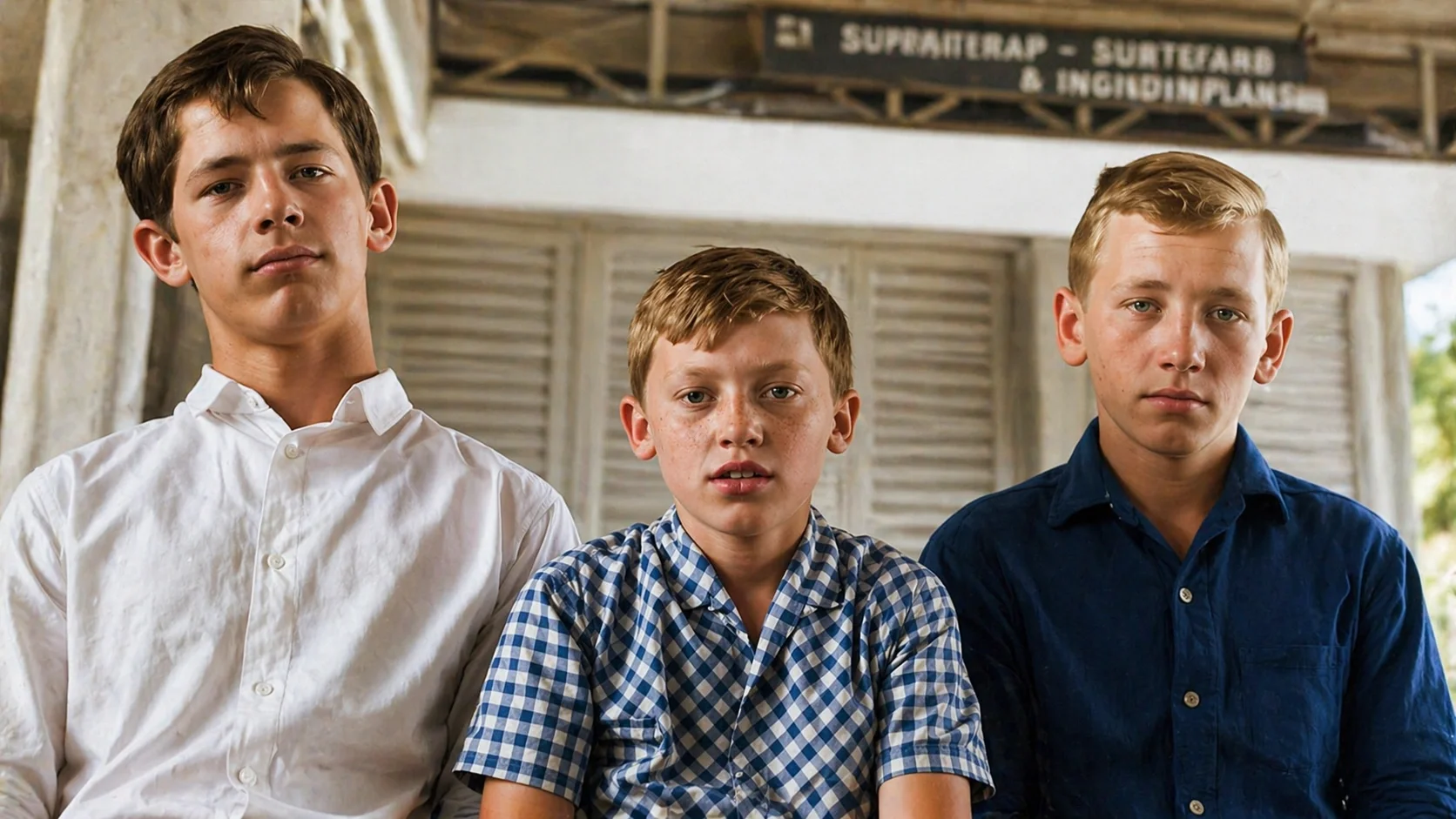
Left to right: Gennadi Timocenko, Anatoly Karpov, and Yuri Balashov
Balashov’s contributions beyond tournament play are substantial and, in some respects, easier to explain historically than his individual results. He first entered the public coaching record as a young analyst in Taimanov’s team against Fischer. He then became part of Karpov’s circle from 1973 onward and, after Semyon Furman’s death in March 1978, Karpov asked him to head the training group that prepared the title defense in Baguio. Balashov’s own recollection, published later by the federation, identifies him as the first second in that team. After Karpov’s successful defense, he and Igor Zaitsev received the title Honored Coach of the USSR; in 2025, the federation also recalled that Balashov had been awarded the Order of Friendship of Peoples and, later, Russia’s Order of Honor. FIDE’s current profile lists him as a FIDE Senior Trainer, and a 2006 Trainers Committee document explicitly described him as a trainer of Karpov and Spassky.
He also contributed as an opening analyst and author. Federation essays report that older grandmasters such as Geller and Bagirov were struck by how much opening theory the teenage Balashov already knew. In his 2025 interview, Balashov described building a hand-copied archive of Fischer’s games so extensive that Botvinnik enlisted him for preparation against the projected Fischer match. His analytical influence was not confined to backstage work. Lubomir Kavalek later wrote that the variation first seen in Balashov-Kavalek, Manila 1976, became a widely used opening system. Bibliographic records also clearly document Balashov’s co-authorship, with Eduard Prandstetter, of the 1992 manual Basic Endgames: 888 Theoretical Positions. Yet the balance of evidence in the consulted sources suggests that Balashov’s largest intellectual footprint passed through preparation, lessons, camps, and match work rather than through a very large shelf of standalone books.
His teaching influence extended into institutions and local schools. Public sources describe a “Grandmaster Yuri Balashov School” in Kurgan in the early 1990s and a Balashov school active in Naberezhnye Chelny, where junior players attended his lectures and received certificates. Balashov himself named other pupils and collaborators more selectively: in the 2025 interview, he mentioned work with Alisa Galliamova and Alexey Alexandrov, alongside episodic training camps with others. On administration, the evidence is narrower. The Russian Federation publicly documented him as a new member of its Veterans Commission in December 2023. On arbitration, the consulted official record is effectively negative: FIDE lists a trainer title, not an arbiter title, so arbitration does not appear to have been central to his public chess identity.
The most consistent descriptive language in official and retrospective sources presents Balashov as an active positional player with strong tactical capacity. The Russian Federation’s 2025 essay emphasizes an “honed opening repertoire,” “deep positional understanding,” “very high technique,” “cold blood in dangerous positions,” and long, accurate calculation. The federation’s world-champions retrospective adds the image of a player whose best games could trouble even the greatest champions. Balashov’s own testimony qualifies that in a useful way. He said that working with Karpov did influence him, yet he still felt his style was closer to Spassky’s. Elsewhere in the same interview, he recalled Botvinnik comparing him to Paul Keres in open positions.
At a high level, non-technical description, Balashov’s chess appears to rest on three connected habits. First, he prepared deeply and remembered large bodies of opening material with unusual reliability. Second, once out of book, he was comfortable improving positions patiently without forcing the issue too early. Third, when the position opened, he calculated concretely and without panic. That model helps explain why contemporaries could view him as both a theoretical expert and a practical fighter, and why he could score against players as stylistically different as Smyslov, Tal, Petrosian, Spassky, and Karpov. This is an inference from the consulted descriptive sources and game-based retrospectives, but it is a secure one.
His influence on peers and students followed from that same profile. He was the kind of grandmaster stronger players trusted with their most sensitive preparation, a role that requires intellectual honesty, discretion, and stable judgment. Karpov’s confidence in him after Furman’s death is one example. Spassky’s willingness to use him in the 1990s is another. At the next level down, his schools, lectures, and camp work extended that influence into junior development and regional training culture. Balashov’s importance, then, is not confined to his own crosstables. He functioned as a transmitter of Botvinnik-school methods into later Soviet, Russian, and post-Soviet chess generations.
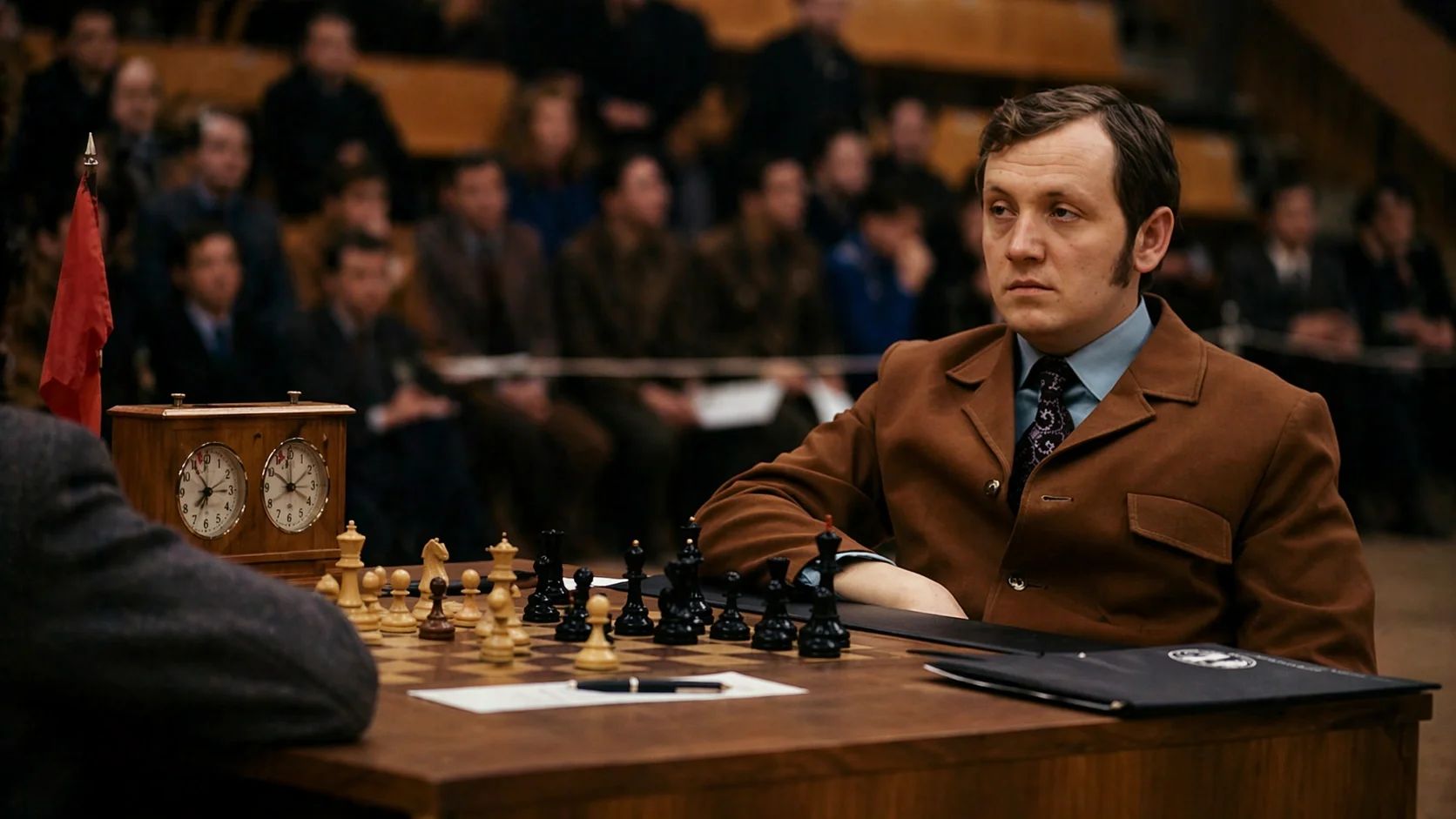
The most significant documented controversy around Balashov concerns memory and authorship inside Karpov’s 1978 title-defense team. In a retrospective statement republished by the Russian Federation, Balashov directly disputed Evgeny Vasyukov’s recollection of events before the decisive 32nd game in Baguio. Balashov argued that Vasyukov misdescribed the timing of his arrival, the reason for Karpov’s temporary break, and the origin of the crucial preparation for the last game. Balashov’s version credits Valery Krylov’s medical suggestion for the Manila trip and portrays the analytical breakthrough as having been collectively recovered only after Mikhail Tal helped Vasyukov reconstruct the right move order. Because this issue comes to us mainly through later memoir-like testimony, it should not be treated as closed beyond dispute, but it is an important window into how high-stakes Soviet match work was remembered and contested.
A smaller, earlier incident appears in Balashov’s recollection of the 1971 Taimanov-Fischer match. He recalled that, on the return to the USSR, customs found a Solzhenitsyn book in Taimanov’s luggage and that Taimanov was later made non-traveling. Since this is Balashov’s retrospective memory, it is best used as testimony about atmosphere rather than as a complete causal explanation of Taimanov’s punishment. Balashov was generally restrained in public, and that restraint shows again in his reaction to the Russian feature film Champion of the World. The federation recorded that he felt ambivalent about the film’s historical treatment, though he appreciated actor Mikhail Troynik’s effort to study him closely.
Several factual gaps remain. The first is the already noted 1966 versus 1967 discrepancy for his move to Moscow and institute admission. Because Balashov’s own detailed interview is more granular than the short federation sketch, I treat the 1966 date as slightly stronger while still flagging the contradiction. The second gap is documentary completeness: official and archival sources consulted here are robust on major championships, interzonals, and team events, but not on every smaller domestic event from the later Soviet years. The third is statistical precision at the very top of his rating peak. The archival rating lists clearly establish a 2600 peak on the January 1979 FIDE list, yet the exact audited world rank attached to that number remains less secure in the official sources reviewed here than the rating itself.
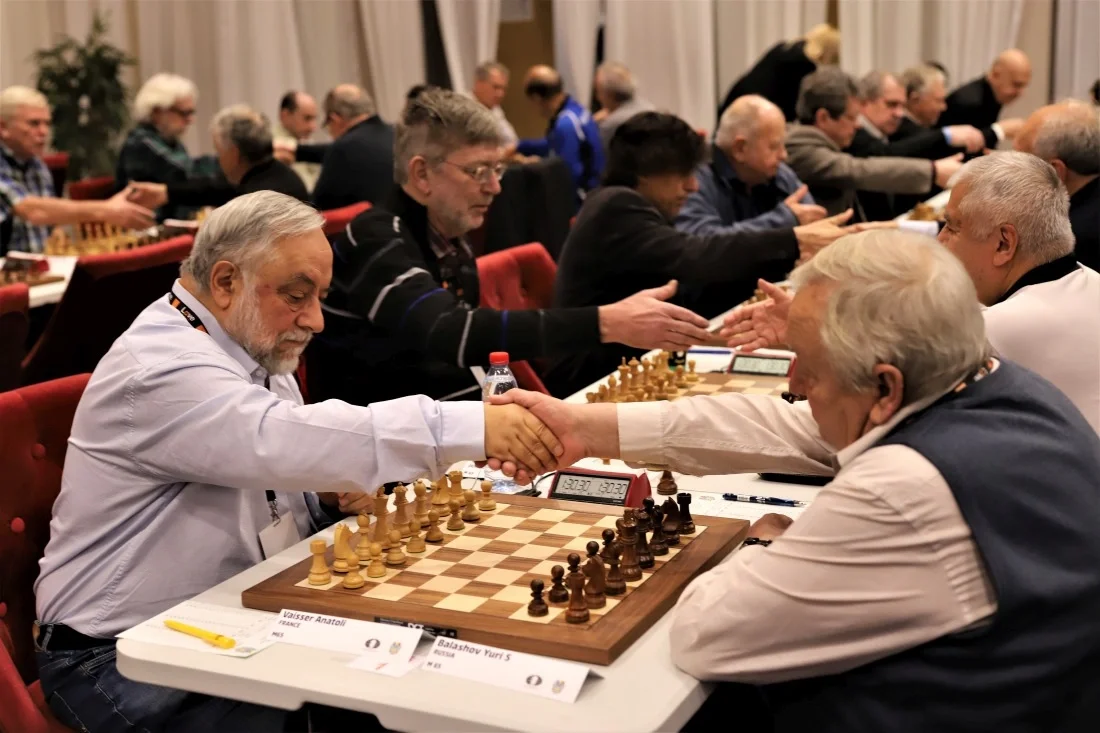
Anatoli Vaisser and Yuri Balashov
Balashov’s legacy is easiest to understand if one avoids measuring him only by the absence of a Candidates match. He was, instead, a central supporting figure in the late Soviet chess ecosystem: a top-class tournament player, a repeated Soviet team representative, a trusted second in world-title preparation, a teacher shaped by Botvinnik’s methods, and an elder active in veterans’ institutions well into the 2020s. That kind of career leaves a less spectacular public narrative than a title match, but it is deeply significant for how Soviet and Russian chess actually functioned.
Historically, he may be best described as one of the strongest Soviet-born grandmasters who never quite punched through the final bottleneck of the world-championship cycle. That formulation is not a backhanded compliment. It points to the reality of the period. A player who could finish second in the USSR Championship behind Karpov, share first at Lone Pine, share first at Wijk aan Zee, reach four Interzonals, collect Olympiad and European team gold, and maintain plus records against some world champions was operating at a very high level. His public profile in world chess ended up smaller than his playing strength because Soviet chess in his prime was overcrowded with players of similar or even greater force.
As of April 2026, Balashov is still listed by FIDE as an active player. Russian chess institutions continue to treat him as a living bearer of classical Soviet expertise, visible in his veterans title, his membership in the federation’s Veterans Commission, and the high state honor awarded in 2025. The broad historical conclusion is clear. Yuri Balashov was not simply a strong grandmaster who also helped champions. He was one of the key carriers of Soviet chess knowledge from the Botvinnik-school generation to the Karpov era and then into modern senior and pedagogical chess culture.
