Alexey Suetin
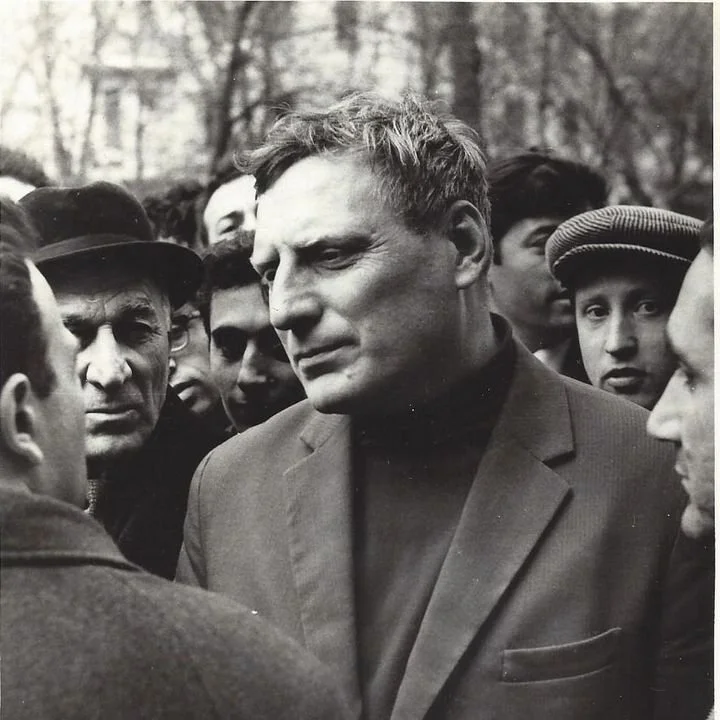
Alexey Stepanovich Suetin was one of those chess figures who look modest only from a distance. Up close, he becomes much larger: a Soviet grandmaster of real strength, a ten-time participant in USSR championship finals, a major Belarusian chess figure, a long-serving trainer and second to Tigran Petrosian, a prolific writer on openings and the middlegame, a newspaper columnist, a television commentator, and, in old age, the 1996 World Senior Champion. He was born on 16 November 1926 in what is now Kropyvnytskyi and died in Moscow on 10 September 2001.
The most useful way to understand Suetin is not to ask whether he was “one of the very greatest” in the narrow world-title sense, but to see him as one of the best examples of a broader Soviet chess type: the player-theorist-teacher-public intellectual. Soviet chess was not only made by world champions. It was also made by the people who kept the machine thinking, teaching, annotating, preparing, broadcasting, and reproducing itself. Suetin did all of that. His résumé spans elite domestic competition, international tournament victories and prizes, institutional coaching, opening innovation, and mass communication. Seen that way, he is not a side character. He is part of the architecture.
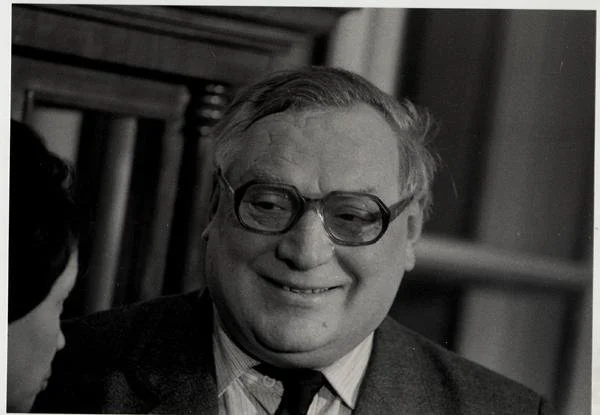
His early life already places him in a distinctly Soviet historical frame. During the Second World War his father served at the front, while Suetin and his mother, who worked as a nurse in a hospital, lived in Tula. Biographical sources state that he learned chess from his father in childhood, later studied at the Tula Palace of Pioneers, finished school externally in 1943, and entered the Tula Mechanical Institute, now Tula State University. He made first category in 1944, lived in Tula until 1953, then in Minsk from 1953 to 1968, and afterward in Moscow. Official memorial reporting from Tula notes that he graduated from the institute in 1948.
That engineering education matters, even if not in a simple causal way. Suetin belonged to the same broad technical-intelligentsia milieu that produced so many Soviet chess thinkers: people trained to treat problems analytically, systematically, and with respect for structure. His later books, especially those on planning, opening systems, and strategic method, feel entirely at home in that world. He did not write like a romantic memoirist who happened to play chess; he wrote like a practitioner who wanted to turn chess into a teachable discipline. That cast of mind runs through his whole career.
Suetin’s rise was steady rather than meteoric. He became a candidate master at 21, achieved the Soviet master norm in 1950, and made his debut in a USSR championship final that same year. He would reach ten USSR finals in all, with his best results coming in the 1960s: shared 4th to 6th in 1963 and shared 4th to 5th in 1965. A contemporary obituary also places those ten finals across the period 1950 to 1967. In a Soviet setting, that is no small credential. The USSR championship was a steel press, not a velvet salon. Reaching its final repeatedly was itself a badge of high class.
Before the grandmaster title, there were already clear signs of heft. The Russian Chess Federation notes that in 1949 the 23-year-old Suetin won the event of the Voluntary Sport Society “Labour,” and in the 1950s became a three-time champion of the Spartak sporting society, which he represented alongside Tigran Petrosian. That pairing matters. It hints at the early institutional proximity between the two men long before Suetin became part of Petrosian’s world-championship apparatus.
The Minsk period was decisive. In 1953 Suetin moved there with Kira Zvorykina, and in Minsk began his creative collaboration with Isaac Boleslavsky. Between 1953 and 1961 he played six Belarusian championships and won every time he entered, sharing first only in the first of those appearances, in 1953, with Vladimir Saigin. Biographical sources also describe him as the first representative of the Byelorussian SSR to reach the international grandmaster title. During these years he was not merely a visiting strong player harvesting local titles. He became woven into Belarusian chess life: writing books and articles, appearing on Belarusian television, and, according to Belarusian historical writing, even serving as chairman of the BSSR chess federation for two years from 1966.
This Belarusian chapter is one of the “important things people forget” about Suetin. In Russian-language memory he is often filed simply as a Soviet grandmaster and Petrosian’s trainer, but for Belarus he was a foundational figure. A Belarusian historical essay stresses that at the 1963 Spartakiad of the Peoples of the USSR, Suetin scored 7.5/9 on third board, the best result on that board, and made a decisive contribution to Belarus winning team bronze. A separate results page confirms Belarus’s bronze and lists Suetin’s 7.5/9 as the best score on board three. That is not just a footnote. It shows him functioning as a central competitive asset of Belarusian chess at team level, not only as a serial champion in domestic events.
His first major international team success came even earlier, at the 1955 World Student Team Championship in Lyon. OlimpBase records the Soviet team winning gold, and its individual table credits a “Suetin, Alexander” on board four with 8/10 and first place on the board, which is evidently a clerical error for Alexey Suetin given the Soviet lineup. The point is clear even through the typo: by the mid-1950s he was already strong enough to contribute to a Soviet gold-medal team and take individual board honors.
The key competitive crest of Suetin’s career came in the 1960s. In the USSR Championship of 1963 he shared 4th to 6th, earned the right to play in a FIDE zonal, and, according to the Russian Chess Federation, fulfilled the requirements for the grandmaster title there. The same official source highlights his famous queen sacrifice against Vladimir Bagirov in that championship, a game that “flew around the entire chess press,” won a special prize, and drew praise from Mikhail Tal. He then again finished near the top of the Soviet field in 1965, sharing 4th to 5th.
Formal title chronology places him as an International Master in 1961 and a Grandmaster in 1965. Biographical accounts connect the GM title to his tournament victories in Sarajevo and Copenhagen in 1965. The Russian Chess Federation’s official profile also credits him with victories and prizes in more than twenty international tournaments and singles out a particularly strong run in the second half of the 1960s, naming Sarajevo, Copenhagen, Titovo Užice, Hastings, Albena, and Havana, followed by first prizes in the 1970s at Kecskemét, Brno, Lublin, and Dubna. This is a record of repeated, geographically varied success, not a single hot streak.
The rating evidence reinforces that picture. On the July 1971 FIDE rating list, Suetin appears on 2560, tied 19th among Soviet-listed players, alongside Isaak Boleslavsky and Gennadi Kuzmin. That is a strong piece of context. To be merely “19th” in the Soviet Union in 1971 was to be situated inside the deepest national talent pool the game had ever seen. Suetin was not a peripheral grandmaster. He was a genuine upper-tier Soviet master operating beneath an unusually crowded ceiling.
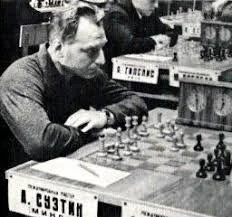
What kind of player was he? The official Russian Chess Federation profile gives the best capsule through Vyacheslav Ragozin’s line: Suetin “is not conventional, looks for the new and doubts the old, even if it has been tested a thousand times.” That is almost a miniature manifesto. It suggests a player who respected theory but refused to kneel before it, who treated opening knowledge as a field for intervention rather than a museum. The Bagirov queen sacrifice fits that image, but so does the broader fact that Suetin made a lasting theoretical contribution in one of the most densely analyzed openings in chess.
That contribution is the system with 9.a3 in the Closed Ruy Lopez, explicitly credited to him by the Russian Chess Federation. This matters more than the average opening eponym. The Closed Spanish was one of the central laboratories of 20th-century chess theory, especially in Soviet hands. To leave one’s name attached to a branch of that opening is to have made a contribution inside the hard core of classical opening thought. Suetin’s importance as a theoretician, then, was not decorative. He worked where the traffic was thickest.
If one wanted a compact characterization of his over-the-board style, a fair synthesis would be this: Suetin combined the strategic discipline of the Soviet school with a willingness to seek original routes inside established structures. He was not an anarchic tactician. His published work and practical record point instead to a player who liked plans, structures, and method, but who also had enough nerve to break with orthodoxy when the position justified it. In modern language, he was a system-builder with a gambler’s pulse.
His collaboration with Tigran Petrosian is perhaps the single most important non-tournament axis of his career. Biographical sources state that Suetin joined Petrosian’s team in 1961 to prepare for the world championship cycle, and the Russian Chess Federation records him as Petrosian’s trainer for the world championship contests of 1963, 1970, and 1979-1980. The federation adds that he made a “noticeable contribution” to Petrosian’s successes. This alone would secure Suetin a place in chess history. Petrosian’s reign was not only the product of Petrosian’s own genius; it also rested on a preparation culture, and Suetin was one of its working minds.
Nor was Suetin merely a private analyst in a back room. The Russian Chess Federation describes him as a recognized trainer of Russia and notes that he served for many years as national trainer for the sports committees of the RSFSR and Moscow. Donskoy’s biographical entry adds that from the early 1970s to the late 1980s he was occupied chiefly with training and literary work, and that he worked as a television commentator, including on the Karpov-Kasparov world championship matches beginning in 1984. Put differently, Suetin inhabited nearly every layer of chess culture: elite preparation, state coaching, and public explanation.
That public-facing dimension is easy to underrate. The federation notes that he popularized chess as a columnist for Pravda and as a commentator on Central Television. The Minsk biography adds that this media work had earlier roots in Belarusian television. So Suetin was not simply someone who wrote books after his “real” chess career. He helped teach Soviet audiences how to see chess in real time. In a culture where chess had civic prestige and mass readership, that role mattered. He was one of the interpreters through whom the game entered everyday public life.
His literary output was enormous. Donskoy’s biographical dictionary calls him the author of more than forty books on opening theory and the middlegame, along with works on Botvinnik, Petrosian, Keres, and Bronstein. It also lists specific Soviet-era works such as The Path to Mastery (1980), The Spanish Game (1982), and The French Defence (1983), with the last two appearing in large print runs of 100,000 copies. Those print runs are revealing. They show that Suetin was not writing for a tiny priesthood of masters. He was part of a mass educational publishing world.
For English-language readers, several translated titles map his pedagogical territory clearly. Plan Like a Grandmaster appeared in English in 1988; Three Steps to Chess Mastery in a Cadogan edition in 1996, described as a practical handbook aimed at improving one’s individual style and eliminating weaknesses; The Complete Spanish in 1992; and Soviet Chess Strategy in a Quality Chess English edition in 2010. Even the titles tell the story. Suetin’s curriculum was not narrow opening trivia. It stretched from planning and self-improvement to major opening systems and general strategic doctrine.
His final book, Chess through the Prism of Time, was published in Moscow in 1998. That title is perfect for him. It suggests not merely instruction, but retrospective interpretation: chess viewed through memory, history, and accumulated experience. By then Suetin had been, in sequence and often simultaneously, competitor, second, teacher, journalist, commentator, and elder statesman. He had enough angles to justify the prism.
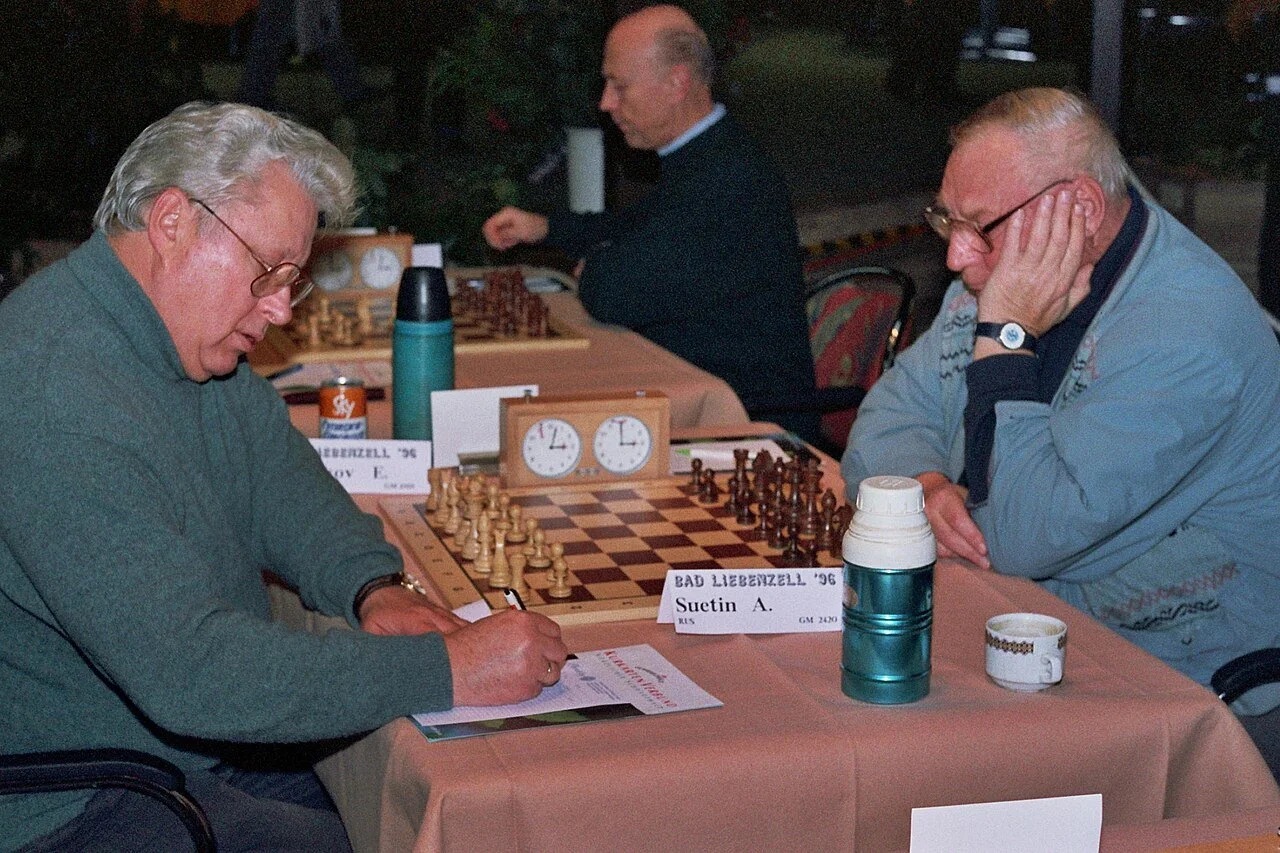
The later competitive coda of his life deserves attention too. Many grandmasters fade into purely advisory roles. Suetin did not do so completely. BritBase records him finishing clear first in the 1990/91 Hastings Challengers with 8/10, ahead of a strong field that included Stuart Conquest, James Howell, Mihai Suba, Mikhail Tseitlin, Yevgeny Vladimirov, Gennady Timoshchenko, Alexander Panchenko, Grigory Serper, and others. Then, in 1996, at age 70, he became world senior champion. These results matter because they show not nostalgia but durability. He was still capable of serious practical success long after his peak years.
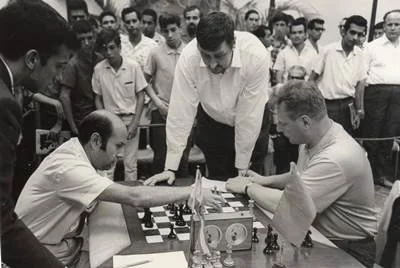
Left to Right - Vasiukov, Suetin
As a person, Suetin seems to have combined warmth with severity, including severity toward himself. A Belarusian essay drawing on the 1987 book Alexey Suetin notes that Vasily Smyslov emphasized the cordiality of Suetin’s character, while Lev Polugaevsky praised his humor, ease in conversation, and reliability, adding that for Suetin work stood above all. Yet the same essay quotes Suetin’s own late autobiographical admissions of impulsiveness, rashness, uncertain calculation, and a recurring “complex of insecurity.” That mix is illuminating. It helps explain why his writing feels so insistently practical and self-corrective: he was not teaching from Olympian serenity, but from a life spent wrestling with his own imperfections.
That inward self-criticism also helps explain the peculiar emotional weather of his career. Suetin was too strong, too accomplished, and too deeply embedded in top Soviet chess to be called a near-miss in any simple sense. Yet he was also close enough to the summit to feel its cold. He belonged to the class of Soviet grandmasters who spent years in the shadow of world champions and candidates while still being stronger than almost everyone else in the world outside that narrow Soviet apex. The result is a career that can look understated on a casual glance and formidable on a serious one.
His personal life intersected directly with chess. Suetin was married first to Kira Zvorykina, a major Soviet woman player; they had a son, Alexander. After their divorce in 1961, he married the philologist Evgeniya Suetina, and the couple had a daughter, Elena. These details matter less as gossip than as reminder that Suetin’s world was one in which chess, family, geography, and professional identity overlapped continuously. His move to Minsk, for example, was both a personal and a chess-historical event.
Suetin died in Moscow in September 2001 and was buried at New Donskoy Cemetery. His memory remains institutionally alive. Official reporting from the Russian Chess Federation shows that Tula continues to host the Alexey Suetin Memorial, with events in 2024 and 2025 held in part at Tula State University, the institution he had entered during the war and completed in 1948. That is a fitting afterlife. Suetin was never only a name in crosstables; he became part of local and national chess memory.
So what is the best final assessment? Suetin was not simply “a strong Soviet GM who wrote books.” He was one of the transmitters of Soviet chess culture. He helped produce knowledge, not just consume it. He carried ideas from tournament hall to training camp, from analysis notebook to newspaper column, from opening laboratory to television audience. He connected Belarusian chess to the wider Soviet center, supported Petrosian’s world-championship efforts, gave generations of readers structured ways to think about planning and strategy, and even in old age remained competitively dangerous. If one wants a single phrase for his historical significance, this will do: Alexey Suetin was a maker of continuity. He helped ensure that Soviet chess was not merely brilliant, but reproducible.
