Ratmir Kholmov (Ратмир Холмов)
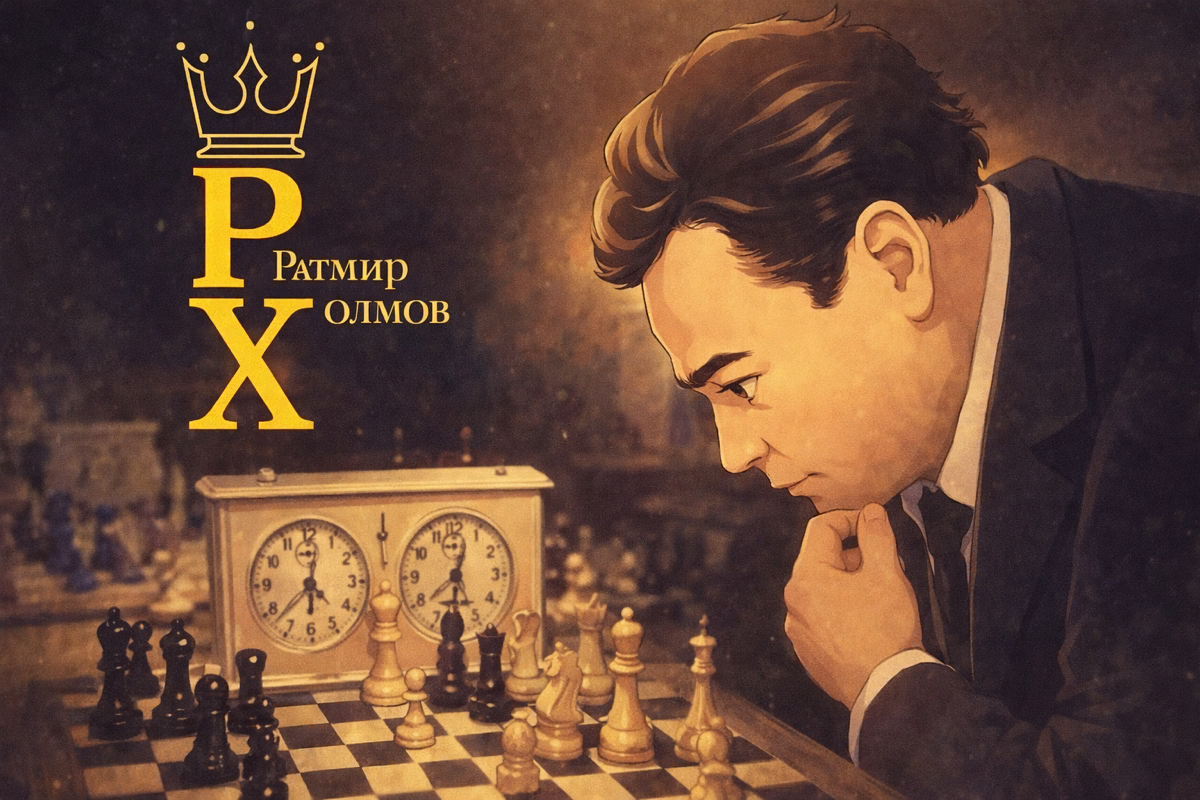
Ratmir Dmitrievich Kholmov, born on May 13, 1925, in Shenkursk and died on February 18, 2006, in Moscow, was one of the strongest Soviet grandmasters who never became fully canonical in Western chess memory. In pure playing strength, he belonged near the top layer of the non-champion elite: he won or shared major international events across three decades, shared first in the 1963 USSR Championship, earned the grandmaster title in 1960, and scored notable wins against Petrosian, Spassky, Fischer, Keres, Bronstein, Tal, Korchnoi, and even a young Kasparov. Yet his name never traveled as widely as his talent, largely because he developed inside the brutally crowded Soviet system and was repeatedly denied the kind of Western exposure that turns strength into legend.
That gap between strength and fame is exactly why Kholmov matters. Retrospective rating systems such as Chessmetrics place him in the world top 25 for a long stretch and as high as around eighth in 1960 to 1961, while contemporary recollections describe him as one of the strongest Soviet grandmasters of the 1960s. He is therefore not a marginal curiosity but a crucial case study in Soviet chess history: a player whose contemporaries understood very well, even if later public memory only half caught up.
Repression, Accident, and War
Kholmov’s childhood reads less like the polished origin story of a Soviet prodigy and more like a Russian novel with missing chapters and singed edges. His father worked for the state security apparatus at the Solovetsky labor camp complex, but was himself later arrested and, after a second arrest in 1938, never returned. Kholmov and his mother moved to Arkhangelsk, where she worked in a colony for juvenile offenders and the family lived among its inmates; Kholmov later described himself as a “hooligan,” left school without qualifications, and grew up far outside the orderly Palace of Pioneers pipeline that shaped many of his rivals.
He learned chess almost accidentally at age twelve, during a trip to a pioneer camp, then quickly attached himself to a chess club and, according to ChessBase, benefited from the guidance of the experienced coach Nikolai Kutusov. The rise was startlingly quick: within about three years he had become city champion among adults in Arkhangelsk, and by fourteen he had already outgrown local expectations. What matters here is not merely precocity, but the form of that precocity: Kholmov was largely self-made, improvisational, and socially rough-edged from the start.
Then the war slammed down. In Arkhangelsk, a major northern port under bombardment, Kholmov first helped put out fires and then went to sea. Sources agree on the broad outline even if some details differ in emphasis: he worked first on a fishing trawler, later on the cargo ship Sovietskaya Gavan, spent time in American ports including Portland and San Diego, endured illness and even a period in a prison camp after refusing to return to sea, and was eventually interned by the Japanese after a wartime maritime disaster in the Far East. After that episode, his permission to travel abroad as a sailor was revoked. He was later discharged because of asthma and moved with his mother to Grodno in Belarus.
This wartime biography is not decorative background. It helps explain both his later independence of temperament and the atmosphere of suspicion that seems to have followed him in Soviet official life. Kholmov did not come out of war with the biography of a model institutional functionary; he came out of it as a survivor, laborer, sailor, former internee, and self-taught talent. That combination gave his chess a peculiar texture: tough, elastic, inventive, and never particularly reverent.
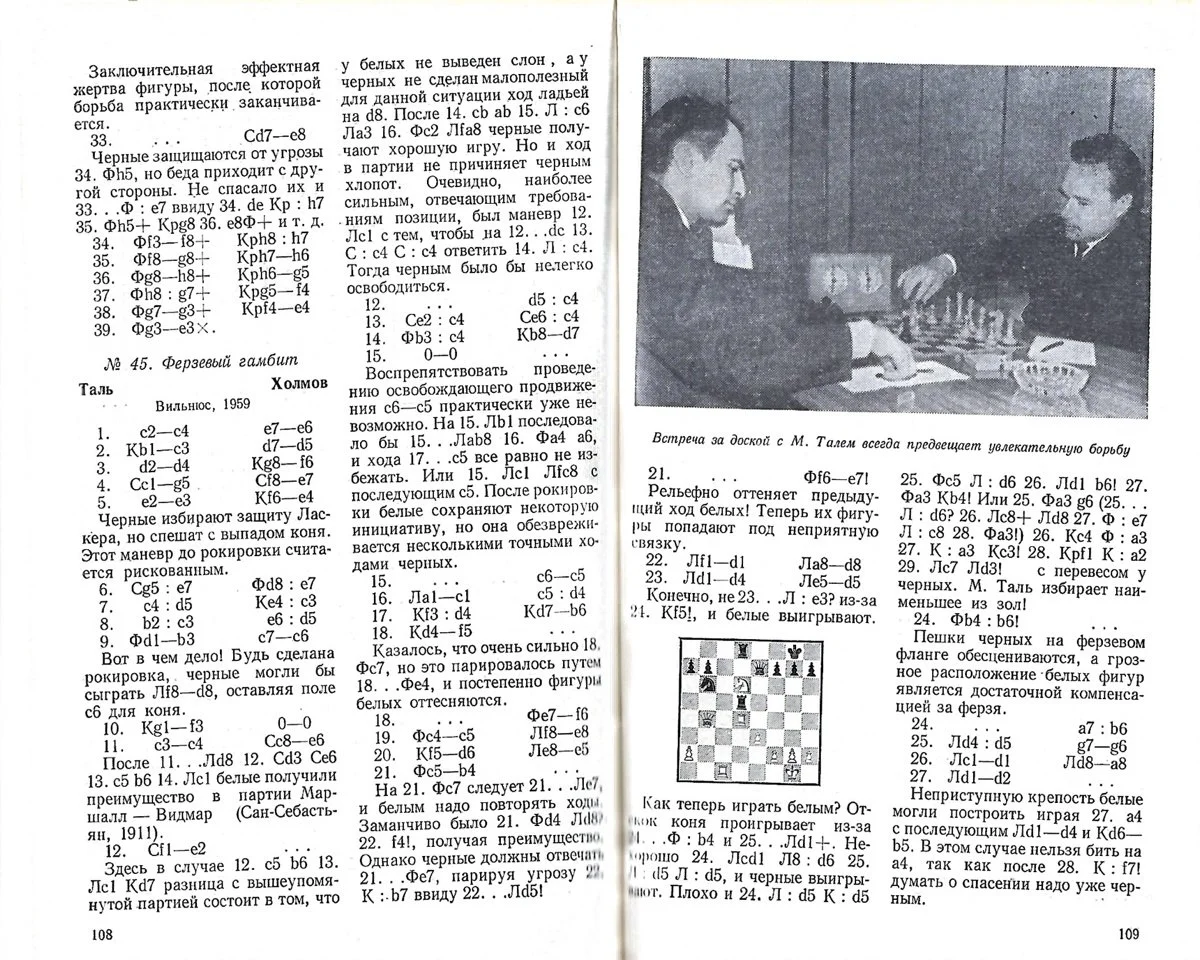
Встреча за доской с М. Талем всегда предвещает увлекательную борьбу
Making a Master in the Soviet System
Once the war ended, his chess ascent resumed with remarkable speed. Back in Arkhangelsk he again won the city championship, scoring 12½ out of 14, and in 1946 he moved to Grodno. In 1947 he won an All-Union first-category event in Minsk to gain the Candidate Master title, performed strongly in the Yaroslavl quarterfinal of the 16th USSR Championship, qualified from the Moscow semifinal, and thereby reached the 16th USSR Championship final, receiving the title of Soviet Master in the process. By the end of that year he was already testing himself in the prestigious Chigorin Memorial against players such as Botvinnik, Keres, and Smyslov.
A decisive phase came with his move into the Lithuanian chess orbit. ChessBase reports that he married and moved to Vilnius; Griffin notes that in the late 1950s and early 1960s he was resident in Lithuania and won or shared first in the republic championship on no fewer than ten occasions. Around age twenty-three, he also received a stipend and effectively became a full-time chess professional. This matters because Kholmov’s reputation was built not through a few isolated flashes, but through sustained high-level work in the dense ecosystem of Soviet republican, union, and qualifying events.
His international breakthrough came in stages. He shared first at Dresden in 1956, and in 1960 he shared first in a strong Moscow international with Vasily Smyslov, a result that brought him the grandmaster title. Kholmov later complained that Botvinnik had argued for delaying that title, an anecdote that, whether taken as grievance or diagnosis, reveals something important about Soviet chess hierarchy: even players of obvious class were filtered through prestige politics and personal authority.
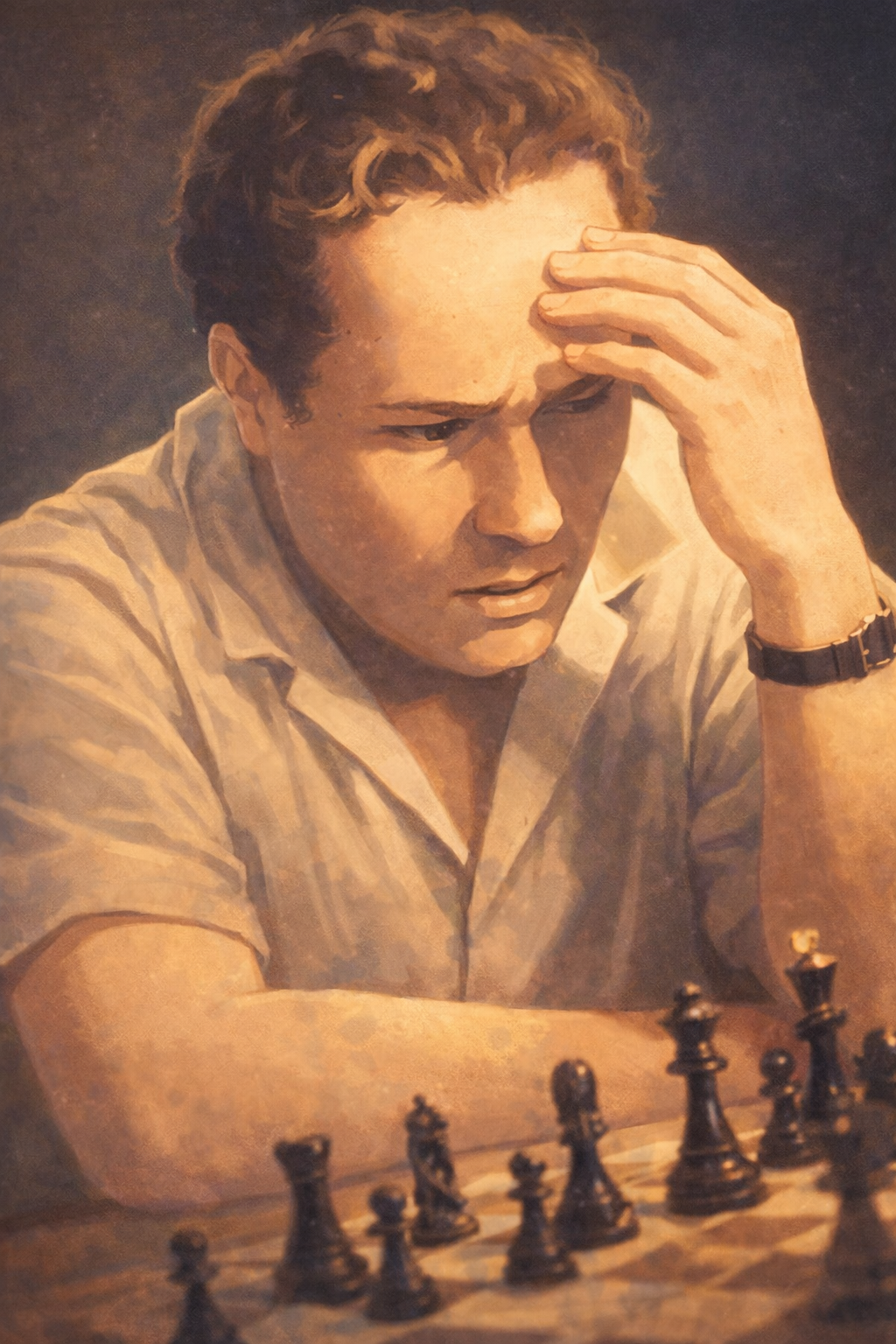
Ратмир Холмов обдумывает ход
Как неожиданный подарок воспринял он приглашение к участию в международном турнире памяти Чигорина. Откровенно го-воря, для такого приглашения не было объективных оснований — послужной список молодого шахматиста тогда еще не очень впечат-лял, в РСФСР подобной чести удостаивались куда более именитые.
Но ведь Холмов представлял Белоруссию, а там, кроме Вересова, более достойных кандидатов не было.
Peak Career Results and The Soviet Bottleneck
From the late 1950s into the 1970s, Kholmov’s tournament record was formidable. ChessBase’s retrospective lists tournament wins or major first places at Bucharest, Kecskemét, Belgrade, Havana, Dubna, Budapest, and Tbilisi between 1962 and 1978; Griffin adds earlier success at Balatonfüred in 1959 and notes that Kholmov later won the Moscow championship in 1987. These were not provincial accidents. They show a player who, whenever given a sufficiently strong boardroom of opponents, could credibly sit down, outlast them, and sometimes finish on top.
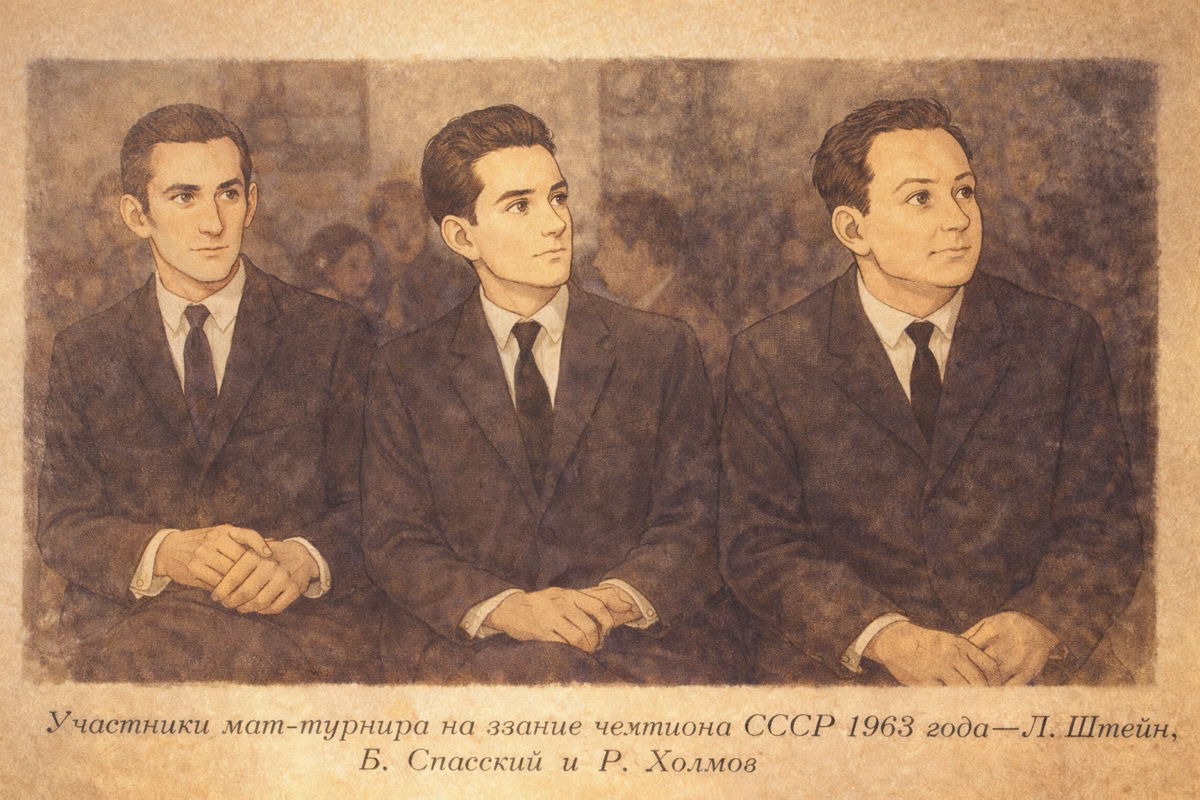
His Soviet Championship record is especially revealing. Griffin counts sixteen USSR Championship finals, while a ChessBase obituary says seventeen Soviet championships. The discrepancy is best explained by the fact that after sharing first with Leonid Stein and Boris Spassky in the 31st USSR Championship of 1963, Kholmov had to play a separate title playoff in Moscow in January 1964. In that playoff Stein scored 2½ points, Spassky 2, and Kholmov 1½. In other words, Kholmov was good enough not merely to survive the strongest national championship in the world, but to reach the very lip of its summit.
His major team success came at the 4th European Team Championship in Kapfenberg in 1970. There, the Soviet Union won team gold, and Kholmov, playing board ten, scored 4½ out of 6 with three wins and three draws, earning the individual gold medal on his board. For a player whose foreign opportunities were rationed by politics, that result stands out like a bright signal flare.
Why “The Central Defender” Was Also a Killer
Kholmov’s style was defined by a productive contradiction. Soviet contemporaries nicknamed him the “central defender,” while other accounts render the sobriquet more loosely as “stopper.” Both labels capture the same fact: he was extraordinarily hard to beat. Yet the nickname can mislead if it suggests passivity. ChessBase and Griffin alike stress that he was not only a renowned defender but also an outstanding tactician and a dangerous attacking player whose originality surprised even world champions. His strengths lay in the middlegame, in resisting pressure, and then in counter-striking with abrupt tactical energy.
The most revealing thing Kholmov ever said about his style may be his admission that he did not really prepare in the modern sense. In his recollections, he said that before games he would sometimes toss a coin to choose an opening and that he had never properly studied chess theory at all. He even explained his reputation as a defender in practical terms: a player who knows little opening theory often lands in poor positions and must learn to survive. That is a marvelous key to Kholmov. His defensive genius was not a separate department from his creativity; it was forged by necessity, by bad openings, by trench warfare, and by a refusal to panic.
Viktor Korchnoi’s appraisal is therefore especially illuminating. As quoted by Griffin from Genna Sosonko, Korchnoi compared the originality of Kholmov’s natural talent to Capablanca’s and stressed that he seemed to understand chess without formal study. That comparison should not be taken as a literal equation of achievements. It should be taken as a witness statement from one great player about another: Kholmov was the kind of grandmaster whose gifts were obvious at the board even when his public résumé lagged behind them.
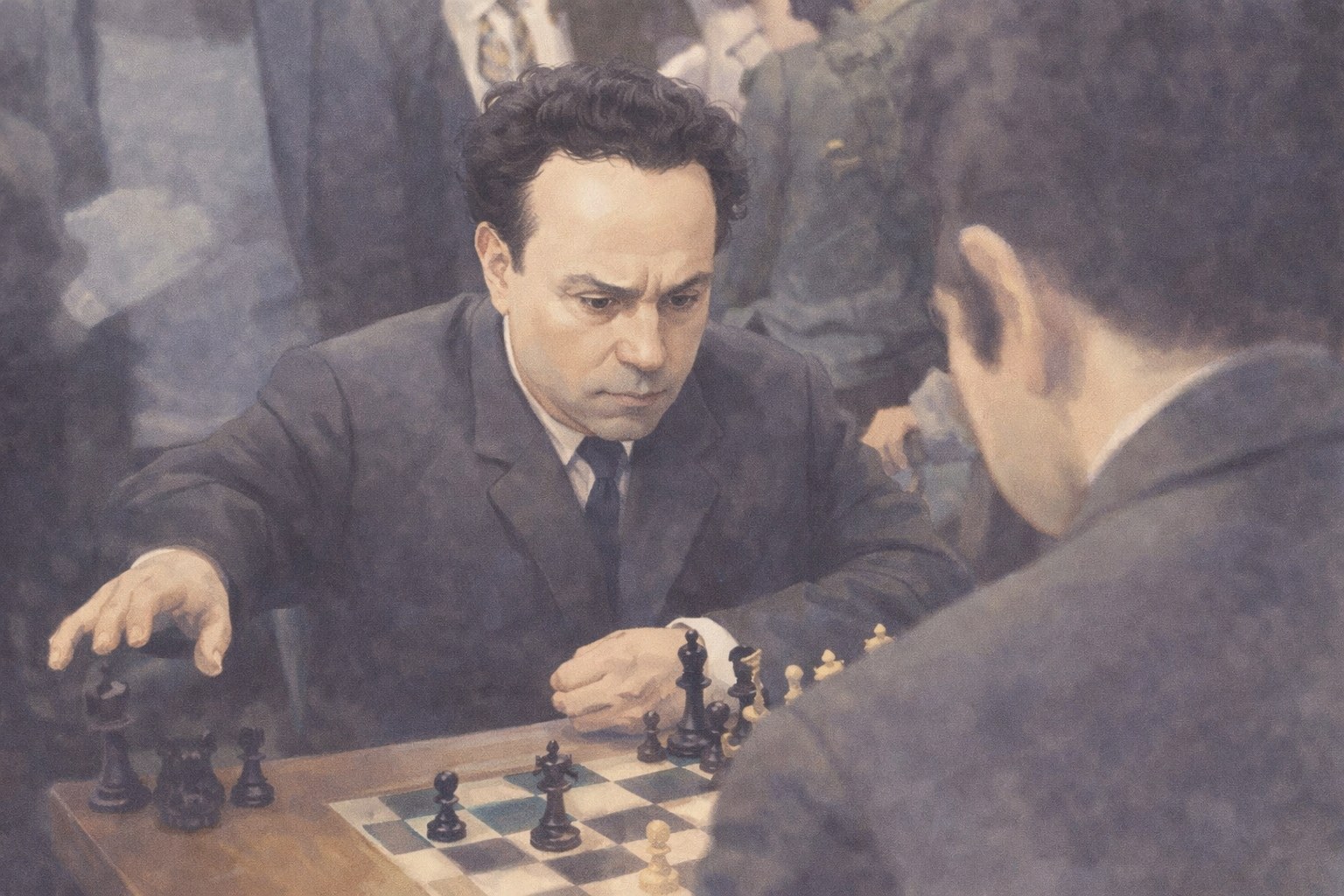
Напряженный поединок
Why He Was Lesser-Known
The largest external reason for Kholmov’s relative obscurity was political restriction. Kholmov later recalled being invited to a tournament in Vienna, receiving travel arrangements from the organizers, and then being denied a passport by Soviet officials, who suggested sending a telegram saying he was ill. He also said that he was only called for the national team when it played in the USSR, with Yugoslavia a rare exception, and that he was never sent to Western countries where larger prizes were available. Griffin argues that his wartime captivity probably contributed to this long shadow of official distrust.
Just as important was the Soviet bottleneck itself. Even without travel restrictions, Kholmov would have lived in the era of Botvinnik, Smyslov, Tal, Petrosian, Keres, Bronstein, Korchnoi, Spassky, Stein, Geller, Polugaevsky, and later the next generation. To be a merely “very strong” Soviet player in that landscape was already to be world-class. Kholmov was more than merely very strong, but the system compressed reputations the way a glacier compresses rock: only a few peaks remain visible from a distance.
A fully honest profile also has to note the role of alcohol. Griffin reports that Kholmov’s drinking led to a one-year ban in 1951 and the loss of his stipend, and Kholmov himself later admitted that he “used to drink, and drink a lot,” adding that he probably would have achieved more sporting success without it. This should not be reduced to gossip. It belongs in the biography because it helps explain the distance between his raw talent, his colleagues’ esteem, and the fact that his career never consolidated into something even larger.
The Grandmaster in the Shadows
Kholmov’s place in chess history is not that of an almost-world-champion in the narrow sense, nor that of a mere cult favorite. He was something subtler and, in a way, more revealing: a players’ player, a connoisseur’s grandmaster, a man whose strength was obvious to experts, whose games entered the aesthetic bloodstream of Soviet chess, and whose career exposes the strange arithmetic of talent, politics, character, and memory. He was strong enough to share a Soviet title, defeat world champions, win elite internationals, and bring home European team gold, yet he remained partially veiled from the wider world.
What people often forget about Kholmov is precisely what makes him historically fascinating. He was not just “the guy who beat Fischer in Havana,” nor just a defensive wizard with a colorful nickname. He was a product of Stalinist rupture, wartime seafaring, self-education, Lithuanian and Soviet competitive culture, state restriction, literary-quality self-mythologizing, and a body of games and annotations that his peers genuinely valued. To study Botvinnik, Tal, Petrosian, or Spassky is to study the summit of Soviet chess. To study Ratmir Kholmov is to understand the mountain that made those summits possible.
