Vyacheslav Ragozin (Вячеслав Рагозин)
Vyacheslav Ragozin occupies a distinctive place in the history of Soviet chess. Though not a world champion contender in the conventional sense, he stood at the center of the game’s intellectual and institutional development during its most formative decades. A leading master of the 1930s and 1940s, a world correspondence champion, a respected theoretician, and a trusted collaborator of Mikhail Botvinnik, Ragozin helped shape both the practical and analytical foundations of Soviet chess. His legacy endures not only in the opening that bears his name but in the deeper structures of preparation, study, and organization to which he devoted his life.
Origins and Early Formation
Vyacheslav Vasilyevich Ragozin was born in 1908 in St. Petersburg and came of age during the formative decades of Soviet chess. He belonged to the first generation of strong masters shaped by the new Soviet system, where chess was increasingly treated not merely as recreation but as a serious intellectual discipline. By 1930 he had already emerged as a player of promise, winning the match that secured him the title of Soviet Master. The 1930 team photograph fits this stage perfectly: it shows Ragozin still early in his public career, already part of the organized chess culture that would define his life. This was the world in which he developed, a collective, ambitious, disciplined environment that produced not only champions, but theorists, analysts, and cultural builders.
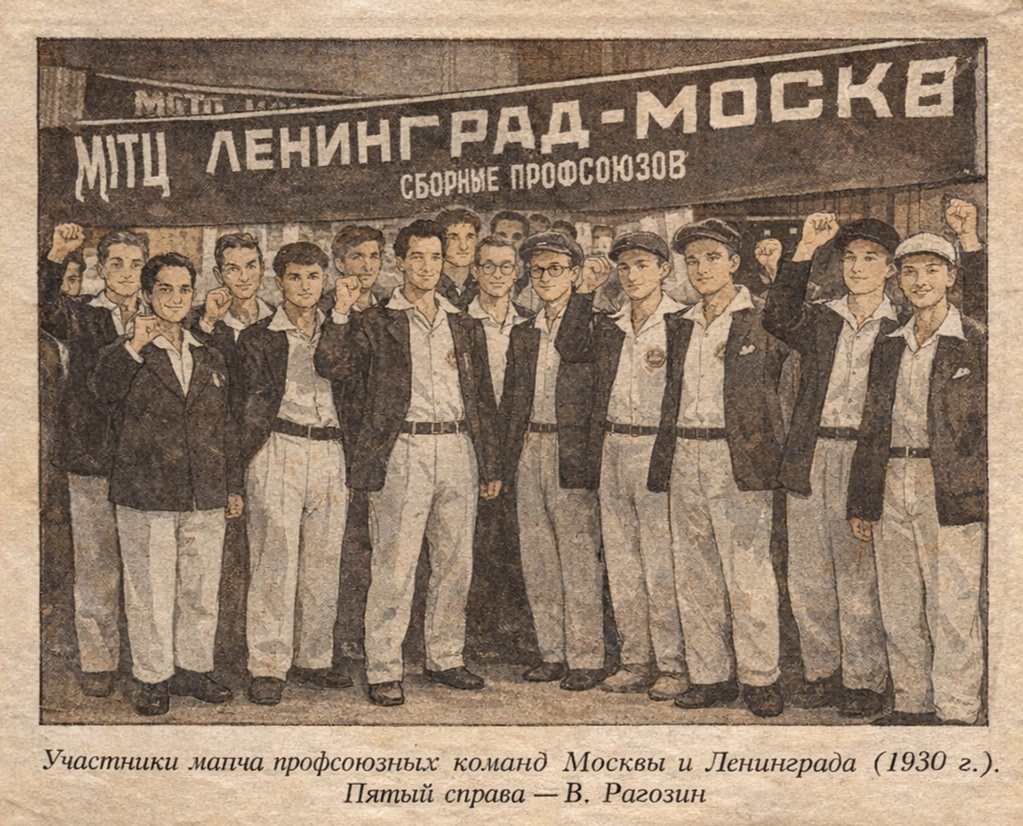
Участники мапча профсоюзных команд Москвы и Ленинграда (1930 г.).
Пятый справа — В. Рагозин
During the 1930s, Ragozin rose steadily through the strongest Soviet and international tournaments. He played in the great Moscow tournaments of 1935 and 1936, defeating major opponents and earning admiration for his tactical sharpness and foresight. By the end of the decade, he had become one of the most respected players in the Soviet Union. The 1939 image with Paul Keres captures this exact phase: Ragozin had moved beyond promise and into the company of Europe’s leading masters. His performances showed that he was not merely a capable competitor, but a player of real originality, able to combine deep calculation with active, energetic play.
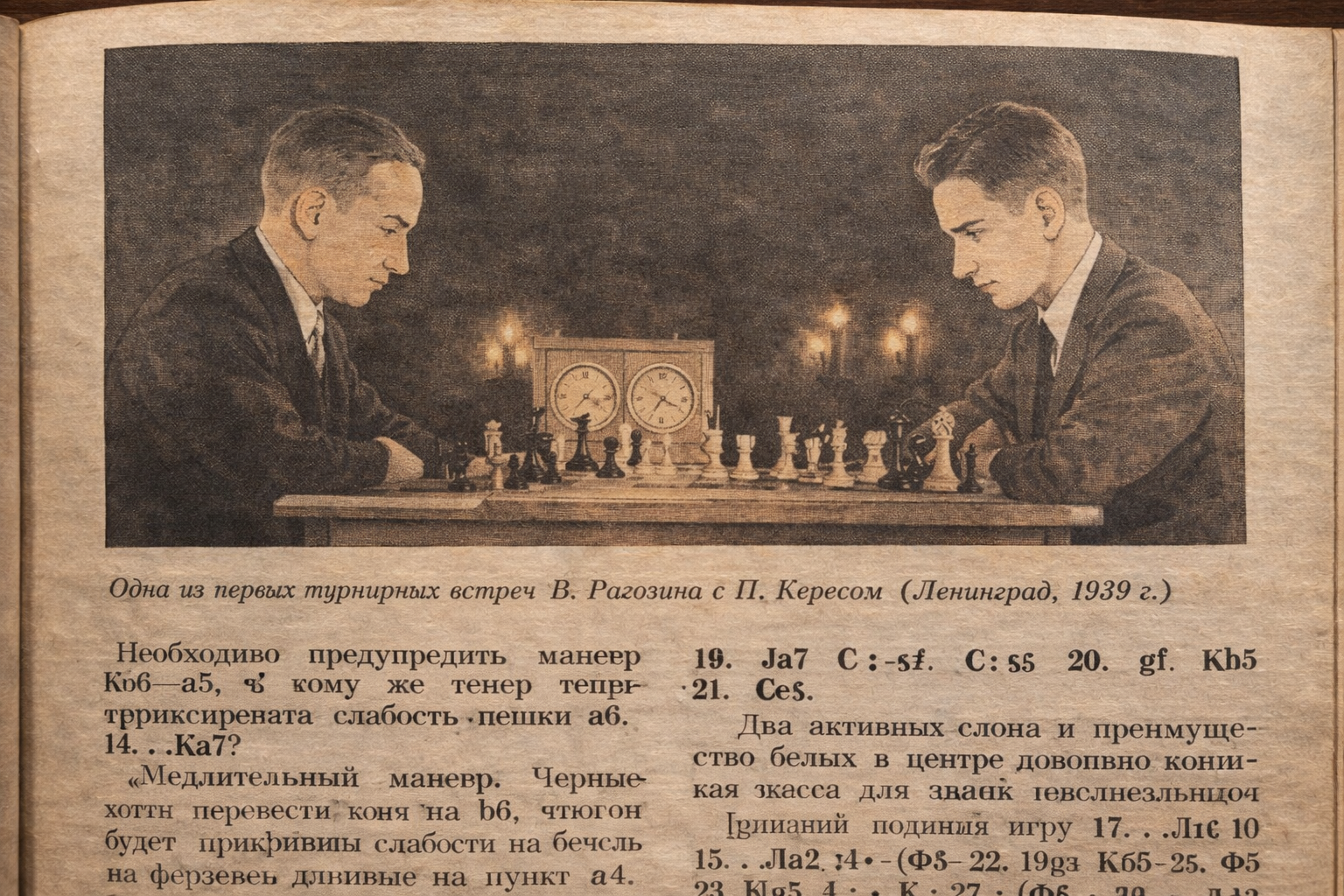
Одна из первых турнирных встреч В. Рагозина с П. Кересом (Ленинград, 1939 г.)
Ragozin’s greatest over the board successes came in the 1940s, when he won or shared first in several major events and established himself among the Soviet elite. Yet his historical importance extends beyond tournament standings. He became one of Mikhail Botvinnik’s most trusted collaborators, helping prepare for the 1948 World Championship and the 1951 Botvinnik–Bronstein match. This image is especially valuable because it reveals Ragozin in one of his most important historical roles: not simply as a player, but as an analyst working inside the engine room of Soviet chess. Botvinnik valued him for his intuitive feel, tactical imagination, and capacity to test ideas under pressure. In this role, Ragozin helped shape the culture of preparation that became one of the Soviet school’s great strengths.
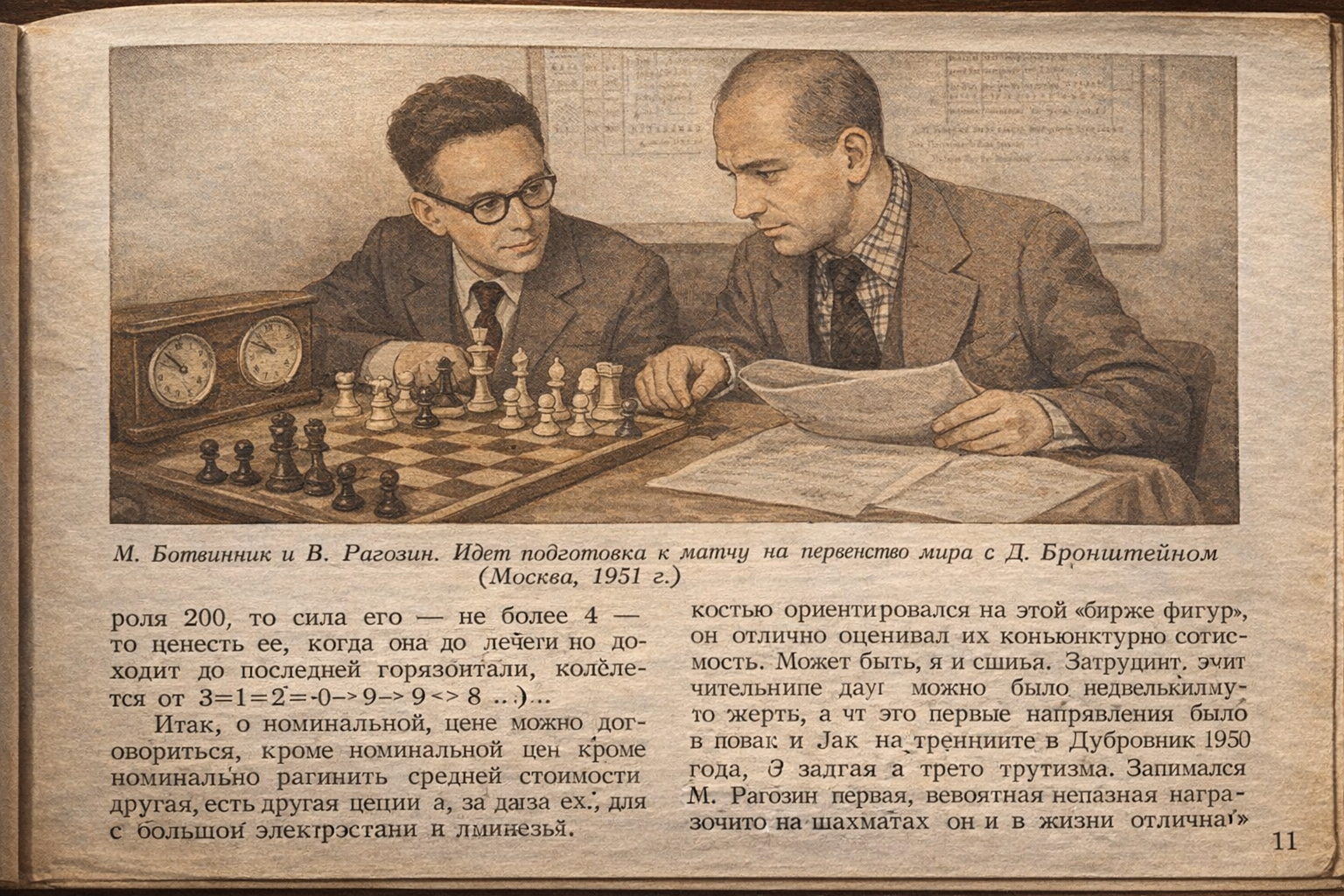
М. Ботвинник и В. Рагозин. Идет подготовка к матчу на первенство мира с
Д. Бронштейном (Москва, 1951 г.)
Ragozin’s name survives most visibly in opening theory through the Ragozin Defence, a system that brought Nimzo-Indian ideas into Queen’s Gambit structures and remains relevant at the highest levels even today. But his legacy was broader than opening nomenclature. He was also one of the great correspondence players of his era, winning the Second World Correspondence Championship, a feat that demonstrated the full depth of his analytical abilities. At the same time, he served Soviet and world chess as an editor, organizer, arbiter, and FIDE official. The 1957 Congress image belongs here because it places Ragozin in the international administrative world of chess, not just the tournament hall. It shows him as part of the institutional structure of postwar chess, a man helping govern and shape the game beyond his own results.
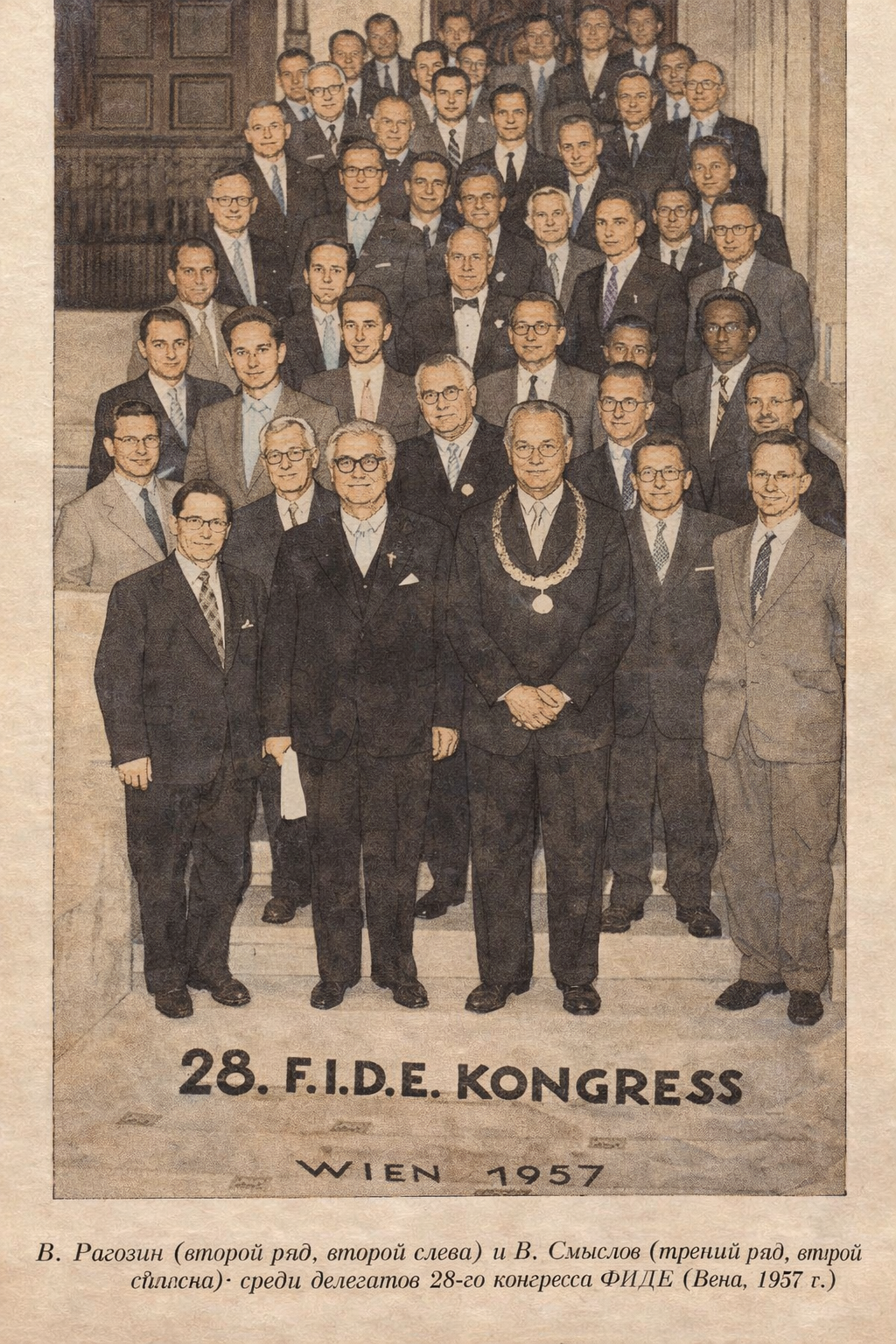
В. Рагозин (второй ряд, второй слева) и В. Смыслов (трений рад, втрой сласна)• среди делегатов 28-го конгресса ФИДЕ (Вена, 1957 г.)
Ragozin was not a world champion, and he is sometimes overshadowed by the larger Soviet giants around him. Yet that can distort his real place in history. He was a world-class master, a first-rate theoretician, a correspondence world champion, a trusted second to Botvinnik, and an important figure in Soviet chess journalism and administration. His legacy is not confined to one opening variation. He belongs to that crucial class of historical figures who strengthen the very fabric of chess culture. He helped build the structures in which champions thrived, theory advanced, and Soviet chess became a global force.
